Man Vs Mkv: The Story So Far

A couple of weeks ago, I decided that I was going to figure out, once and for all, how best to take MKV formatted fansubs files with soft subtitles and convert them into files with burned-in subtitles so I could play them back on the AppleTV and/or PS3.

By all rights, this should have been easy.  I use mplayer to play back mkv files on my Mac, so I should be able to use mencoder to convert them, right?

There’s one problem with that, though.  Well, two problems.  The first is that mencoder really doesn’t write h.264 files very well.  It’s GREAT if you want to convert video to divx-encoded AVI files, mind you, but I wanted to make .m4v container files.

The second, and larger, problem is this:  Most fansubs use “ass/ssa” style subtitles.  This lets the subtitler do all kinds of neat positioning and graphical effects with the text.  Here’s a VERY simple example.

Note that Mplayer will correctly interpret ass/ssa style subtitles and display them:

Mencoder won’t.  The same frame after running the file through mencoder looks like:

…you see the problem.

I did eventually hit on a solution.  You can run mplayer in a mode that directs its output to a file instead of to the screen.  This makes a huge file, but it gives you what you need to then make proper looking .m4v files that play back on either an Apple TV OR a PS3… and, hell, while I was at it, I decided I’d figure out how to make PSP and iPhone compatible files.

This took a little time, and it’s not for the faint of heart or for anyone who fears the OSX Terminal window.

Here’s how I did it.

First: I needed mplayer and ffmpeg.  There’s an excellent guide available on how to get these on to your mac.

Fair warning:  You need to be comfortable compiling programs from source code.

Then, I spent a couple of weeks trying out different encoding settings, and finally hit on some that seem to be both compatible and fairly high quality.  I wasn’t optimizing for file size, mind you.  I owe Robert Swain a great deal for his tutorials, I would not have been able to figure things out without them.

After that, I wrote a shell script that I could run from inside a directory of .mkv files.  This script iterates through every .mkv file in the directory and encodes two new versions of each:  One for the Apple TV and PS3, and one for the PSP and iPhone.

If you want the script, here it is.  Copy this and paste it into an “mkvconvert.sh”, chmod it to executable, and you’re good to go.

Some warnings:

  1. You need to be doing this on a partition that supports files over 4GB.  So it needs to be an HFS+ partition, not FAT32.
  2. The PSP conversion assumes that your source has an aspect ratio of 16:9.  4:3 files will be stretched and look terrible.
  3. I don’t like spaces in file names, so this converts all spaces in file names to underscores.
  4. I have no idea whether this will work on anyone’s mac but my own.
  5. This rather heavily relies on the input file’s resolution and frame rates being compatible with the Apple TV, since I don’t monkey around with them.  If you throw a 1920×1080 mkv at this, you’re going to get a 1920×1080 m4v out of it and the AppleTV won’t know what to do with it.
  6. I’ve had problems with files that throw a “invalid and inefficient vfw-avi” error, because mplayer drops frame like crazy if it has problems.  If you see these messages, you’re going to have out-of-sync video and audio.  I’m trying to figure out a way to remux files to fix this.

With that said, here’s the script.  If you choose to go down this path, I wish you the best of luck.

#!/bin/bash
# fullfilename = full name including mkv extension
# filename = file name with mkv extension stripped
# m4vfile = file name with new m4v extension
# pspfile = file name with _psp.m4v added
for videofile in *.mkv
do
fullfilename=${videofile// /_}
mv "$videofile" $fullfilename
filename=${fullfilename//.mkv/}
m4vfile=${fullfilename//.mkv/.m4v}
pspfile=${fullfilename//.mkv/_psp.m4v}
echo Input file $fullfilename Output files $m4vfile and $pspfile
mplayer -ass -ao pcm -vo yuv4mpeg $fullfilename
ffmpeg -i stream.yuv -i audiodump.wav -vcodec libx264 -vpre hq -vpre baseline -crf 18 -threads 0 -b 3000k -acodec libfaac -ab 160k -y $m4vfile
ffmpeg -i stream.yuv -i audiodump.wav -vcodec libx264 -vpre hq -vpre main -level 21 -refs 2 -threads 0 -s 480x272 -b 500k -maxrate 768k -bufsize 2000k -ac 2 -ar 48000 -acodec libfaac -ab 128k -y $pspfile
done

Posted in anime | Leave a comment

It warms my heart.

Let’s see, where to begin…

Let’s start in December of 2006.  I drove up to Seattle to take my very first crack at the JLPT, and while I was there I met up with a friend and went to the Books Kinokuniya inside Seattle’s Uwajimaya.  It’s a pretty good Books Kinokuniya, by the way, much bigger than the fairly anemic one in Beaverton and possibly even better than the one I used to go to in Los Angeles.

Anyway, while I was there, I bought a Full Metal Alchemist calendar as a Christmas present for my wife, and I bought a couple of artbooks for me.

One of them was Etsu’s “Girls, Girls, Girls” artbook, cover reproduced below:

Etsu: "Girls, Girls, Girls" cover.

The title is Truth In Advertising, and since Truth is Beauty, this represents a Thing of Beauty.  Irrefutable logic, there.

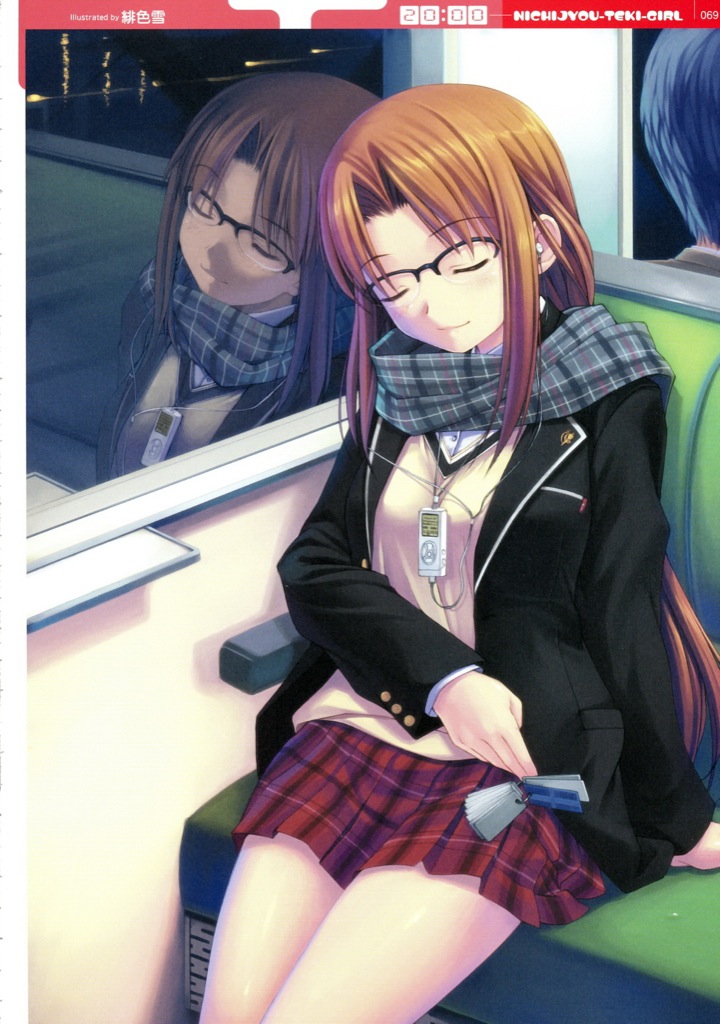
It’s actually a (as such things go) fairly classy book, with no nudity.  Cute girls with glasses are well represented:

Some time later, I found a wallpaper that featured the cover image from “Girls, Girls, Girls”, but with the background text chopped out and replaced with a mansion (or maybe restaurant?) background.  Which made sense considering the whole maid thing, I suppose.  Anyway, I thought it looked a lot better that way.

I put it up on my desktop for the sole reason of making my wife roll her eyes when she walked by the computer, and I was actually a little disappointed when I DIDN’T get an eye roll, or even a sigh of resignation.  Apparently she’d become immune.

She did say that the girl on the left looked decidedly uncomfortable, and I have to admit that she has a point

I left it as my desktop wallpaper for a while, failed to elicit any eye rolls, and then changed it out, defeated.

Anyway, that’s not the point I meant to arrive at.  The point I DID mean to arrive at was that I ran into the same image when looking for a wallpaper recently and it was tagged “symmetrical docking”, which I thought was just the goofiest, and possibly greatest, descriptive term ever derived by man.

So I threw “symmetrical docking” at Google Image Search just to see what would come back, and it brought me to One Man’s Quest To Assemble Images Of Girls Standing Too Close Together.

It truly warms the heart to see devotion to a cause.

(Actually, he has a fair number of well-written articles on “serious” topics like analog synthesizers and astronomy mixed in with the cheesecake, so don’t get me wrong, it’s a neat blog, I just came to it down a sordid path.)

Posted in anime, meganekko, nekomimi | 2 Comments

Another Translator’s Nightmare

As I’ve mentioned a time or two before, I’m quite the Studio Ghibli fan.  This isn’t exactly setting me apart from the crowd, mind you; Ghibli’s movies are some of the best loved films to come out of Japan.

Anyway, one of my favorite Ghibli movies is Umi Ga Kikoeru, or “I Can Hear the Sea”, though the official English title is something like “The Ocean Waves” which I don’t really understand but whatever.

I have an odd association with Umi ga Kikoeru and Porco Rosso: I think of them both as “newer” Ghibli movies, though the truth is that they’re both coming up on two decades old.  See, the first time I saw a Ghibli film was in 1991 or so.  That was My Neighbor Totoro, by the way, and watching that made me immediately track down everything else I could get.  At the time, that was Nausicaa, Laputa, and Kiki’s Delivery Service.

So everything released post-Kiki’s gets lumped into the “newer” category, and everything up to that point gets lumped into my internal “classics” category, even though it doesn’t make sense to divide it that way.

Anyway, Umi ga Kikoeru came out in 1993, I got to see a fansub of it in 1994 or so, and I’ve watched it every year or two since then.

It wasn’t until the most recent watching that I noticed something, though, and it kind of blew my mind.

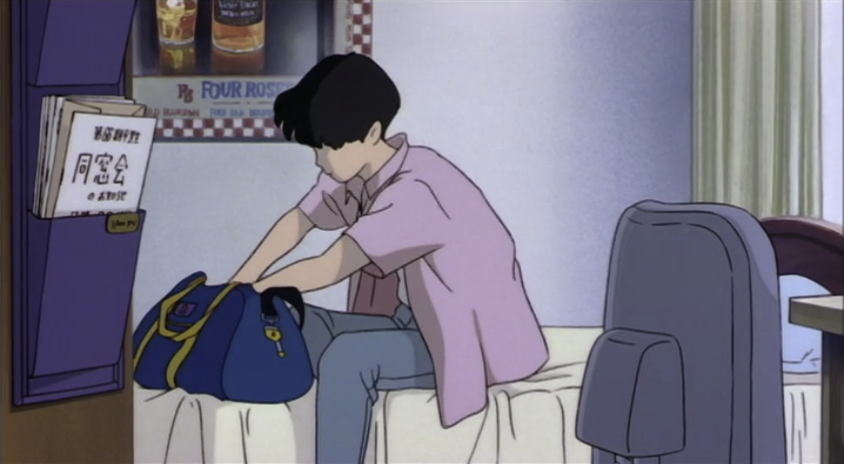
Here’s a very early shot from inside Taku’s apartment.  Note that, while Taku is centered in the frame, there’s a very obvious piece of paper tucked into his mail sorter on the left side of the frame.

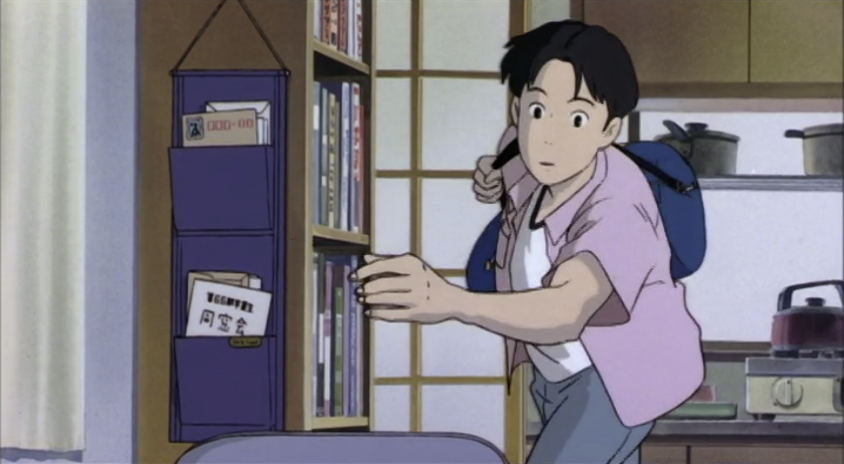
He’s getting packed for a trip.  He gets up, leaves, there’s a pause, and then he comes back into the apartment; he’s forgotten something:

What he’s reaching for is, basically, one half of an RSVP card; it’s the half that has the address and time of the event on it.  In this case, it’s an RSVP card for a 同窓会, “dousoukai”, or “class reunion”.  Since he only has half of it, we know that he’s already returned the RSVP part of it to say that he’ll be attending the event.

I wouldn’t know this, mind you, except that we happened to study these things back in JPN301 during Fall term; in fact, one of our assignments was centered around how to properly respond to RSVP cards.

So if you’re watching this and you can read the card, you know exactly what his situation is, why he’s packing for a trip, where he’s going, and why the movie shifts into flashback mode a couple of minutes later and stays in flashback mode for the next hour.

It sets the tone for the entire story.

Unfortunately, neither the fansub I saw back in the early 1990s nor the official Region 2 DVD bother to translate it, and I guess I can’t blame them; it’s a very quick scene in the film and it’s hard to think of  a way you could explain it without putting up a big “cultural note” subtitle.

Posted in anime | Leave a comment

Buying Used = Stealing?

I’ve noticed an awful lot of chatter recently in video game forums and blog comments that consists of posters / commentators trying to equate buying used video games with piracy.

The argument, as I understand it, is basically that, since buying a used game generates zero revenue for the game publisher, it’s functionally the same as if you’d downloaded the game.

Actually, it’s even worse than that, it continues, because in addition to stealing revenue from the publisher, you’ve given revenue to a used game store – generally, Gamestop – who are now making money from the publisher’s hard work in producing the game, while assuming none of the costs of development.

It’s this chain of logic that’s lead to Electronic Art’s “Project Ten Dollar”, where they are planning to release new games with a code in the box to get some piece or another of DLC, and selling the same DLC online for $10.  Basically, they’re trying to make used games less attractive to buy, but also trying to get some cash out of people who stubbornly persist in buying used.

I don’t get into these conversations online, because I suspect that half the people arguing that buying used = stealing are actually astroturfing for publishers, and the other half are well meaning people who, for some reason, feel the need to stand up for the rights of giant publishing corporations.

So, instead of getting into a conversation, I’m going to put up an opinion post here, where I can squelch any dissent.

I’ll start by saying that I see the publisher’s point.  They’ve put their hearts & souls (OK, they’ve put the personal health and social lives of their worker drones) into publishing games, and they spend an awful lot of money up front with the hopes of recouping the money when the game comes out.

And, it’s kind of undeniable that the existence of the second hand market hurts their sales somewhat.

The thing is, though, if there were no second hand market, things would probably be considerably worse.

Let’s start with one unfortunate truth: No form of DRM is going to stop piracy.  I can only remember two video games – ever – that posed a serious issue to software crackers.  One was Bounty Bob Strikes Back, on the Atari 5200, and the other was Dungeon Master, which was on the Atari ST.  Neither one was cracked for years after their release.

That’s two games in 30+ years of video game releases.  Odds are, if you put out a game, it’s going to be cracked and put up on torrent sites.

In a theoretical world with no used game market, consumers would have two choices: Buy games at full price, or pirate them. It’d be better if they paid full price for everything, of course, but basic economics tells us that a rational consumer will always seek to get something as cheaply as possible.

What game companies need, in order to stay in business, are slightly irrational consumers.  This actually applies to any industry whose product can be pirated easily – you need consumers who are willing to act in a way that serves the interests of the producer, not the consumer.

Part of this is social.  It’s less acceptable, these days, to talk about piracy.  Most gaming forums don’t permit discussion of the topic.

Part of it is releasing special editions, with doohickies and geegaws that can’t be digitally replicated.  Aksys’s upcoming Agarest Wars release is one example – you may be able to pirate the game, but you can’t torrent a squishy mouse pad or pillow case.

Most of it, though, is convincing consumers that games have value and therefore it is Correct and Appropriate to exchange currency for them.

If you get someone, who would otherwise not buy your game, to buy it because it has a squishy mouse pad, you’ve proved that the consumer believes that squishy mouse pads have value, not necessarily that the game does, and that they are willing to exchange currency for the experience of resting their wrists on foam jubblies.

This is something different, and not entirely desirable.  It may get you a short-term positive effect, but if Special Premium Collectors Editions become the norm, they lose their cachet.  If every game released comes with a squishy mouse pad, suddenly it’s hard to stand out from the crowd, and long-term, you’re putting out tons of squishy mouse pads to the point where people have gotten bored of them and their perceived value drops to the point where they’re no longer worth exchanging currency for.

The trick, then, for long term profitability, is to encourage the Games = Worth Buying mindset.

Used games do this.  A consumer buying a $17.99 used copy of Shooter Guy II  isn’t putting any money into a publisher’s bank account, this is true – but, they’re recognizing that the entertainment experience they’re about to get from Shooter Guy II is worth SOMETHING, in this case $17.99.

This is an important mental step, because it opens the consumer’s mind to the idea that games are worth spending money on, and from there it’s a reasonably slippery slope to them spending $60 on Shooter Guy III when it comes out because they loved the hell out of Shooter Guy II and can’t wait for Shooter Guy III to show up in the used bin.  In other words, they go from one slightly irrational decision – spending money on something they COULD get for free – to an even more irrational decision: spending MORE money on something because they want it NOW.

On the other hand, a guy who pirates Shooter Guy II hasn’t ever made the mental step.  To them, Shooter Guy II had no value, so why should they spend money on Shooter Guy III?

And that’s the critical difference that separates people who buy used games from people who just download everything:  We’re a little irrational.  Encourage this.  Don’t do anything to make us change our minds.  🙂

Posted in videogames | Leave a comment

Let’s talk about color.

After School Days, I needed another cute school romance show that maybe didn’t end with any decapitations.  I decided I’d go with Akaneiro no Somaru Saka, which was recommended in Chris Swett’s anime podcast a few months ago.  I figured I was probably pretty safe with it, I’ve known Chris since the early 90s and he’s yet to make a recommendation I really disliked.

Now, then, it always kind of confuses me when translators take care to translate every little bit of dialogue in a show but for some reason never translate the title, and it was a simple enough title, so I figured I could just look it all up in a dictionary and be done with it.

Starting with “akaneiro”… “iro” was using the kanji for “color” and “somaru saka” meant “dyed hills” or “dyed slopes”, so obviously it means the “xxx color-dyed hills”, and that’s when I got into trouble.

See, I’m a guy, and guys have like, oh, 10 or 12 colors.  We’re good with colors if you’re talking about “red” and “blue” and if you were a guy that grew up with a Commodore computer in the 1980s, you even know what “cyan” is, but when you get out of our comfort range we get confused.

“Taupe”, for example.  I never quite got “taupe”.  Eventually a woman explained to me that it simply meant “beige”, and I knew “beige” meant “light brown” and I don’t get why people don’t say “light brown” when they mean “light brown” and stop inventing words for no reason other than to confuse men, because lord knows we’re generally confused enough.

Ahem.

Anyway.  “akaneiro”, according to the first dictionary I picked up – the venerable (my copy dates from 1985) Kodansha Japanese-English Dictionary, means “rose madder”

Rose madder.

Huh?

That’s not a color name.  I mean, “Rose” is a color.  It means red.  Well, not red.  It means a color that men describe as “kinda red”

But madder?

I looked through a few more dictionaries.  It turned out that I made a good choice going with the Kodansha dictionary to start, because it’s not a common word.  It wasn’t in the next four dictionaries I looked in.

I was starting to think that they’d made up the word.  I mean, Rose Madder?

I threw it at WWWJDIC and it came back with “Madder red”, so at least we had “red”, which is a recognizable color.  Things were looking up.

Finally, I went to my DS dictionary, kanji sonomama rakubiku jiten or something like that, and it defined it for me as such:

“madder; dark red”

I breathed a small sigh of relief.  “Dark red” is a color I understand, so the title of the show is simply “The Dark Red Dyed Hills”

I’m going to file that away in my list of Japanese colors with “aoi”, which means “sorta blue, unless it means green”

Oh, there was a show, too, attached to the title.  It wasn’t bad.  It had an over-the-top rich princess girl type, which is just about my least favorite character stereotype of all time, so that was a major down point, and the love dodecahedron resolved itself in a way that I didn’t entirely approve of, but it didn’t have any really painfully over the top episodes and absolutely nobody got gruesomely murdered, so it delivered everything I really wanted: A goofy romantic comedy with a host of cute girls fighting over a clueless guy.

Well, it could have done with more girls with glasses, I guess.

Still, pretty good.

Posted in anime | Leave a comment

After School Specials Done Wrong

Dear Diary:

Today, in an effort to be more “in tune” with modern anime fandom, I watched all of “School Days” in one sitting.

As a result, I now feel slightly more up-to-date, so desired effect achieved and all that.

Unintended minor side effect: I’m convinced that the world is a bleak and uncaring wasteland devoid of any hope for the future.  It’s not that the characters didn’t get what was coming to them or anything, but woof.

I mean, WOOF.

I need to scrub my brain with something now.

Posted in anime | Leave a comment

For the record:

The Federation of Bosnia and Herzegovina makes a damn fine candy bar.

That is all.

Posted in food | 2 Comments

Reflections on a scene

I had a few posts last week about video encoding, mostly because I’ve been on a quest to take .mkv files with soft subtitles, which is the Current Popular Format, and crunch them into Yesterday’s Popular Format of .avi or .m4v files with burned-in subtitles, so they can be played back on the AppleTV or PS3 hooked up to our TV.

I’ve had some success in this.  Mind you, there’s an obvious quality drop because I know virtually nothing about how to encode video properly, so I’m more or less making things up as I go along, but I’ve managed to make it work.

In the process, I found out more than I wanted to know about h.264 video, and I found out that the AppleTV doesn’t display animation as well as the PS3, using the exact same files, but does seem to have the edge for live action stuff.

It’s also had the effect – since an awful lot of what I was reading was blog postings and forum posts and the like – of catching me up to date on the anime “scene”, which is one of those concepts I’d been vaguely aware of only in that I was pretty sure I wasn’t part of it and hadn’t been for at least the last decade.

Put simply: It’s ugly out there.  Well, that is, it’s ugly if you’re a western anime licensor. Firefox claims that “licensor” isn’t a word, but I think it is so I’m going to leave it in there. I digress.  Where was I?  Oh, yes, it’s ugly out there.

The advances in technology over the last few years have made it so that a program broadcast in Japan can be grabbed from Japanese P2P networks, translated, subtitled, and put up for download in the US within a day, and popular programs will have three or four different groups of translators competing to be the first ones to put up their version.

Furthermore, the old “gentleman’s agreement” to do this only with shows that hadn’t been licensed for western release has been completely tossed out the window, because it gets in the way.

Obviously, groups wouldn’t be competing to put out fansubs faster faster faster if there weren’t demand for it, and ye gods is there ever demand.

I ran into several fans claiming to watch at least a thousand episodes a year – that’s something like forty complete series.  Granted, that’s probably only a quarter to a third of the complete anime output of Japan over the same period, but it’s still a staggering amount.  I’m not sure if I’ve watched forty complete series in the last five years.

These fans tend to have blogs – and there are a lot of anime blogs – that exist solely to recount the blog owner’s day-by-day watching of the Latest Hot Shows, with Brief Commentary and Extensive Screencapping of each episode to prove that they are, in fact, keeping up with the Joneses, and also of course that they are current with the latest memes and imported-from-2ch jargon.

I do much the same with video games, I suppose, the difference in my case being that most of the games I’m playing are at least five years old, so in my case I’m carefully chronicling how far behind the bleeding edge I’ve fallen.  🙂

Anyway, lots of people trying to Keep Up With The Bleeding Edge combined with fansubbers that are competing for bragging rights and have lots of time on their hands means that the domestic distributors are in a boatload of trouble.

See, fansubs give their audience instant gratification in the form of HD-resolution video files (even if at pathetic bitrates), with soft subtitles, the day after the show airs in Japan, with no pesky copy protection, for free.  It’s hard to turn that down in favor of waiting for a DVD release, or watching a low-resolution ad-supported stream.

Moreover, the industry doesn’t seem to have any personality, so there’s no sense of community.  Back in the Good Old Days, by which I mean the days when we were paying sixty-five dollars for a laserdisc, or forty dollars for a tape with four episodes on it, there was kind of a sense that the anime companies were On Your Side, that we were all part of the same Grand Crusade to bring anime to the english-speaking world, and that actually charging money for it was just an unpleasant reality.

That was then.  Now, the smaller, fan-run or fan-centric companies seem to have gotten out of the business, leaving a few big names – Funimation, AD Vision or whatever they’re calling themselves now, Bandai – to hold the reins.  There’s no more sense that, say, bootlegging an Urusei Yatsura LD is taking money from Robert Woodhead’s pocket, now it’s that subtitling the new Full Metal Alchemist series before it can be streamed legally is putting one over on a giant, uncaring corporation.

I’m not going to hold myself up as any bright shining example of respecting copyright, mind you. I’m not deleting my fansubs and buying the DVD releases as soon as they’re announced; I got burned on THAT after I spent $70 buying the first two volumes of Welcome to the NHK and having the series get canceled.  I do replace fansubs on occasion, but I have to admit that I wait for the entire series to be released, and then I wait for it to be collected in a thinpak version; the last show I went all-out on was the limited edition Haruhi discs.

Basically, back to the thing where I said that domestic licensors were in a pile o’ trouble: yeah, they are.  I’m not going to predict The End Of The Industry here, but I think it’s fair – if sad – to say that, if every single American anime distributor went bankrupt tomorrow, it wouldn’t actually have much of an effect on the “anime scene”.

Posted in anime | Leave a comment

In which, I sample the delights of the former Eastern Bloc.

A week or so ago, I ordered a hard drive enclosure from Newegg.  This is a perfectly normal transaction, and nothing worthy of comment really.

Problem is, I’d never updated my address with Newegg.  I didn’t realize this until the day it was delivered, however, when I looked at the UPS tracking page and saw “Delivered: Portland, OR”

And I cursed a bit.

Fortunately, when I called my old apartment building, they were willing to put the package aside for me and not hand it over to the current residents of the apartment, who presumably don’t need any hard drive enclosures.

Then I just had to drive two hours to go and pick it up, which meant that I was going to be in the Portland area anyway, which meant that I could do stuff like shopping at Uwajimaya and H-Mart and Fry’s Electronics and having lunch at Marinepolis in Beaverton.

So I guess it wasn’t a total loss of a day.

Anyway, last term in Japanese class – and I promise this is all leading somewhere – I was in a small group project team with a woman from the Ukraine.  As a side note, this is the single unluckiest student in the world, because her last name happens to be one of the most vulgar words in Japanese slang and I am constantly torn between finding a way to subtly warn her and being afraid to mention it lest she already know.

At this point, you have all gotten entirely the wrong idea about what the title of this blog post refers to.

Anyway, when we were working on our project together, she’d mentioned that she really missed, of all things, candy from her home country, and I remembered while I was having sushi that there was a European market and deli in the same shopping complex as the sushi place, so I decided that I would go there and get their business card to pass on to her so she could potentially get her fix of the taste of home.

I didn’t, you know, pick her up any snacks, because that might have been inappropriate and I’m a cheap bastard and to be honest I don’t know how to tell Russian candy from Ukranian candy and I think I might get beaten up if I made a mistake there.

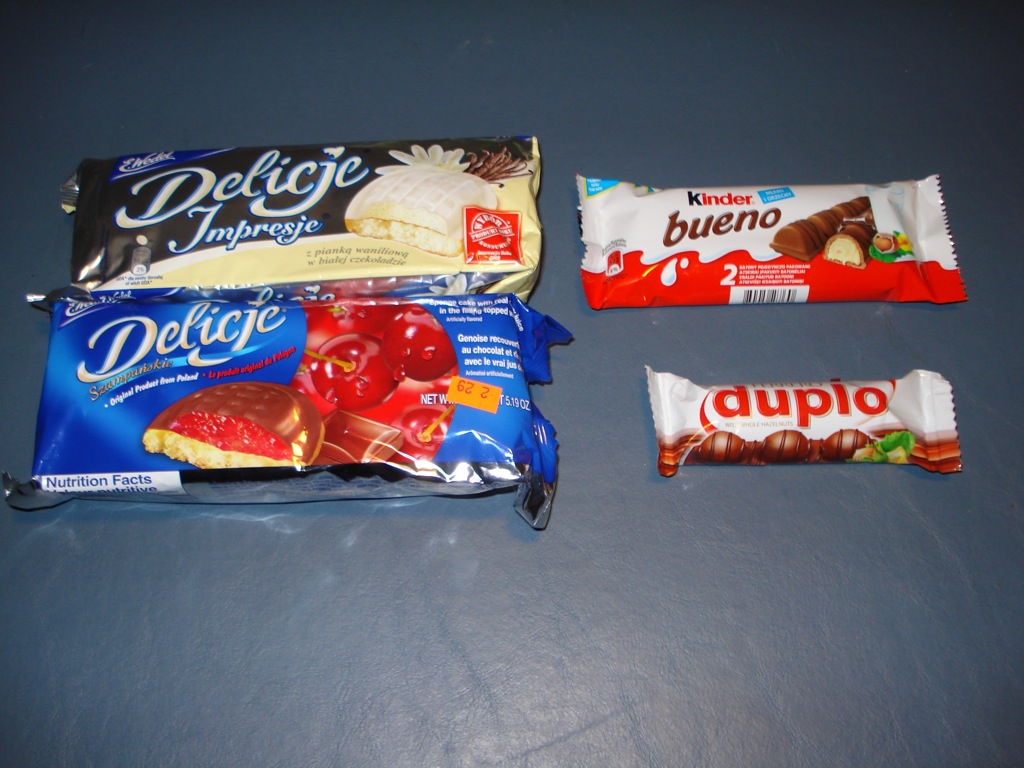
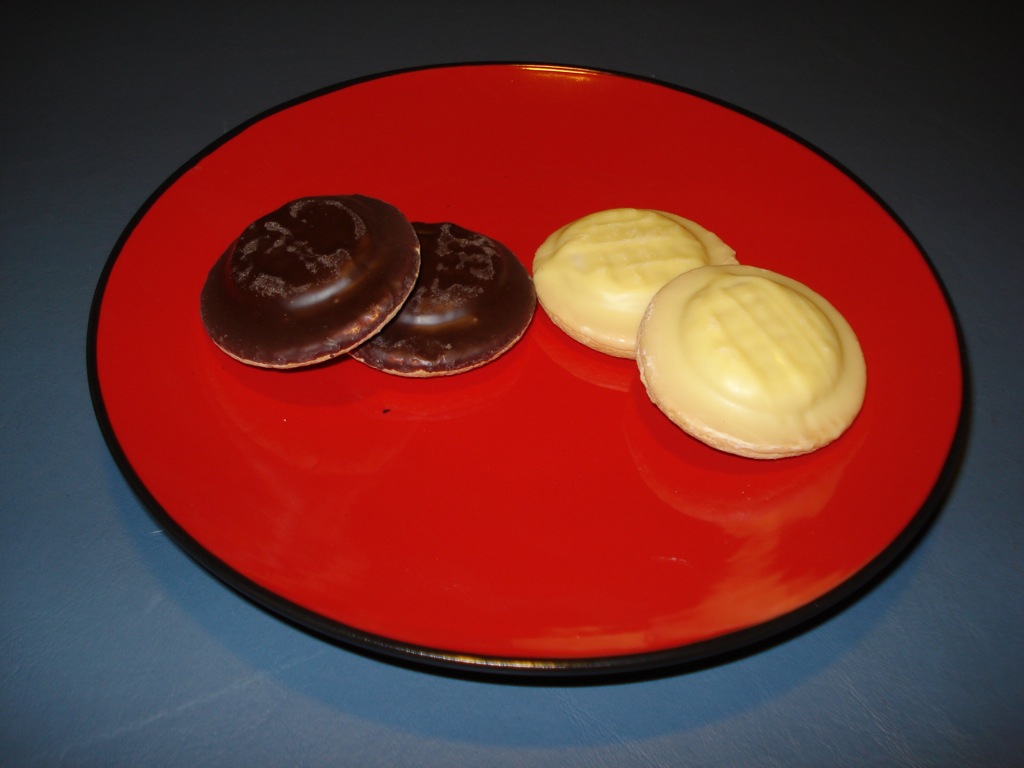
On the other hand, I wasn’t going to leave empty-handed, so I browsed the snacks & candy selection until I found a few things that looked promising, and bought them:

Basically, I wound up with two packages of cookies from Poland and two candy bars.  The largest is also Polish, the smaller is from Tomislavgrad, a city in the Federation of Bosnia and Herzegovina, which Wikipedia tells me is one of two political entities that comprise the nation of Bosnia and Herzegovina, which Wikipedia then tells me is one of six former Federal units of the former Yugoslavia.

Let me get one thing straight:  That second candy bar there is the single most educational piece of candy I have ever purchased.

Anyway, I’m saving the chocolate for another day because I suspect it’s going to be pretty similar to chocolate from pretty much any country in the world.  That is to say, any country outside of the US, because the rest of the world considers our chocolate to be one step above brown candle wax and I’m hard pressed to fault them on this topic considering news stories like this one.

On the other hand, the cookies looked tempting.

In adherence to the universal laws of snack food, they looked a little better on the package than they did once I’d gotten them out:

The vanilla, I’m sad to report, was nothing extraordinary.  It didn’t seem worth the trouble that had been taken to ship it all the way from Poland to Portland.  I suspect that any Polish expatriate needing a fix of vanilla-flavored “Delicje Impresie” would be well served by any number of vanilla cookies available in the United States.  Let me be clear – it was good, it just wasn’t exotic.  I expected more from the 9th largest country in Europe.

Again, thank you Wikipedia for turning this into an educational experience.

The cherry, however, was really good.  It was almost exactly the flavor of black forest cake, or Schwarzwälder Kirschtorte, the traditional dessert from southern Germany.

And thank you again Wikipedia.

Now, I don’t know your personal views on Schwarzwälder Kirschtorte, but speaking only for myself I’m a big fan.  So having it in cookie form is a Big Win, and I now have a generally favorable view of Poland and each and every one of its 38,130,302 (estimated) inhabitants.

Posted in food | Leave a comment

It always comes down to psychic schoolgirls.

After taking some breaks due to class, I finally finished Red Alert 3 tonight, and I plan to start on Uprising before I forget what all the units are and what they do.

I tackled the Rising Sun campaign last, and I’m glad to have done so.  Compared to the other two factions, it took a LOT of micromanaging of units to get through, and it took me quite a while to get used to how closely I needed to watch things.  Also, of course, you don’t get the REALLY cool units until the last mission or two, so you get the new shiny toys and only get to play with them for an hour or so before the end.

Particularly cruel is how long the game makes you wait until you get to play with the Rising Sun’s commando unit, Yuriko, who is just a ton of destructive fun wrapped up in a plaid skirt & pigtails.  She also takes more micromanaging than any other unit, because she dies an awful lot. Fortunately, a new Yuriko is always just a button press away.

Hmm.  That having been said, “dying an awful lot” is a common quality among the commando units for the various sides, but I just never felt the need to bother with either the Russian or Allied commando units.  So I can’t single Yuriko out in that regard.

Anyway, making you wait to play with the more powerful units makes sense, of course.  If you had access to every unit at the start of the campaigns, the game would be insanely complex.  Easing you into it is the only sane way to do things, and ramping you up slowly is a good way of getting you ready to jump into the online multiplayer.

Which I don’t play.  So it’s kind of a waste, I guess.

Even if you do look at the single player campaign as “just a training mode”, though, it IS 27 missions long and they’re joined together by delightfully cheesy cut-scenes, and it does have a surprising amount of fanservice.  Can’t go wrong with fanservice.

It’s not a quick game.  With multiple failed missions – I EVENTUALLY learned that I should be saving often – it took me probably 40 hours to play through.  If I’d played an RTS since Starcraft, I might have done a better job at that.

Posted in PC Gaming, videogames | Leave a comment