Speak & Spell Not Included

If I had to pick an unexpected benefit of visiting China rather than Japan, I’d have to say that it was a fairly inexpensive trip.  When I visit Japan, I tend to do a LOT of shopping.  I mostly stick to second-hand shops and used game stores, so I’m not spending a lot on any one thing, but it adds up pretty quickly.

I passed through a bunch of different shopping districts in China, but I never felt too inclined to do much shopping.  Most of the brands on offer were western fashion brands, there were very few game stores and I only ever ran across one store that offered Japanese character goods, so I simply didn’t have the opportunity to go nuts.  I’d converted $900 into Chinese yuan and, with only a few days left in the trip, still had the majority of it.

Of course I bought a gadget.

With the recent Fatal Frame V and Rodea announcements, I actually considered buying an American WiiU from an import shop and flying it back to the states, but I dismissed that as fundamentally silly.

Instead, I decided on a phone.

Specifically, I bought a Xiaomi Mi4, a phone that will never be sold anywhere near the US, because Apple no doubt has an army of lawyers just waiting for them to come within reach.  The Xiaomi engineers took a good look at the iPhone 4 – still Apple’s best-looking phone, in my ever-so-humble opinion – and decided to hit Control-C/Control-V and take off early for the weekend.
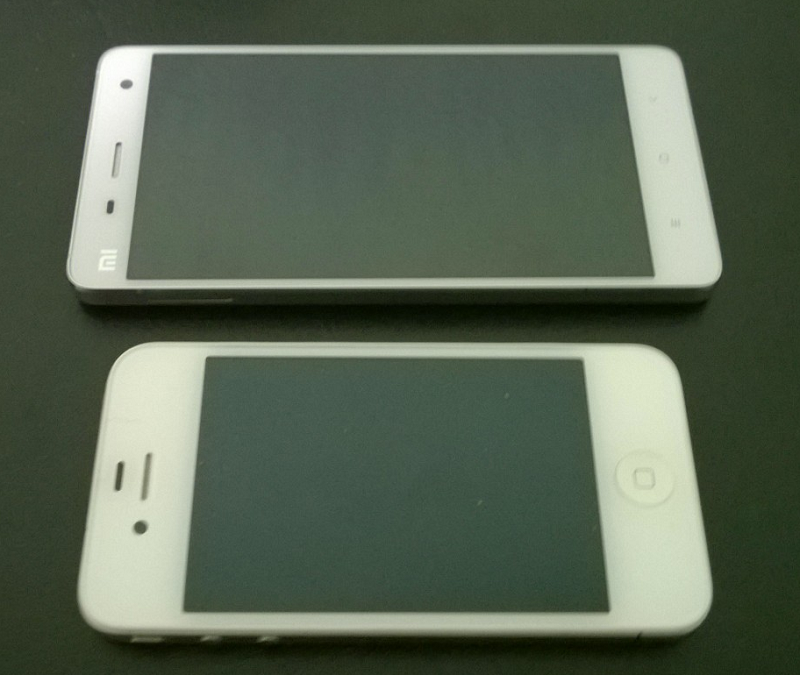
xiaomi_mi4_iphone_4

OK, so they also hit the “resize to 120%” button halfway through the process.

I won’t go into the details – there’s an Ars Technica review for that, if you’re curious – but it is a big jump in hardware from the Nokia Lumia 920 that I’ve been packing for the last couple of years.  The screen is bigger and pushes a lot more pixels, it’s got a quad-core processor and 3GB of RAM which makes it snappy as all get out, and it’s just generally a brute under the hood.

The drawback of importing a phone, of course, is that while this IS an LTE phone, it doesn’t support the LTE frequencies as we use in the US.  I’m stuck with GSM frequencies and 2G data when I’m not near wi-fi, which is great for battery life but which means that I’m not going to be doing any mobile video streaming.  It’s plenty fast enough for email, twitter, and wikipedia, and those represent the majority of my on-the-go data use, but heavy duty stuff is going to make me find an access point to get things done.

Ignoring the aesthetics, the reason that I went looking for this specific model of phone is that Microsoft has promised to release Windows Phone 10 for the thing, and I really want to get a Windows Phone that is not beholden to a specific carrier for updates.  That should be coming in July or so, if we’re lucky.

In the meantime, I am experimenting with Android.  This phone is designed for tinkerers, so it was very easy to replace the scary Chinese ROM with a global ROM that has Google services and presumably phones home to China far less often.  There IS a vanilla AOSP port for the thing, but I elected to stick with Xiaomi’s MIUI V6, based on Android 4.4.4 “Kit-Kat”.

It’s been interesting coming from Windows Phone to Android.  There’s obviously a ton more application support on Android, and even applications available for both platforms are better maintained on the more popular platform.  I SHOULD be falling in love with Android, but I’m really not, and I think it’s a case of me butting heads with a basic design philosophy.  Both Windows Phone and iOS feel like extensions of your PC (or Mac), and Android feels more like a conduit to servers and services on the web – it has an ephemeral nature about it that I’m not quite comfortable with.

To be fair, Google is at a disadvantage when it comes to desktops.  The AppleID and Microsoft ID systems give a huge advantage when integrating into their respective ecosystems, and an Android-based phone is never going to log in to my iTunes account or let me add points to my Xbox Live Gamerscore.  Google owns the web, so it makes sense to sell an OS that is tightly integrated with Google-provided web services.

I’ll give it a couple of months to grow on me, though, and see what I think once I’ve had some time to get used to the quirks.

Posted in China, gadgets, travel | Leave a comment

Kentucky Fried What Now?

Of the big western fast food chains, I don’t think any have adapted quite as thoroughly to Asian tastes as Kentucky Fried Chicken.  In Japan, the chain has even managed to make itself part of the local Christmas tradition and the Colonel regularly shows up in popular culture.

In China, I can’t say whether the chain has made that much of an impact, but the menu is decidedly tuned to local tastes, with fried shrimp on the menu and red bean pies and egg custard on the desserts list.

There’s just one problem – with the option of getting fried shrimp OR fried chicken, how is a man ever supposed to make a choice?  I can see myself wasting my entire lunch hour staring at the menu board, desperately locked in one of the world’s greatest conundrums.

Thankfully, KFC heard my pain, and came up with something called the “伴鸡伴虾堡”, or  (if Google Translate is to be believed) “Companion Chicken Companion Shrimp Fort”

kfc_sand2

This is dangerous alchemy indeed.  Is man MEANT to eat such a thing?

I decided to find out.

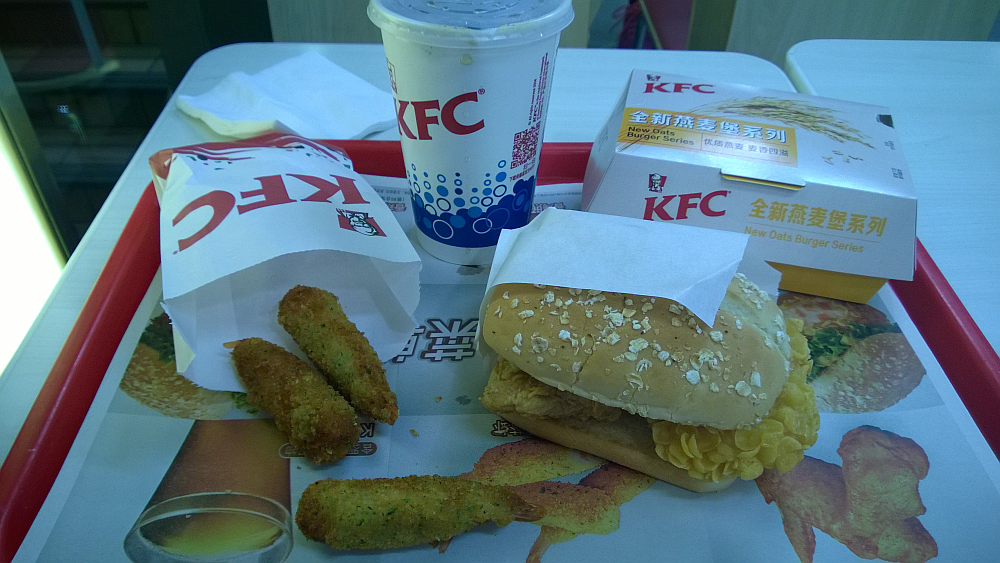
Now, I am used to fast food items not exactly living up to the advertising images when actually ordered, so it was a bit shocking to order a Companion Chicken Companion Shrimp Fort Combination Meal and wind up with a tray that looked like this:

kfc_sand1

You’ll have to pardon the bad lighting.  This is what happens when you don’t want to use the flash in a crowded restaurant.

The point is, when I got it out of the box, it looked rather tasty, not a disgusting mess.

And, yes, it was pretty good.  They’re pitching the Companion Chicken Companion Shrimp Fort as part of their “New Oats Burger Series”, which suggests that they’ve put a lot of effort into the bun.  It paid off – it was one of the better fast food burger buns I’ve had.  There’s also lettuce, some sort of mustard-based dressing, and the promised separate shrimp and chicken patties.

The chicken patty was, well, a KFC chicken patty. I did not count the herbs and or spices, but I feel confident that all eleven were present.

The shrimp patty was, as expected, shrimp, but covered in one of the strangest breadings I’ve experienced.  The fried shrimp in the side dish were a more or less traditional breading, but the patty was fried in something that resembled a breakfast cereal of some sort, with a most unusual texture.

This would be a tricky one for KFC to bring to the states, and I’m not sure we’re ready for Companion Chicken Companion Shrimp Fort.  I wouldn’t mind if they added fried shrimp to the list of sides here, though.


Posted in China, food, travel | Leave a comment

Liberation Maiden

liberationmaiden

I’m going to commit a bit of a cardinal sin in talking about Liberation Maiden, which is that I’m going to assume that you’ve played either Panzer Dragoon or Rez or preferably both.

If you haven’t, go get on that now.

If you have, and you have liked them, you would likely enjoy Liberation Maiden as well, because it copies the core mechanic of those games – hold a button and drag a targeting reticule around the screen to highlight stuff you are displeased with, release the button to unleash Macross-level missile spam, repeat.

Honestly, for a Suda51 game, it’s surprisingly, um,   normal. The plot is a little wacky – you play the teenage President of New Japan, tasked with flying into battle to save her country from alien invaders – but there are none of the truly bizarre moments I’ve come to expect from anything with a Grasshopper logo.

It’s a satisfying few levels of flying around and blowing stuff up, with some fantastic boss fights. It’s hindered a bit by being on a tiny screen – some of these visuals really deserve a better presentation, and it IS super short, but for 8 bucks on the eShop, I don’t see how you can go wrong.

I played it on the 3DS but it’s also been released for iOS. I will have to try it on the iPad to see the improved visuals and to see if the touch controls are better suited for it – the 3DS controls have you manipulating the left thumbstick and using the stylus AND using the shoulder buttons all at the same time and I wound up with a fantastic pain in my left wrist for most of the next day after playing for an hour.

Posted in 3DS, videogames | Leave a comment

Code of Princess

codeofprincessI’ve had a 3DS for a few months now, and it’s seen frighteningly little use playing actual 3DS software. It does make a fabulous regular DS – but, since I already had one of those, that’s scarce justification to have bought the new system.

It’s not my fault that the Vita is my portable system of choice – it’s a fantastic piece of kit and is positively flooded with games that fit into my wheelhouse, as it were, and the 3DS has an unfortunate lack of non-first-party titles to earn it a place in my go bag.

So, knowing that I’d be in China for two weeks, I made the conscious decision to leave the Vita home. Instead, I packed my pretty princess pink 3DS, with DoA Dimensions, Kingdom Hearts and Code of Princess on carts and Senran Kagura, Liberation Maiden, and Demon King Box on the SD card. I had to leave my only other retail title, Spirit Camera, at home as it relies on AR cards.

I wound up playing through two of these.

I was under the impression that Code of Princess was a 6-hour-or-less game, so that’s where I started.

It turned out to be a four hour and eight minutes game, so it really WAS a good place to start. It also turned out to be playable on a single 3DS charge – the power LED went red during the final boss fight and the battery held out through the closing credits like a champ.

There’s not much to say to the plot. There’s a peaceful kingdom, it gets attacked by monsters, there’s an evil queen behind it all, it falls to you to strap on your bikini armor and pick up your massively oversized sword and save the world. Along the way, you wind up with a big group of followers.

It does get some points in my book for having a genuinely likeable cast of characters and some good banter during the cutscenes. Sadly, there’s no Japanese language option, but you can mute the voice track to achieve a result that’s almost as good.

Even with it being a terrifically short game, I didn’t feel as though I’d been cheated in buying it. Part of that is probably because it was twelve bucks new on Amazon, of course, but it also felt like a complete experience. The main character (you can play as any of four different, but I stuck with the princess character) is kind of slow moving and her attacks have a lot of vulnerable frames to them. You can’t hope to win if you are constantly on the offense, so I found myself in the odd position of needing to learn how to block and dodge, rather than just mashing the A button to victory. The game is divided up into a bunch of missions – and you can go back and replay any of the earlier missions at any time – and they do a very good job of forcing you to learn the mechanics. The final boss fight, in addition to being the story climax, is really a final exam testing whether you’ve been paying attention up to that point. They certainly could have padded it out some more, but that’s where you have the option to play through the game as one of the other characters, I suppose.

So, overall, a nice use of a few hours of an international flight and a general thumbs up from me.

Posted in 3DS, videogames | Leave a comment

Beijing’s Yaneura – Maid Café From Hell

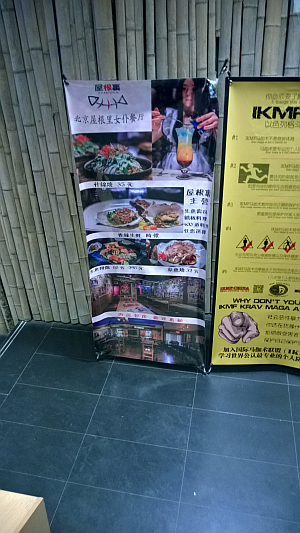
yaneura1I’m not going to claim that I’m any sort of Maid café expert, but I’ve been to a couple in Tokyo and one in Osaka, and my opinion is that they’re generally nice places to go if you’re in the mood for some light pampering and heavy pandering and a generally relaxing atmosphere. The ones I’ve been to have all been in the hearts of otaku shopping districts, and a few hours shopping in any of those will put anyone in the mood for a comfy chair and some classical music and an overpriced omelet with a heart drawn on it.

So, when I heard that Beijing had a maid café of its own, I had to go and check it out. This was a bit of an adventure, because the directions I had were not entirely complete and I don’t really understand Chinese addresses and the building it had been in was completely gutted when I DID find it and then it took me a while to find it at its new location.

yaneura2

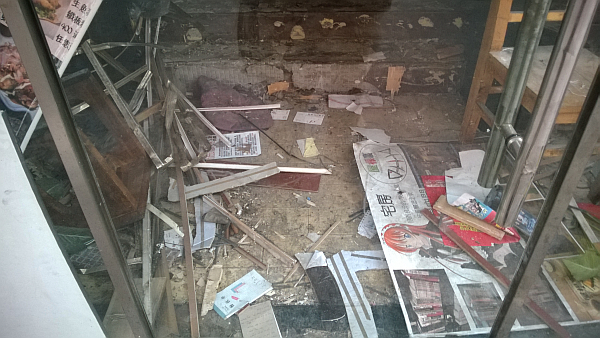
The lobby of the former location.  There was, at least, a map pointing me to the new restaurant.

Not that any of that is their fault, and walking that much DID get me really ready to eat something, so I was glad to finally find the place.

I got the sense something was wrong when I entered and was greeted with a half-hearted “okaeri nasai” rather than “okaeri nasai, goshuujinsama”.  I don’t need THAT much pandering but it was a little jarring.

Leaving that aside, it wasn’t a great experience.

To start with, their front room had 8 tables set up for anywhere between 2 and 6 people. One of these tables was occupied. That left seven empty tables and they still seated me at the bar so I’d have my back to the room. Any attempt to look at the decor or, to be honest, watch the staff at work meant twisting around and staring.

The first menu they handed me was bilingual in Chinese and Japanese. I tried ordering in Japanese, and I got a blank look and a trilingual picture menu (English/Japanese/Chinese) and it was made clear that ordering should be done through gesture.

Yaneura is a little atypical in that it’s actually an izakaya rather than just a café, so it has a pretty full menu. I still ordered the omelet rice, which should be the symbol, in any maid-themed establishment, that Mr. Customer is in the mood to have something goofy drawn on his food. Usually, this is a heart, but I’ve seen some more creative stuff from time to time.

Mine came with sauce, but no art.

I also got a coke, which was delivered in the form of a 330ml can of coke and an iceless glass, plunked down with all the coquettishness of a drive-by shooting by whoever had drawn the “serve the foreigner” short straw.

Again, this is Maid Café 101 stuff here. You open the can for the customer, you pour it in the glass. If you’re looking for advanced marks you get them a bendy straw and stick it on in there.

About the only thing they got right, really, was to have five servers on duty in maid outfits, and the outfits were suitably frilly. There were also some anime tchotchkes stuck on shelves around the main dining area, so I guess they worked on the décor and uniform parts and called it good.

Several really basic maid café traditions completely ignored or done halfway, Yaneura had one last insult after I’d finished my food and paid the bill.

yaneura3

I went looking for the bathroom, and there were signs pointing me downstairs, and this was where stuff started to go a little Douglas Adams because the bathroom was in a basement that looked to have been ripped apart for remodeling and left that way, with lots of building materials lying around and virtually no illumination. The men’s room had two stalls; one had a chef’s apron draped over the door from the inside and cigarette smoke wafting over the door, the other was an Asian-style floor toilet that had been prodigiously used and not flushed.

Being faced with a massive pile of the last guy’s business just put a fine cap on the experience.

I’m trying to envision a scenario where I could put a happier face on this place. I guess if you speak Chinese, or are with someone who does, and you came in with at least a group of four, and you’d never ever ever been to a maid-themed establishment before so you had really low expectations it might be OK.

Oh, and maybe they’ll finish the basement one of these days too.


Posted in China, travel | Leave a comment

The sky above Beijing was the color of television, tuned to a dead channel

I have waited 30 years for an excuse to rip off Gibson.  China provided that excuse.

When I went to the flea market at Panjiayuan, I had a rather pleasant conversation with one of the vendors, mostly about the weather which was quite frankly lovely at the time.  His response was that the air was going to be terrible later on, and I wrote this off with a hint of smugness – after all, I used to live in Los Angeles, and I’ve seen a lot of smog.

At any rate, my conversation with this vendor was in the morning and I more-or-less put it out of my mind until deciding to leave the hotel, a little after five PM, to look for dinner. There was a famous restaurant street that I wanted to go to, and it was only a few stops away on the metro.

It was still quite pleasant out, at least as far as temperature. I’d say low 70s.

It was also nearly pitch black out. Well, not really pitch black.  It was dark out, but there was light somewhere above – it just wasn’t reaching the ground.  Likewise, the neon signs on buildings were diffused, fuzzy around the edges.  The effect was very much like trying to see the world through static.

There were very few people on the streets, and most of then were wearing filter masks. I’d bought some in Shanghai as a precaution, so I congratulated myself on my foresight, put one on as well, and kept going.

I made it very nearly to the subway station before I realized that I was being an idiot and turned around to find food closer to the hotel.

It turned out that the lovely high temperatures and sunny morning had been the start of an inversion that had pumped Beijing’s AQI up from its typical levels in the 50-100 range to an off-the-charts 465, and also that the cheap filter masks I’d bought were just not rated to handle particulate on that scale. I had a sore throat for a couple of days afterwards.

For point of reference: The mainland China air quality scale tops out at “300+”, at which level it is recommended simply to not be outside if you can help it, as it can cause breathing difficulties even in normally healthy adults. There aren’t levels above that, but I’m going to classify this one as “The air is actively trying to kill you, please avoid breathing”

In addition to my crash course in air quality standards, I learned a valuable lesson about trusting the locals when they talk about weather.  So it was really a very educational day.

Posted in China, travel | Leave a comment

In Which, I Am Forced to Accept Defeat

I didn’t have many things in mind to buy when I went to China. I wanted to get the Xiaomi Mi4 so that I could put Windows Phone 10 on it when it became available, and that wasn’t too hard to come by. I may put something up on here about that later, but there’s not too much to talk about yet.

The other thing I wanted was a poster from the 1960s that I fell in love with during a Chinese Art History course I took back in sophomore year.

Cailu guafei chanliang duo

It’s both a really pretty poster and surprisingly dark, because the message is “look at all this food I am harvesting, all this tasty food!”, and the country was actually in the middle of a famine of epic proportions, mostly because of that wacky Mao guy and his dislike of birds.

That is simplifying things a bit, I realize.

Anyway, they printed over a million of them, presumably because people would take pictures of delicious food even if they couldn’t have the real thing, so I figured it wouldn’t be that hard to find a vintage poster or modern reprint. It turns out that most propaganda posters got destroyed in the 1970s, either because they were no longer PC or for paper recycling drives, so it turned into quite a frustrating quest.

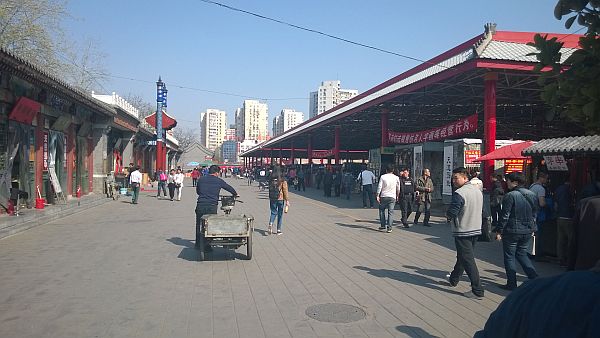
Eventually my search took me to the Panjiayuan “dirt market” in Beijing. This is part flea market, part crafts fair, part actual shops. The actual, established shops surround the part-time vendors, who all get to lay out their wares for sale in temporary stalls or on blankets.

panjiayuan_market

As a guy who used to be a craft fair vendor in my teens, I have a lot of sympathy for the poor schmucks in the cheap seats. They’re the ones trying to sell cheap jade, amber and malachite carvings, fake antique coins and assorted other cheesy junk, and they’re the ones who are going to be bundling up 95% of their wares at the end of the night and trying again the next day.

The established shops have the Serious Jade and Ivory carvings (with, to give them credit, very large signs pointing out that what they’re selling is mammoth ivory), paintings, antique furniture, and – finally – a huge number of shops selling vintage posters.

I even found the poster I’d come looking for, only to find that the vendor wanted CNY4000, or about $640, and was not in the mood to talk price. So… That one is going to stay on my Things I Will Not Own list.

I went back to browsing the vendor stalls, vaguely looking for a magatama in some sort of stone. Did not find any, despite there being carved stone of virtually every other shape and size – even one lovingly crafted jade “marital aid” that goes down next to J-List’s moon wands as being an unexpected material for that sort of thing –  vaguely considered getting a random hunk of malachite to commemorate my days playing an EQ mage, and eventually left empty-handed.

Still, a fascinating place to browse knick-knacks.  Also, if you have much deeper pockets than me and a taste for vintage posters, this was the only place I was able to find them.


Posted in China, travel | Leave a comment

Some Serious Roaming

china_data

So, the first couple of times I went to Japan, I was more-or-less completely cut off from the world.  I’d specifically bought a “global” Motorola RAZR, only to find that “global” meant pretty much “anywhere except Asia” – Japan in particular was famous at the time for not supporting GSM phones.

By my third trip, in 2007, I’d gone to the lengths of importing a Nokia 6630, a very early smartphone indeed.  It ran Symbian, had a very rudimentary web browser, and – most importantly – supported Japanese cell radio frequencies and protocols.  Nokia had actually sold it in Japan through Softbank under a different name.

So I had a phone that would connect to the local network in Japan, though the actual process of using it as a phone was a bit touchy.  I could receive calls from the US, but not actually call out.  This may not have been so much the fault of the provider as it was my fault that I didn’t realize that you actually needed to dial a “+” and that there was actually a way to dial a “+”.

Also it cost over $2 a minute.

By 2010, I had an iPhone 3GS, which was the same model everywhere in the world and which worked flawlessly in Japan, at least for voice calls.  I couldn’t seem to send or receive texts from the US, and data was right out unless I wanted to spend CRAZY roaming fees, but it was a serviceable phone.  Calls were still pretty expensive though.

In 2014, thanks to switching mobile providers to T-Mobile, I was able to land in Japan, take my phone out of my pocket, text my wife to let her know I was OK, and even get some mobile data, though I was paranoid at every turn that I was going to get slammed with massive data charges when I got home.  (I didn’t, thankfully)

In 2015, using my phone in China was just like having a fully featured smartphone.  Calls worked, at 20 cents a minute, texts worked, data worked* to a point (China Unicom is terrible, and they’re T-Mobile’s roaming partner).

In the space of a decade, things changed from “you are completely cut off from the world” to “wherever you are, you are in touch with everything and everyone you know”

That’s pretty neat.

*(OK, so I couldn’t use Facebook or Twitter, but I actually look at that as a convenient feature thoughtfully provided by the PRC.)

Posted in China, Japan, travel | Leave a comment

Streetpass in China

I took my 3DS to China for a couple of reasons – first, the thing has been criminally neglected and I figured that I might play it more if I didn’t have the Vita option, and second to try to get some exotic streetpasses.

I knew, of course, that game consoles in general were scarce things in China, that they had only recently become legal to openly sell, and that the country’s gaming scene was dominated by phone games and China-only MMORPGs.

Still, I figured that Shanghai was a massive, very cosmopolitan city and that I might on occasion actually run into someone else with a 3DS and get the cheerful green glow of the streetpass notification.

This turned out to be largely wishful thinking.

The four days I spent in Shanghai yielded a total of 9 streetpasses, 7 of them from Japanese tourists and two from Germans.

This includes the trip I took to the electronics district in Xiajuishi, which was notable for at least having some video game shops mixed in amongst all of the stores selling iPhones and iPhone related accessories. I could have, if I had felt particularly spendthrift, even picked up a Chinese Xbox One, a rare and unusual beast indeed.

About the only thing positive I can say is that I got to fill in the Aichi prefecture spot on my map of Japan, so I’m up to 30 out of 43 prefectures filled.

7 days in Beijing added two streetpasses, both from Japanese tourists. No more new Prefectures, tho.

Oddly enough, I didn’t see a single store in either city selling the localized versions of Nintendo products, though I did see a few selling the Chinese Xbox One and PS4/Vita. The only Nintendo stuff I saw on shelves was imported from Japan or the US.

So, on that front, it was a bust. I did play through a couple of games, anyway.

Posted in 3DS, China, travel, videogames | Leave a comment

In China, it’s spelled “HooTERS”

hooters_pudong_shanghai

I confess that I am not well-versed enough in recent Chinese history to know when the first western restaurant chains started opening locations. I can’t imagine that it’s been more than 20 years or so, and it’s rather staggering if that’s the case, because you can’t go five minutes without tripping over a McDonalds or Dairy Queen or Starbucks.

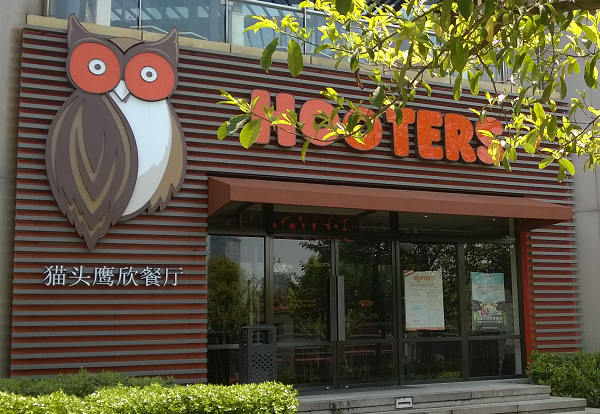
Despite the ubiquity of those recognizable brands, I was a bit taken aback when I walked past two separate “Hooters” restaurants in the space of one day of wandering Shanghai.

I’d never been to one, but it’s not that I have anything against the establishment.  From their reputation, they’ve always struck me as similar to maid cafés, really, in that you go to them to be served by cute girls in very specific uniforms and eat overpriced food.  Hooters DOES have a bit of an Enforced Fun vibe about it, though, and that’s not really my thing, so I’ve never felt compelled to go to one in the states.

On the other hand, seeing the chain in China made me terribly curious.  The success of Hooters, as I understand it, is based on hiring servers with a very specific phenotype – and, without getting TOO crass, a phenotype not well represented throughout most of Asia.

After some soul-searching, I decided that it was my sworn duty to investigate and report back to my readers.

The sacrifices I make.

To answer the question on your mind at this point in as oblique a fashion as possible, there is an entrée on the Hooters menu called the “Double D” Burger.  In case one were to miss the point of the name in question, it appears on the menu directly next to words proclaiming that Hooters is “more than a mouthful”.

I am sad to report that this was hopelessly optimistic on all counts.

It’s not that the staff wasn’t TRYING, but there’s only so much you can do with what nature hasn’t provided. I’m probably going to hell for that observation, so let’s just ensure the trip with the recommendation that this particular burger should probably be called the “Double B” in China.

The burger and a soda set me back 144, or $29, making it the most expensive meal I’d had in China, but it WAS a very tasty, VERY American-style burger.

After the visit, I was left with an odd sense of national pride. At this point, I’d been in China for three days and absolutely stunned by the sheer drive on display. Shanghai is BOOMING, with new construction everywhere you look and a general sense of raw hustle about it, and as a westerner, it’s hard not to feel a little inadequate.

On the other hand, I feel confident that, if I were to walk into a Hooters in the US, the restaurant would live up to its name in spades.

So we’ve got that going for us, at least.

As a followup, I undertook the same experiment at the Beijing branch of the chain, with similar observations as to the appropriateness of the brand name.  The staff at the Beijing store were really friendly, however, and either really enjoyed their jobs or were just amazingly good at faking it. Poor fan-service, sure, but tremendous customer service.

As a followup to a followup, I then returned to Shanghai and I went to the second Hooters location, near the city library, and I can confirm that the burgers are just as tasty and that the staff turns the HOOTERS MAKES YOU HAPPY attitude (it’s a motto?) up to 12 compared to Beijing’s 11.

Also, since I was in on lunch and the place was pretty empty except for me, a couple of folks on their lunch hours, and a family having a birthday party for a little girl of about 5, I got mobbed by employees looking for English practice.  I am not complaining about this in the least  – there have been times in my life when being made to stand up in a circle of eight strangers and sing silly songs would have left me embarrassed beyond the point of coherent speech, but apparently I have transcended shame.

Posted in China, food, travel | Leave a comment