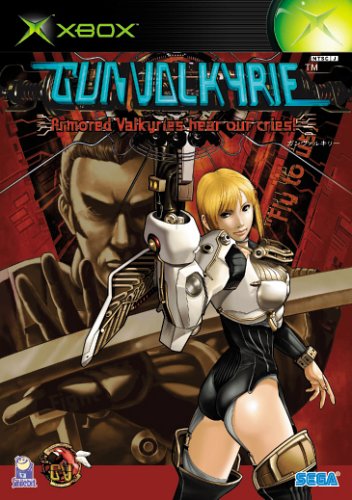
So, Gunvalkyrie, eh?

A few days ago, I made the mistake of mentioning how the control scheme for the new Yar’s Revenge reminded me of Gunvalkyrie, Smilebit’s 2002 3rd-person shooter and hidden-object game.

Well, technically, the only part of the game that’s a hidden object game is the cover art, reproduced here for your brief puzzlement.  US on left, Japan on right:

Did you see that there’s actually a guy on the cover?  It took me a while, too.  There’s no shame.

Anyway, I originally bought Gunvalkyrie back in April of 2007.  That’s five years ago, now, come to think of it.  I really am not good about getting right to games.

Back then, I played a little bit of it and felt like there was a decent game in there, unfortunately hidden behind a control scheme that was a bit dense, but it fell off my radar pretty quickly.

After reminding myself of it last week, I was inspired to give it another go.

Now that I’ve dug it out of the box that all non-360-compatible Xbox games had been stuck in, managed to coax our old Xbox back into service, and put the last three days into seeing what I could do about that control scheme, I can verify that there actually is quite a decent game in there, partly because it draws you in with a bizarre plot centered around Great Britain conquering the world and seeding the galaxy with colonies (in the late 19th century, mind you) and partly BECAUSE the control scheme is so bizarre compared to other 3rd-person games.

Take, if you will, the Assassin’s Creed games.  They use a pretty bog-standard control scheme which isn’t difficult to pick up.  Run around with the left stick, steer with the right stick, and it has a single button that puts you into Awesome Assassin Mode, where you hold down the button and run forward and your on-screen character does Amazing Parkour Stunts and you get a vague sense of smugness at how awesome you are.

Gunvalkyrie is as far from that familiar and accessible control scheme as you can get.

Your character IS capable of pulling off some terribly impressive aerobatics, but actually getting them done is left in your hands and depends entirely upon you learning a set of controls that are… well, not BAD controls, just terribly, terribly unique and entirely non-configurable (you can’t even invert the view axis!).  It makes constant use of the stick buttons, the “L3” and “R3” buttons as it were, and the result is that you are pressing DOWN on the pad at the same time as moving the pad most of the time.  The sound of the controller during a heated boss fight is, well, remarkably similar to the sound of a Guitar Hero controller being used to play a particularly heated solo.

The result of this is that, once you start getting the hang of using the thumbsticks in ways that no game before or since has asked you to, there’s a tremendous sense of satisfaction.  The game has a meter on screen which slowly counts up as you perform more and more mid-air stunts in hazardous conditions (you must be near an enemy for it to count up) without actually being hit or touching the ground, and when the meter fills you turn into a Massive Badass for the next 10 seconds, invulnerable to incoming damage and with your weapons turned up to 11.

Managing to pull this off during the final boss battle, during the brief period of time when the boss was actually vulnerable, and after 20-some failed attempts at beating the final boss, is going to stand as one of my all-time triumphs.

I am not, by and large, a fan of “hard” games.  I like running through games as, well, a bit of a tourist to be honest.  I’m the reason they PUT “easy” settings on games, and I am also the reason why developers like Smilebit DON’T add a difficulty setting – they don’t want tourists to finish their games!

Every single person playing this game has to face the same challenges in the same way. The result is that, once you get the control scheme down, once you suffer through the platforming HELL that is the Naglfar’s Pit level and put the requisite hours in to figure out how to beat the bizarre bat-winged-cherub last boss, you are in a very small crowd of gamers who have done the same, and it feels good to be there.

I’m so stoked, in fact, that I am going to dig out my copy of Ninja Gaiden and…

…wait, I’m not THAT crazy.

Posted in videogames, xbox | Leave a comment

Credit where credit is due:

Total time from my initial chat with a live support agent until I got the email letting me know that my unlock request had been approved was about 40 hours, which wasn’t bad considering the load they must be under.

So, well, thank you, faceless overlords at AT&T, for finally being decent sorts about the whole unlocking thing.  The next time I leave the country, it will be nice to just be able to buy a SIM card instead of having to buy a cheap mobile wherever I wind up.


Posted in gadgets | Leave a comment

Yar’s Revenge (have you played Atari today?)

As a grown man of a certain age, I have a certain fondness for the Atari 2600 era of gaming.

I never owned one as a youth, but spent endless hours playing on the console whenever the opportunity arose, usually in the form of an in-store demo kiosk or at the house of a friend.

Knowing that, I also knew that it was a forgone conclusion that I would be buying the Yars’ Revenge rehash.

Of course, as a more prudent chap now than in my earlier years, I did wait for the inevitable Steam sale so that I could pick it up for five bucks or less. I then more or less sat on it for several months before getting around to playing it.

Should I start with the bad or the good? Let’s go with good.

Yar’s Revenge is hella pretty and the design aesthetic is designed to reach right into the lizard brain of any science fiction geek and give it a good squeeze. It’s a nice mix of futuristic floating industrial complexes and creepy organic caves, the enemies are insectoid or mechanical or a mix of both, and – in a nod to modern sensibilities – your mutant fly-thing character from the first game is now a hot girl with four arms and a predilection for wearing shapely Powered Armor with Strategic Cutouts.

There’s enough plot in place to cover the needs of any shooter – you’re a slave who’s been conditioned to fight for her conquerors, you break the conditioning, realize the plight of your people and, well, the game is called Yar’s REVENGE and you’re Yar…

The gameplay is classic shooter gameplay, the sort of thing that hasn’t significantly changed since Scramble, to wit: You are moving from point A to point B, where you will fight a boss. While you are moving you have limited maneuverability but are always moving forward as things try to kill you and you try to return the favor.

Yar’s Revenge livens the amusement-park ride style of game up with a fun scoring system and a weapons system that adds a touch of strategy, but it is, at its heart, a new incarnation of, say, Space Harrier or Panzer Dragoon.

That last is in no way a complaint.

For complaints, now we must come to the bad parts.

Firstly, this genre of game usually doesn’t give the player a whole lot of choice in movement. Generally you are either moving a character with a fixed target, or you are moving a target indicator with the character following the target.

Yar’s Revenge uses the twin sticks of the Xbox360 controller – and the game pad is the only reasonable way to play the game, by the way – to move both the character and her completely separate targeting reticule. You then use all four triggers and occasionally the face buttons to fire weapons or select powerups.

Until you learn to look at the screen as a whole and manipulate both character and target to, say, aim at the weak point of a boss with the right stick while simultaneously dodging incoming fire with the left, you are going to be constantly bumping into things and getting shot, and your hands will be in terrible pain after an hour or two.

After the controls become second nature, you will be darting around the screen like a heavily-armed hummingbird, effortlessly dodging barrages of incoming fire and raining laser death upon your enemies, also your hands will STILL be in terrible pain because the control scheme was made for players with the same four arms as the protagonist.

It reminds me terribly of Gunvalkyrie, another game with fantastic visuals for the time and with a control scheme that actively rewarded those willing to put in the time to learn it but which was not designed for humans with human anatomy.

In addition, the game has difficulty settings labeled “easy” and “normal”, but there is a yawning gulf of difference between the two. While I had trouble completing even the first level on “Normal”, switching the game down to “Easy” resulted in my coasting through the game in a matter of about two hours, often killing bosses without bothering to dodge their attacks or use any of my shield powerups.

I like easy games, but a middle ground might have been a nice thing.

As you might expect, then, it’s also quite short, a mere six stages and out. They are some of the best looking stages I’ve seen in a while, but it’s still a very quick game.

These are things that I was able to forgive the game for, and your enjoyment will likely be based on whether you can do the same.

Less forgivable, though enjoyable from the point of view of someone who is leading up to a miserable pun, is that this game – which is about shooting giant insects – is full of bugs.

For a few examples: when you launch the game for the first time, you have the option of choosing a Dx9 renderer or a Dx10 renderer. Upon choosing Dx10, the game would invariably crash for me.

When using Dx9, I was able to set graphical options – for example, to set the game to 1920×1080 and fullscreen – and those options would stay in effect until such time as I exited the game and came back in, upon which time the game would revert to a windowed 1024×768.

Furthermore, this was obviously designed as an XBLA title and they reused assets in a somewhat inconsistent way when making the PC version. The tooltip for “Exit Game”, for example, reads “Return to your game library”, and the on-screen powerup display shows icons of the Xbox360 controller, but in-game tutorials tell you to press keyboard keys for things, even if you’re playing with a controller.

There are also some graphical elements that are cut off when playing in a 16:9 aspect ratio. I’m not sure what those are, unfortunately, I just see the borders of windows taunting me from the top of the screen.

I had fun with Yar’s Revenge, though it definitely didn’t make itself easy to love, and I’d recommend it to anyone who likes the genre, with a couple of caveats:

First, don’t bother if you don’t already own a game pad.

Second, wait for the Steam sale. 🙂

Posted in PC Gaming, videogames | Leave a comment

Best 20 bucks I’ve spent in a long time

A few days ago, my wife and I were coming home from a friend’s house when I noticed that there was an unfamiliar indicator lit up on the dashboard.

A brief perusal of the service manual revealed that this was the Mazda version of the “Check Engine” light.

I hate check engine lights.  I should more properly phrase that as I FEAR check engine lights, as they almost universally mean “something is wrong, we’re not telling you what, and you’re at the mercy of the mechanic to tell you what you desperately need done RIGHT NOW or else your car will probably explode.”

Basically they’re a license for unscrupulous mechanics to print money, and I’m in a city where I don’t have a mechanic that I trust yet.

Anyway, I was staring at this light as I was driving to work the next morning, and I had a crazy realization – I could buy a code scanner, plug it in, and get advance warning for how much my upcoming trip to the mechanic was about to hurt.

The last time I looked at code scanners, they were in the $80-$100 range, which was a bit expensive but I figured that I could justify it for peace of mind.

It turns out that they’re a little cheaper now.  I got this little red beauty for $20.58:

Thanks to Amazon’s never-ending efforts to lose money on shipping, I even got it the very next day.

I plugged it in under the dash of our Mazda3 and it whirred and clicked a bit and spat out a punch card with “P2404” printed on it.

Well, ok, it did none of that.  But it would have been awesome if it had.

I looked up P2404, and it turns out to be a problem with my “EVAP leak detection pump sense circuit malfunction”

That sounded expensive, but at least I knew what I was in for.  I was about to close the browser on my phone and go in to the house to relay the bad news and consider making a service appointment, when I decided to check one more web site.

A gentleman on that web site had been in my position and had asked for help.  One of the responses he’d gotten was, and I quote: “did you forget to tighten your gas cap?”

I thought about this a moment.  I’m in Oregon, where we don’t pump our own gas, so I didn’t actually know the answer to this question.

I got out of the car and walked around to the tank side, opened the little door, tightened the cap, got back into the car, and turned it on.

Every indicator on the dash lit up, as normal, and then most of them turned off.

Including the check engine light.

Life is good.


Posted in random | Leave a comment

Sony Hell

I have had a couple of Sony-related annoyances in the last week, and what good is the Internet if you can’t use it to rage impotently about things of incredibly minor import in the grand scheme of things?

First, they seem to have patched the loophole I was using to buy points on the Japanese Playstation Network from the US.  I was using a Japanese-issued credit card before and had been able to buy points without issue, but they seem to be actually looking at my location now and blocking me out of hand.  I still have Y600 in my Japanese PSN account, so I guess I can buy a PSOne game if I find one I like, but the Saki game just got added to the store at Y2800 and I loves me some mahjong.

Secondly, and somewhat more annoyingly, the Blu-ray drive in my launch 60GB PS3 gave up the ghost last weekend.  You can insert discs into it and eject them, but the console doesn’t acknowledge them at all.  I’m torn between dropping the $150 to get it fixed or admitting that I can probably live without backwards compatibility and moving on.  It can play downloaded games, sure, but a PS3 with no drive is one step up from a boat anchor.

At least they added Amazon Instant Video now, so it’s a slightly more useful boat anchor.

Phew, I feel better now.

Posted in ps3 | Leave a comment

Pony Hell

One of the big questions raised by My Little Pony: Friendship Is Magic is this: why the heck does Princess Celestia let Twilight Sparkle stay in Ponyville? I mean, we’ve seen that Twilight is a fluke on the power scale with regards to magical ponies and, worse yet, has serious control problems. She’s basically munitions-grade unicorn, a pony Akira if you will, and Neo-Equestria is about to explode.

I  had wondered about this for a while, but it wasn’t until a couple of episodes ago that I got an answer.

Equestria is pretty heavily infested with some of the more sordid entries from the Monster Manual. Our intrepid equines have faced off against hydras, manticores, cockatrices, the odd dragon… A nice selection from the Gygax Rogue’s Gallery, in other words.

For god’s sake, they have Wendigos, and I actually had to look up what those WERE.  An obvious deficiency in my education.

These are all pretty heavy hitters, in their own rights, but they kind of pale in comparison to Cerberus breaking off his lease and winding up in Ponyville.

Let me point out what this means: There Is A Pony Hell. Specifically, Tartarus, a place wikipedia describes as ” a deep, gloomy place, a pit, or an abyss used as a dungeon of torment and suffering”.

Pretty heady stuff for a show about big-eyed unicorns.

Furthermore, after Cerberus has been subdued, Twilight leads him back to his post guarding the gates to Tartarus and is back in a matter of hours. Ponyville, then, is built very near to – if not directly ON – Pony Hell.

Looking at things like that, it makes a certain amount of sense to keep Twilight in Ponyville. Sure, she’s the sparkly purple equivalent of a hydrogen bomb and that’s bad, but if Pony Hell ever bursts open, spilling hordes of the damned across Sweet Apple Acres, that’s the kind of firepower you’re going to need to bring to bear.

I suppose that it is vaguely possible that I may be overthinking this.


Posted in mlp:fim | Leave a comment

Better than the Movie

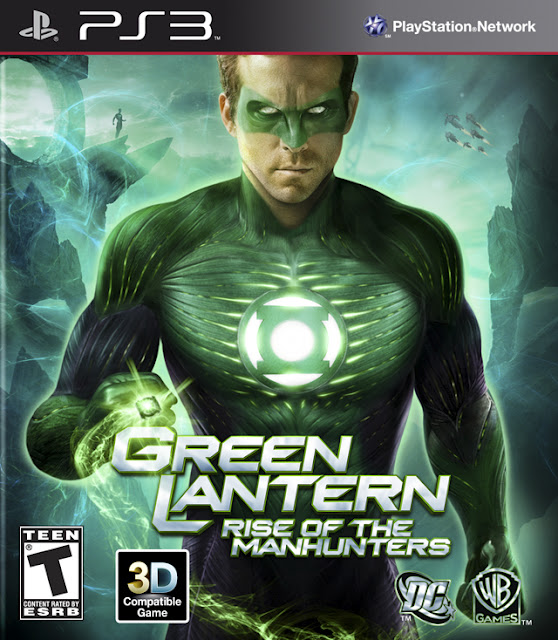
Last year’s Green Lantern movie was a bit of a confusing mess, trying to mash the highlights of a character with 50 years of backstory into 2 hours and failing miserably in the process.

Granted, Green Lantern is one of those characters that’s a bit tricky to deal with and one where comic writers have had to balance the “superhero who fights supervillans on earth and is a member of the Justice League” aspect of the character against the “space cop who’s responsible for handling emergencies on thousands of planets” side of things.

The movie tried to do both and didn’t do well with it.

Rise of The Manhunters, on the other hand, focuses entirely on the space cop aspect and is better for it.  It’s a 3D brawler type of affair with occasional Space-Harrier-style flying levels and just enough plot glue holding them together that it kind of makes sense.  Said plot will take you to four different planets, and I was actually pretty impressed with the effort put into giving each world a unique environmental look.  Granted, this may have been helped by the natural low expectations that come when playing any movie tie-in game.  The assorted ring constructs you create are nicely flashy and have a high cool factor to them, though some of them really didn’t seem appropriate for the character.

To be just a little geeky for a moment, making a giant suit of powered armor to stop around in is a Kyle thing, not a Hal thing.

Anyway, you spend 10 levels beating up robots and aliens, you earn experience points so you can unlock new abilities and upgrade your skills, you have to hunt down things hidden randomly in the environment to boost your innate abilities, occasionally you must solve simple puzzles of the “rotate these rings until they form a shape to unlock the door” variety… It’s pretty generic on that front, but you do eventually get proficient enough with your various abilities that you start chaining them together to in viscerally satisfactory ways as you beat your way through a bunch of robot mooks.  Really, that’s the best reason to play one of these games.

It did lose some serious points with me the first time I fought a slightly-larger enemy and had to go through a quicktime event to finish it off.  I’ve had more than enough of that, thank you, and there is little more annoying than enemies with QTE armor.

Fortunately, the game does allow you to – if you can’t be arsed to deal with QTEs – simply hit whatever you’re fighting more times to kill it.  For that alone, it deserves some credit.

Oh, except for the final boss.  I actually had to take a second go at him because I failed the “Press circle to not die” moment, which was tooth-grindingly vexing.

Overall, it’s a good way to wash the lingering disappointment of the movie out of your brain.

There’s a Wii version as well as the PS3 and Xbox 360 versions, and I’m given to understand that it’s a bit of a different game so I may check that out one of these days.  I’ve been given to understand, however, that I should go into that with even lower expectations, so “One of these days” will probably be “when I see it for five bucks or less”


Posted in ps3, videogames | 1 Comment

You friended me! Picard never friended me!

I do not often find myself filled with glee and anticipation at any news regarding actors. By and large, I have trouble even recognizing actors and I spent several years convinced that Keanu Reeves, Johnny Depp and River Phoenix were all the same person.

I’m still not 100% sure that I’m wrong there.

So it is, as you can imagine, an unfamiliar sensation to find myself utterly gleeful at, well, the news that John de Lancie would be taking another turn as Discord in My Little Pony.

Considering that Discord is basically Q, just turned to 11 and with even less regard for the laws of physics, this should be good. 🙂

Posted in mlp:fim | Leave a comment

Gunter glieben glauchen globen

Steam Sales are fantastic things.  I mean, sure, they’ve left me with a virtual backlog that beggars belief, and they’ve made me give companies money for some truly questionable bits of software, but they’ve also made me take a chance on some games that I thought looked neat but couldn’t justify buying at full price what with the whole backlog thing.

Rock of Ages is one of those games, and it’s one that I would feel no shame about if I’d shelled out the full price for.  Which is, by the way, a modest 10 bucks.

It’s sort of a bizarre combination between a tower defense game and Marble Madness, though far less rage inducing than Marble Madness ever was.  You could think of it as a racing game, maybe?  It’s difficult to put into a genre.

The gist of it is, you play as Sisyphus – no, really – who’s grown tired of rolling a boulder up a hill over and over again and who realizes that, hey, I have this giant boulder and nobody’s going to stop me using it to bust out of hades.  With your giant boulder, you, well, you roll down hills throughout various periods in classical art, crushing guys in environments inspired by, say, Rococo design or a Goya painting, culminating in trying to break into a castle and crush one of 20-odd adversaries.  When you’re not rolling, you’re putting up towers and trebuchets and deploying cow soldiers designed to hinder your opponent who is trying to break into YOUR castle and crush you.

It’s very educational.  I didn’t know who “Goya” was before I played this game.

It’s one of those games where someone had a solid idea of some gameplay mechanics and then someone decided to take a quirky art style and run with it.   There are a couple of levels where the difficulty spike is enough to make me see red – just a little red, mind you, not Meat Circus levels of red – but apart from that it’s sheer joyful fun, and even with those levels it doesn’t outstay its welcome.  It clocked in at 5 hours to beat, with some multiplayer modes I really haven’t examined.

Strongly recommended.

Posted in PC Gaming, videogames | Leave a comment

What if?

I think that “what if?” is one of the most fundamental human questions, like “who am I?” or “what is my purpose in life?”

There are a ton of What Ifs in life, like “what would happen if Superman fought the Hulk” or “what if Bill Buckner had caught that ground ball in 1986”, but one question I’ve never heard asked is “what if Portal was actually a terrible game?”

Having never heard this question asked, I was surprised to find it answered – not in random speculation on the Internet, or in idle conversation at a game store, but in the form of an entire game, designed and written solely to show the world how Portal could have gone horribly, horribly wrong.

I don’t know how I came to own Twin Sector. It’s in my Steam Library, though, which suggests that I spent money on it as part of a bundle of games. It’s an excellent excuse for things like this, anyway; it lets me disclaim responsibility for what might have been a very poor life decision.

I do know that it bubbled to the surface of my conciousness recently when it appeared in one of the Indy Game Bundles that isn’t actually the Humble Indie Bundle. I should feel a little bad, I suppose, about splitting the various Indy bundles into “The HIB” and “Things that are not the HIB”, but that’s one of those mental groupings that just make things easier, like “Download Services that are Steam” and “Download Services that are Not Steam” rather than having to remember Direct2Drive and Games On Demand and all the other bit players in the business.

But I digress.

Anyway, the sudden burst of publicity made me realize that I owned this thing and that, despite the bad press surrounding it, I ought to give it a chance and find out whether the bad press was justified or just sour grapes. I love a lot of games that other people don’t like, after all.

I don’t think there should be any shock in revealing at this point that I found myself agreeing with the general opinion of the game at first, before I realized what it was trying to do.

It wasn’t TRYING to entertain. It was trying to be an object lesson.

Let’s review what Portal was. It was a fairly short but well-paced puzzle game with a few simple mechanics set in a series of featureless and largely monochrome environments, where you as the player are constantly subjected to the advice of an artificial intelligence. It featured a single gadget by means of which you manipulated the world around you, and you could describe the operation of the gadget in about a dozen words.

Twin Sector is, well, read the above.

So why did one go so wrong?

Well, let’s start with the environments. The world in Portal makes absolutely no sense. You’re given buttons to press and boxes to put on the buttons to press them with, there are lasers you must avoid or redirect, you often have to solve a puzzle just to get to a next box that you need to push the next button. This is excusable because the plot of the game revolves around the artificialness of the world; you’re told from the beginning that you are in test chambers designed to make you solve puzzles and it all makes sense.

Twin Sector points this out brilliantly by putting you in the same sorts of environments and pretending that they exist for a reason other than to be puzzles. Very early on in the game, I ran across a button on the ceiling that needed to be pressed by having a barrel thrown at it. This opened a grate in the ceiling that released a handful of explosive gas cylinders which all clattered to the floor. If GlaDOS had introduced the explosive gas cylinders falling from the ceiling as part of a test, it would all have made sense, in a bizarre sort of way. As part of an underground cryosleep facility, a sort of Ark in which humanity could sleep while waiting for the aftermath of an unspecified disaster to pass, it doesn’t make a whole lot of sense.

Furthermore, your character in Portal can fall for any distance, safely landing due to some sort of springy leg brace things. This allows for the ability to experiment and mess things up and get back to the puzzles without penalizing you too badly. In Twin Sector, magic leg braces aren’t part of your equipment and most falls simply kill you unless you have good timing with your telekinesis gloves. Take a tumble? You’re looking at a loading screen. The last straw for me with Twin Sector was, in fact, a room where I kept falling to my death, after which I would have to listen to a particular bit of dialogue every time I died, unable to move or do anything until the dialogue had finished.

Basically, Portal reminds me a lot of the first time I played Simon the Sorceror back in the mid 90s. Simon was an adventure game designed around the principle that the player should not be able to get himself into any situation that he could not get out of, and Portal mostly follows the same template. You may be able to die in Portal, but you’ll never find yourself in a position where you simply can’t progress and your only option is to die or restart a level. Twin Sector takes that design element away; death comes easily and failure is always an option.

Speaking of throwing barrels at button, this is something that happens a lot in Twin Sector, from what I saw of the game at any rate. Unfortunately, the process of actually aiming a barrel at a button involves picking up the barrel, pointing it at the button, realizing that you can not SEE the button while you’re holding the barrel, and throwing it, hoping that you’ll land on the button.

Should I mention that, while buttons in Portal are huge things, buttons in Twin Sector are these tiny little targets?

Like Portal, Twin Sector is based around the skillful manipulation of a Gadget. In Portal, it’s a gun that shoots holes in space, while the gloves in Twin Sector can pick things up or push them away from you. I’d like to find something snarky to say here but the gadget in Twin Sector is actually kind of neat. It is also thoughtfully color coded red and blue which, so that might actually serve as a selling point if you don’t like the ORANGE and blue color scheme in Portal.

The two games also share the concept of a helping / tormenting character who exists as a dismbodied voice. Unfortunately, while GlaDOS was full of personality, OSCAR is, well, the awkward guy in the sweater vest who somehow found out where your birthday party was and showed up with a gift set of bath salts. I understand that, like GlaDOS, he eventually tries to kill you. I didn’t get far enough to find this out for myself, but I must assume that it is an awkward and stilted assassination attempt.

It is inaccurate to describe Twin Sector as a game and unfair to judge it as such. It is best considered a Near-Game Experience, the sort of thing you wake up from and you find that it’s made you really appreciate things you’d simply taken for granted in the past. Like, say, Portal.

Play Twin Sector. It will make you glad for all the good things you have in your life.

Posted in PC Gaming, videogames | Leave a comment