Prince of Persia: Now With Less Banter

I seem to have a yearly ritual going where I play through a game from the Prince of Persia series.  2008 was Sands of Time, 2009 was, uh, the 2008 “Prince of Persia”, and 2010 is Prince of Persia: The Forgotten Sands.  This is a bit of a milestone in that I’m actually playing a game within months of its release as opposed to at least a year late.

I haven’t finished it as of this writing.  I’ve been playing it for a couple of nights, though, and I’ve just gotten the last of my Spiffy Magical Powers so I suspect that another good play session will wrap it up.  At any rate, my impressions of the game are based on only what I’ve seen so far and I reserve the right to get snippy if it ends with a Psychonauts-style difficulty spike.

It’s a really good game and I’m glad they made it.  That’s a bit of a reversal for me because I was quite happy with the 2008 PoP game and wanted to see some resolution to that story’s cliffhanger, but I’m glad that Ubisoft has apparently decided to go back and try to undo some of the mess they made with the previous Sands of Time sequels.

What they gave us this time is a game that’s full of nicely fatal traps and difficult platforming, like Sands of Time, but has the graphics muscle of PoP2008.  It’s a great combination, made better by a combat system that doesn’t suck. As much as I’ve enjoyed playing PoP games in the past, combat has never really been a part of the game that’s any fun, so the button-mashy style freeflowing swordplay in this outing is rather a relief.

Sadly, it doesn’t have a companion character like SoT or PoP2008, so it is rather lacking in the conversation and banter that made both of those games extra fun to play.  There’s a couple of other characters in the game, excluding the Prince himself, but they really don’t do much tossing one-liners back and forth.

Oh, and it doesn’t seem to have anything whatsoever to do with the film, though its release was certainly timed to take advantage of the film’s release.  That’s a pretty big plus – I don’t have anything against movie adaptations done well, but there’s always the risk of getting a bad one, and there’s not much more painful than a bad movie adaptation.

Oh, there’s a weird little Ubisoft loyalty program thing called UPlay that’s built into the game; as you play the game you earn points that you can spend on virtual items and unlocks for Ubisoft games.  It seems harmless ENOUGH, but I hope it doesn’t lead us down the Day 1 DLC path that publishers are trying out to discourage used game sales.

Posted in ps3, videogames | Leave a comment

Yeah, we’ll just mark this one off and move on.

So, after putting Idol Janshi wo Tsukucchaou to bed, I had a couple of Dreamcast titles left that weren’t RPGs, and I figured that playing through one or both of them might be a good idea.

I chose Jet Grind Radio, alternately known as “Jet Set Radio” everywhere in the civilized world, loaded up my old save from 2002 or so, noted that I’d only completed the first two levels on my old save, elected to start again from fresh, got through the same two levels, and popped it out of the Dreamcast.

It’s not going back in, ever.

I’ve got nothing bad to say about the world of Jet Grind Radio.  It’s a pretty neat place – it oozes style, the music is great, and the cel shading works really well.  It makes me want to see a lot more of the world.

Unfortunately, it’s teeth-clenchingly difficult.  The idea is basic enough; you play one of a small band of scofflaws out to save the world through the liberal application of spray paint, and to accomplish this and avoid pursuit, you do it all while wearing roller skates.  There’s lots of rail grinding and flipping and feats of dexterity that would be accompanied, in the real world, by throwing up your arms in triumph.

You might even be tempted to shout “woo!” or something similar.

Sadly, the fantasy life of an expert rollerskater / graffiti artist is somewhat hampered by a camera that seeks your death, time-limited levels that discourage experimentation and exploration, and a bewildering control scheme that maps two functions to the exact same button, leaving three buttons on the Dreamcast controller completely unused.

In addition, an awful lot of the game centers around jumping onto rails – to be fair, the rail grinding in the game IS awfully neat – but getting your on-screen avatar to jump onto a rail is really bloody annoying at times.  Most of the time, I wound up either falling short, overjumping, or jumping just slightly to one side of a rail, which meant that I lost all the momentum I’d built up and had to take several seconds to circle around for another pass.

So, getting through the first two levels took me a couple of hours, and there are sixteen levels, and I understand that the game takes a massive difficulty leap about halfway through, and if I’m struggling this hard on the early levels there’s no way I’m going to be able to stick with it once it gets “hard”.

So, hell with it.  I may give the Xbox sequel a try sometime, because I understand that it’s gotten rid of a lot of the frustrations from the original game, but I’m going to file the original game under the category of games that I wish I could play but am going to accept that I won’t.

Posted in Dreamcast, videogames | Leave a comment

About that resolution…

A few days ago, I mentioned that I’d missed my goal of working through my Dreamcast backlog by 9/9/2010, and that was apparently sufficient shame to convince me to go back and boot up the little white box and play some Idol Janshi Wo Tsukucchaou, or “Let’s Make a Mahjong Idol”

This is, well, a version of Idol Janshi Suchie-Pai III, but it’s a bit… well, it’s a bit changed.

See, back in the mid-90s, the Sega Saturn was the go-to home console for slightly naughty videogames, and the first two games in the series had been released for the Saturn with slightly naughty bits intact.  Suchie-Pai Remix was, in fact, my first import Saturn game, and it got me hooked on mahjong for life.

By 1999, however, Sega had bowed to the mighty lobby that was the Japanese PTA and banned anything that could be seen as less-than-wholesome, so Suchie Pai III – which was originally a slightly naughty game when it was released in arcades – had to be turned into something considerably less naughty when ported to the Dreamcast.

Moreover, the name had to be changed to remove any association with the earlier entries in the series.

As an aside, there’s an amusing bit on the back of the game box where one of the characters is asking “why doesn’t the box say “Suchie-Pai” anywhere?” and another character responds “Shh, we promised not to ask about that”

So, the publisher did have a bit of a sense of humor about the whole thing, but there’s no disguising the sad truth that the game was pretty much hacked to ribbons for its home release.  You only have a choice of six characters, each path through the game is limited to four rounds of mahjong, and it only takes a few hours to burn through all of the “scenario modes”, which is the term they use for the brief stories that set up each set of mahjong contests.

Oh, and just to add that extra little bit of fail, it’s one of only two Dreamcast games I own that refuses to boot if you have a VGA box.  That probably more than anything else explains why it took me so long to get around to playing it.

After you’ve dug out an S-video cable and spent a few hours to play through the scenario modes, though, you can start the “Making Mode”. This is where you create your own character, dress her up, and go challenge people to mahjong.  Here’s where the game actually strives to get some longevity value, because you need to earn points to buy new clothes and hairstyles and such, and you can lose points just as easily as win them.  If you really want to outfit your Mahjong Idol in serious kit, it could take a very long time.  In addition, the mahjong you play during Making Mode is rather harder than the mahjong from Scenario Mode, because there’s (a) no “panel match” game to earn powerups from and (b) no powerups to use against your opponents.  You live or die by your straight-up skills with the tiles.

I played with that for a while, beat all of the available opponents once, discovered I could actually challenge my personally-created character to a contest, beat her after some consternation, unlocked a special outfit for doing that, and decided that I could probably put the game aside and still feel like I’d done it justice.

Posted in Dreamcast, mahjong, videogames | Leave a comment

Rants about manga

Summer’s pretty much ended in Oregon, we’ve got rainy days and cloudy skies in our future for the foreseeable future, and the temperature is dropping down into the low teens celsius.  In addition, I just read an article at Colony Drop talking about Scramble Wars, which is one of those obscure bubble-economy-era OVAs that you probably only remember if you were a fan at a Very Specific Time, and it sent me spiraling into a bit of a navel-gazing nostalgia funk.

It’s the perfect time to talk about dying industries.

I wasn’t there for the actual beginning of the American manga industry.  By the time I became a fan, series like Appleseed and Urusei Yatsura and Mai the Psychic Girl were already being translated and published.  Nonetheless, I got to watch it grow from very early on, to the point where the manga section in bookstores expanded to cover multiple rows of shelves, and now I’m watching it correct down.

I was going to put something in here about the death of the comic book industry as a parallel, and then I decided to go looking for sales figures and found that comic sales in 2010 are right about where I remember them being ten years ago, so I think that it’s already reached its “economically sustainable” point and will probably totter along at its current pace for another twenty or thirty years.

Anyway, manga.  It was interesting to be surrounded by manga fans for a couple of months in Japan, because it let me correct some assumptions I’d made about the species and come to some other realizations.

For one, I’d assumed that they were cheap, so watching them go out and spend thousands of dollars on officially-licensed anime and manga merchandise was a bit of an eye opener.  They even bought a surprising amount of untranslated manga, though I’m betting that that was at least partially for the novelty factor.

On the other hand, there was a collective wailing and gnashing of teeth when onemanga got closed down, so there are obviously some things they have no interest in spending money on – those being, sadly for the English-speaking industry, officially translated works.

I went wandering around the net and found all sorts of articles talking about what could be done about all the manga piracy that’s going on and how to turn readers into buyers and how to compete with fan translators, and it all seems quite well intentioned, but I don’t think it’s likely to actually happen.  What I rather suspect will happen, instead, is that the market will correct down to the point where the only things being licensed and translated for the English speaking market are guaranteed sellers – the Bleaches, One Pieces, Narutos and so on, which can make enough money to keep going even if only one in ten readers is actually buying it  – and that any publisher trying to make a living translating smaller projects will probably have to close up shop or move heavily into merchandise sales and pray.

It’s not really the end of an industry so much as the end of an illusion.  The illusion was that the US was actually a market full of consumers who you could sell manga to, and the reality is somewhat less profitable.  It was nice while it lasted, though.

Posted in anime | Leave a comment

Soft Cream

I’m a big fan of soft-serve ice cream, I think it’s pretty much the definition of the perfect summer treat.

Japan, fortunately, agrees with me, though they just call the stuff “Soft Cream” and leave it at that.

This last trip to Japan, I ran into a development in Soft Cream technology that, well, is probably nothing new but which I found to be bloody brilliant.

Basically, instead of having banks of different ice cream machines, each one dispensing a different flavor, they’ve put the actual ice cream into these little styrofoam cartridge things that each hold a single serving, so you can have very small stalls that nonetheless offer a nice variety.

For example, this sign taken from one of the two soft cream vendors at the Great Buddha at Kamakura:

or this truck from Ueno Park, which was selling seven varieties of soft cream in addition to quite a rainbow spectrum of shaved ice:

Anyway, faced with the panoply of new flavors, I saw it as my duty to expand into the Worlds Beyond Vanilla.

For example, sweet-potato-flavored soft cream, which was fantastic:

and also purple, or purpple if you’d prefer.  Apparently, in Japan, purple is the color of sweet potato, and this summer seemed to have a LOT of sweet potato flavored products for sale.

Also, sesame, which was a little less fantastic on the first bite but which grew on me by the end of the cone:

and they’ve even cracked the swirl problem.  In a display of mad-scientist-level-genius, they PRE SWIRL their soft cream before packing it into the aforementioned styrofoam cartridges:

Ahh, Japan.  For all your problems, you do have your good points.

Posted in food, Japan | Leave a comment

A Rather Decent Sequel

About a week ago, I finished up Bloodrayne.  It wasn’t a particularly great game – it had a bad case of Ugly First Level Syndrome, for a start, and character animation was pretty atrocious, and the story went all the heck over the place.

Oh, and it spawned a pretty awful movie, too.

On the other hand, it was mostly about beating up Nazis, which is always a good time, and the main character was fun to watch run around.

So, overall, it was a C+ with a note of “A little more effort next time!” written in red ink and circled next to the letter grade.

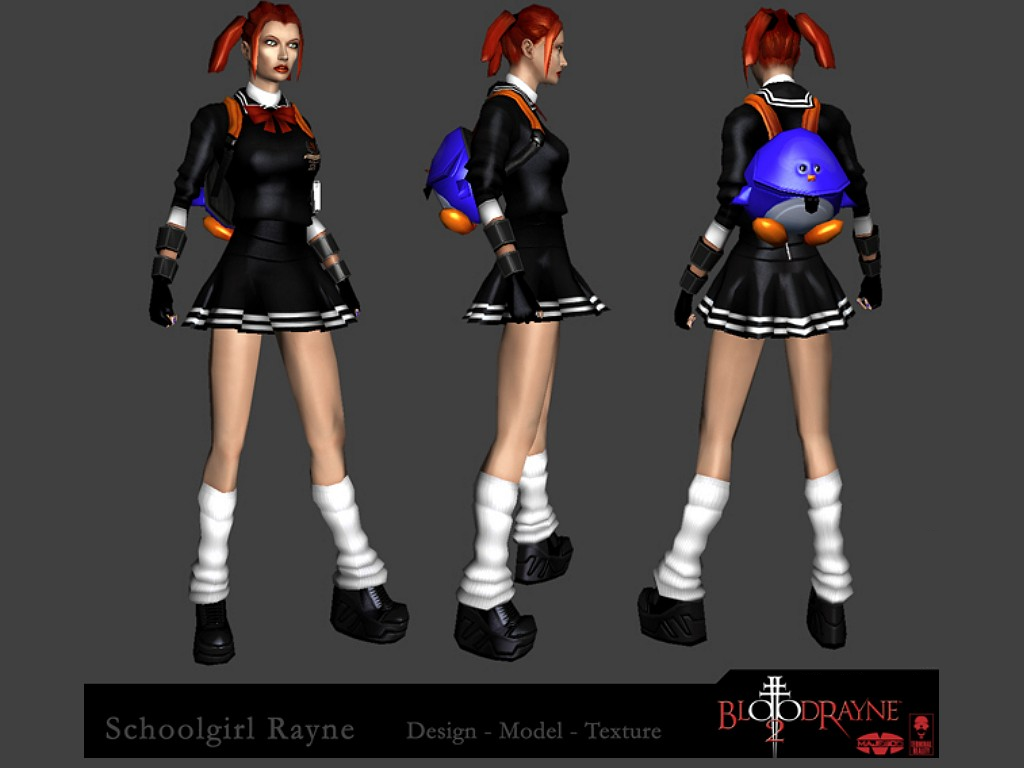
Having now played through the sequel, well, they put in rather a little more effort on the sequel.  Hit detection is still kind of wacky, and some of the animations still tend to drop frames, but it’s obvious that the developers had much higher ambitions this time around.  The story, while definitely B-grade vampire fiction, is rather more cohesive, they boosted Rayne’s move set to include all kinds of acrobatics, put some very Prince-of-Persia-esque platforming bits in to make use of the new moves, boosted the number of environments you fight in and drastically increased the number and quality of boss fights.

Also you can put in a cheat code to unlock different outfits and run around for the entire game dressed like this:

Frankly, considering the kind of search terms I see in my referrers list every day, that should be enough for most of my readers to go play it right now.

One thing I particularly liked about the boss fights in the sequel is that, while it’s not always obvious what you need to do, most of the bosses have a hard time killing you quickly.  Almost every boss fight comes with a horde of accompanying minions, and since you can get Rayne’s health back by feeding on minions, you can try out different tactics until you hit on the Right Way To Kill The Boss.

There were a couple of particularly frustrating fights, and while the developers DID add a bunch of puzzles to the game in an attempt at depth, they’re almost as one-dimensional as Heavenly Sword’s Hat Boxes, but these are reasonably small complaints.

A slightly larger complaint is that it doesn’t support modern resolutions and, while there is an amazing fan patch that, among other things, adds in support for higher resolutions and full-screen anti-aliasing, it’s a bit of a hurdle to get it working.  It took me a good three hours of tweaking things to make it run in 1920×1200 with all the cutscenes operational.  You may have better luck, of course, but it really did bring home that PC gaming is a bit of a two edged sword.  🙂

Also, the PC version pretty much requires a gamepad, which I don’t mind at all, but the default sensitivity values for the gamepad, at least on my Logitech Dual Action pad, were far too sensitive.  After I turned them down a bit, it became much more playable.

Posted in PC Gaming, videogames | Leave a comment

Missed resolutions

So it’s the ninth of September, marking the 11th anniversary of the North American Dreamcast launch, and I’ve not done well with my goal from last September.

I had planned to, over the last year, finish up my Dreamcast backlog – that is, sit down with the curiously non-ergonomic controller in hand and slip GD-ROM after GD-ROM into the thing.  I actually did get off to a decent start at this when I started – I played through three DC games in the space of a couple of weeks – but I fell off the horse fairly quickly, seduced away by more modern consoles.

The biggest problem, of course, is that the games I have remaining are fairly lengthy games, not knock-out-in-a-weekend sorts of things.  As of this moment, I’m looking at having to play through all of these:

  • Jet Grind Radio
  • Record of Lodoss War
  • Resident Evil: Code Veronica
  • Shenmue II
  • Skies of Arcadia
  • アイドル雀士をつくっちゃおう

Six games, including two 40+ hour RPGs.

Oh, well, let’s give it another year.  🙂

Posted in Dreamcast | Leave a comment

Back to Stabbing Mans

So, Assassin’s Creed came out for the 2007 holidays, I think I got it as a birthday or holiday gift sometime in 2008, finally played it in August of 2009.  For me, that’s actually almost being up-to-date with a series.

The PSP sequel came for the 2009 holidays, so a couple of months after I finished the original game. I got it as a Christmas gift, sat on it for 9 months, and finally played through it over the weekend.

I was quite happy with it, to be honest.  There were a few terribly frustrating moments revolving around timed sequences, but they represent a fairly small part of what the game has on offer – most of the game is, like the original, a fun romp around the rooftops while you go stabby on mans.

A word here, because it’s appropriate.  The guards in Assassin’s Creed  were terribly, terribly annoying.  They treated anyone moving around the city at any pace over a slight jog to be a criminal immediately in need of a cold steel infusion, and heaven forbid you climb a ladder in their presence.

In Assassin’s Creed: Bloodlines, to give the game its full title, the guards are much more forgiving about you running around town at full speed, but they’re also about as dumb as a pillowcase full of doorknobs, and often completely deaf to their buddy’s dying gurgle, if that buddy happens to be standing slightly behind them.

On the other hand, it meant that I had to spend less time running away from guards while looking for a haystack, and could instead spend time walking up to rooftop archers and trying to stab them in the most amusing parts of their dialogue.

Obviously I can’t stab something in the dialogue, there’s some bad grammar in that last sentence, but I’m confident that you’ll be able to follow along.

Other good things: They did cut the game down a bit from its console incarnation, which eliminated many of the annoyances.  Instead of having a massive world with lots of empty space to cross between towns, the world is pretty small and the towns likewise.  This also makes things pretty linear – good for me since I like knowing what I’m supposed to be doing – but maybe not good for everyone.

The towns are also a bit depopulated compared to AC1, and this is again actually kind of nice.  The developers took out the annoying NPCs that would follow you around asking for money or occasionally attacking you, which was a big frustration for me while playing the original, so I’m happy with the change. The NPCs that ARE left feel no shame about making fun of your running around Cyprus and occasionally climbing buildings, so it kept that feel as well.

It didn’t really advance the AC1 story that much, though, so that’s a bit of a down point.  As far as expansion packs go, it was better than the 2008 Prince of Persia’s epilogue, but it also cost four times as much.

I’ll close this with something that got a laugh out of me, and something that was a personal revelation.

Laughter: Since you’re an assassin for the good guys, you hang out with a group of Cypriot resistance fighters.  At one point during the game, you have to go bust some resistance fighters out of prison.  The developers didn’t spend the time / money to make a new model for the resistance fighters as you were releasing them, and the normal model has the NPC wearing a sword at his belt, so the effect is that you bust open a locked cell and a bunch of heavily armed former prisoners rush out.

Revelation: I’ve seen a lot of frustrating things in gaming, from escort missions to timed fiddly platforming bits, but there’s nothing quite so painful as sitting through Ubisoft credits.  Seriously, I’m sure that the assistant to the director of EMEA marketing is a wonderful person, but they don’t need to appear in the credits and slow them down even more.  🙂

Posted in psp, videogames | Leave a comment

Speaking of the Movie of the Game

Being in Japan for a couple of months, I wound up missing most of the Big Summer Movies.  Fortunately, we have a $1.50 movie theater in town that has most of them playing right now, so my wife and I went on a movie binge this last weekend and did some catching up.

For a whopping $9 total, we took in Knight and Day, Iron Man 2, and Prince of Persia: The Sands of Time.

I was a bit worried going into Prince of Persia (You’ll forgive me if I leave the subtitle off from now on, I hope), because I’d played the game and quite enjoyed the story of it and was rather afraid that they were going to throw most of the game’s story out of the window and whatever was left would be terrible.

In fact, they DID throw most of the game’s story out of the window, but what was left was actually pretty good.  It keeps the important events from the game but replaces the “running around a booby-trapped palace while slowly building a rapport” bits with “running around the countryside while slowly building a rapport” and replaces sand-fueled zombies with, uh, some kind of Persian ninja assassin guys.

And, to be honest, that makes a lot more sense for a movie.  As a gamer, I didn’t mind that the game consisted of 10 hours of dodging whirling blades and spikes, but I can see how two hours of dodging whirling blades and spikes might be kind of dull to a movie audience.

It’s a rare video game move that you can say “it was quite good” about, without adding a “for a video game adaptation, anyway”, but this was one.

I am a little vexed, I admit, that the movie’s release has delayed – or perhaps put off forever – any sort of sequel to the 2008 PoP game, so we’ll be waiting longer for a resolution to that cliffhanger, if one comes at all, but it DID bring us a new game set in the Sands of Time timeline that comes between The Sands of Time, which was one of the best games ever, and The Warrior Within, which was dire.

So I bought that, and I may even play it at some point in the next year.

Oh, we saw those other movies, too.  Knight and Day was quite good, Iron Man 2 was not as good as the original but not as bad as, say, Spider-Man 3, both were easily worth the cost of admission granted that the cost was actually quite slight in this case.

For something completely unrelated, I ran into an interesting site while googling a game title I didn’t recognize: Lijakaca’s Otome Gaming Blog. I’m not exactly a fan of games chock full of attractive-yet-vaguely-androgynous men, but it was kind of neat to see an English-language site aimed at  women who are fans of visual novels and similar genres.

Posted in movies & tv | Leave a comment

The Movie of the Game

I have a habit after playing a game.  Once the ending credits roll and I’ve had a little time to reflect on how much fun or unfun it was, THEN I read reviews of it.

Some people would say that I should read reviews BEFORE buying games, but I prefer to make purchasing decisions based on the character designs and whether or not they have cool box art.

OK, that’s not ENTIRELY true.  The main reason I avoid reviews is that there are an awful lot of reviewers out there who don’t seem to care about spoiling major plot points, and I really hate being spoiled.  I recognize that my habit of playing games five or more years after release means that I really don’t get the right to complain when I DO get spoiled, mind you – I’m not THAT irrational.

Anyway, after finishing Bloodrayne, I went looking for reviews and ran into a bit of a problem – an awful lot of the search results that popped up in Google were reviews of the movie rather than the game.  One in particular caught my eye, because in addition to denouncing it as a horrible film, it took pains to point out that it was morally offensive in the extreme.

I’m not used to reviewers actually questioning the morality of a film, so I thought this was a particularly interesting perspective.  Unfortunately, it had an effect on me that was probably the exact opposite of that intended – I found myself actually curious as to what was so bad about the film, and I realized that I was in the position of being able to find out firsthand.

See, a few years back, I bought a copy of “Bloodrayne: The Movie”, because it came bundled with the second game and was actually cheaper than buying the game by itself.  I’d never actually intended to watch the movie, but I’d never gotten rid of it either.

So, I gave it a spin.

It’s not a great movie, or even a good movie.  It’s heavy on really unnecessary gore, the plot doesn’t really seem to follow from one scene to the next, and there’s a bit of gratuitous and uncomfortable sex thrown in.  In those regards, it was an awful lot like the game it was based on.

OK, I suppose that there’s no actual nudity in the game, just a bit of bounce and jiggle, but there IS an awful lot of over-the-top-gore, and the movie has that bit down.

Would I watch it again?  No.  I mean, if I was told that I had to watch one of, say, this movie, “Knowing”, or the second Aliens Vs Predator movie, I’d probably go for another round of Bloodrayne, but that’d be a pretty horrible choice to have to make.

Posted in movies & tv, videogames | Leave a comment