Call of Cutey: Alchemical Warfare

Even though you’d think the Atelier series would be smack dab in my wheelhouse, I’ve never played any of them.  It’s a combination of (a) being afraid of time limits, which were a Thing in the earlier titles and (b) their reputation as being cutesy girly games for manly spreadsheet enjoyers.

As a side note, to test that last theory, I spent some time looking up reviews of Atelier Ryza after finishing it, and every one I read (sample size: four) was written by someone with XY chromosomes.  I can’t speak to their fondness for Excel, mind you.

Anyway.  Atelier Ryza: Ever Darkness & The Secret Hideout.  It’s the 21st game in the series, has no time limits, introduced a main character so popular that she got her own trilogy, and is generally considered a good place to jump on.   I bought the first two games during a PSN sale last year and just got around to finishing the first.  Nine months later.  For me, that’s actually a decent speed.

It’s a good thing I bought two games, because the pacing in Ryza drove me crazy for quite a while and I might have dropped it if I hadn’t already spent money on the sequel.  I’m glad I didn’t, and I’m glad I played it to completion as it was a lot of fun, but WOW does this game spend a long time spinning its wheels before the plot kicks off.  If you’re reading this and considering trying it out, I figure you’re forewarned now.

Part of the reason that the game doesn’t really get into the Stuff Just Got Real phase for quite a while is that, well, it’s got a bunch of characters and they’re all pretty fleshed out and interesting and you get a lot of talking-heads-style cutscenes while you’re learning about them and their backstories.

There are also a ton of systems that I had trouble wrapping my head around at first, which resulted in quite a few nasty and brutal deaths to bosses.  In fact, I don’t think I hit any boss that didn’t wipe me out at least once or twice, which in most games would mean that you needed to go grind levels for a bit and come back.

In Ryza, it means that you need to go Do Some Alchemy, which you would have thought would be obvious but which took me a while to realize.  It also took me hours and hours until I realized that the game wasn’t going to hold my hand and tell me WHAT I should be alchemizing.  I just needed to take every new recipe I got, make it for the first time and then look at what else I could make with it.

Honestly, I’m not entirely convinced that’s on me.  It felt like there were a ton of quality-of-life features the game could have, like letting you know where you had collected an item before and what tool was needed to collect it from which sort of gathering node.  I’m not going to say definitively that it’s a subtle way to push you to buy a guide book, but I will say that alchemy gets considerably less annoying if you have a drop locations table open on a second screen at all times.

One late-game alchemy synthesis, in particular, involves collecting components from flowers in a certain zone.  There are only 3 or 4 of the flowers in the zone and they give different materials based on which tool you use to harvest them, so I wound up having to make several passes through the zone with different tools.

On the other hand, you can simply run around enemies to avoid combat if you don’t feel like it, so farming really isn’t much of a chore.  Ryza runs at a pretty good pace, you can make items to make her run faster, and there’s even a sprint button that you can keep activated more or less 100% of the time as there’s no stamina loss associated.

Sprinting DID wind up giving me motion sickness after a while, though, so mostly I kept that off.

Once I got the hang of where I could find things, and how to efficiently gather them, and how to use the fast travel system to instantly reload the zone I was currently in, I had a lot of fun with the alchemy system.  I didn’t get into it to the point of discovering infinite loops that could be used to completely break the game, but I did enjoy the going out and farming for just the right materials to make cool gear for all of the characters.

Well, the three characters I used.  There are six characters, you can only have three in your party at any time, and none of them are particularly worse than others so you really get to pick whichever like the most based on looks and personality.

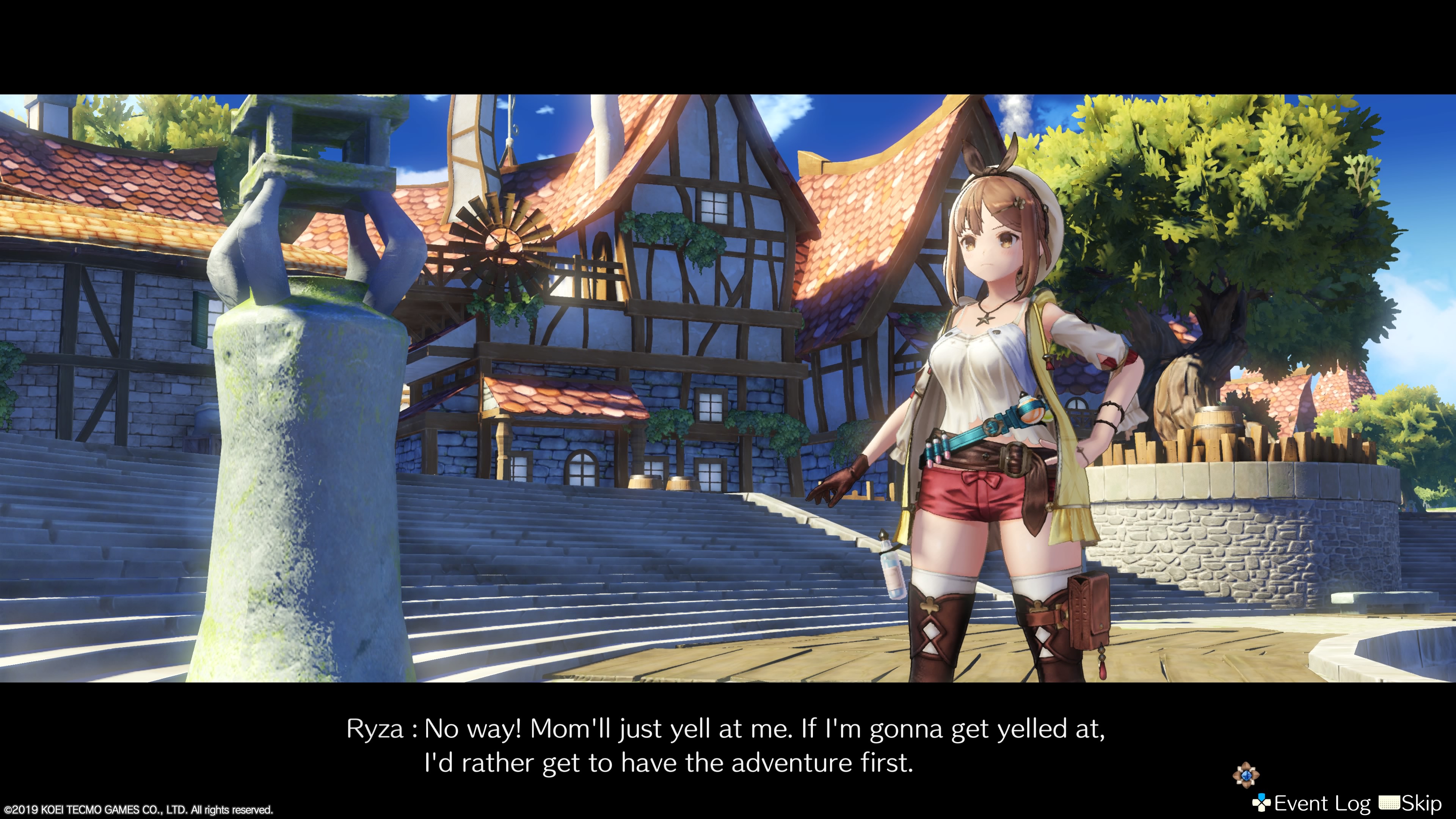
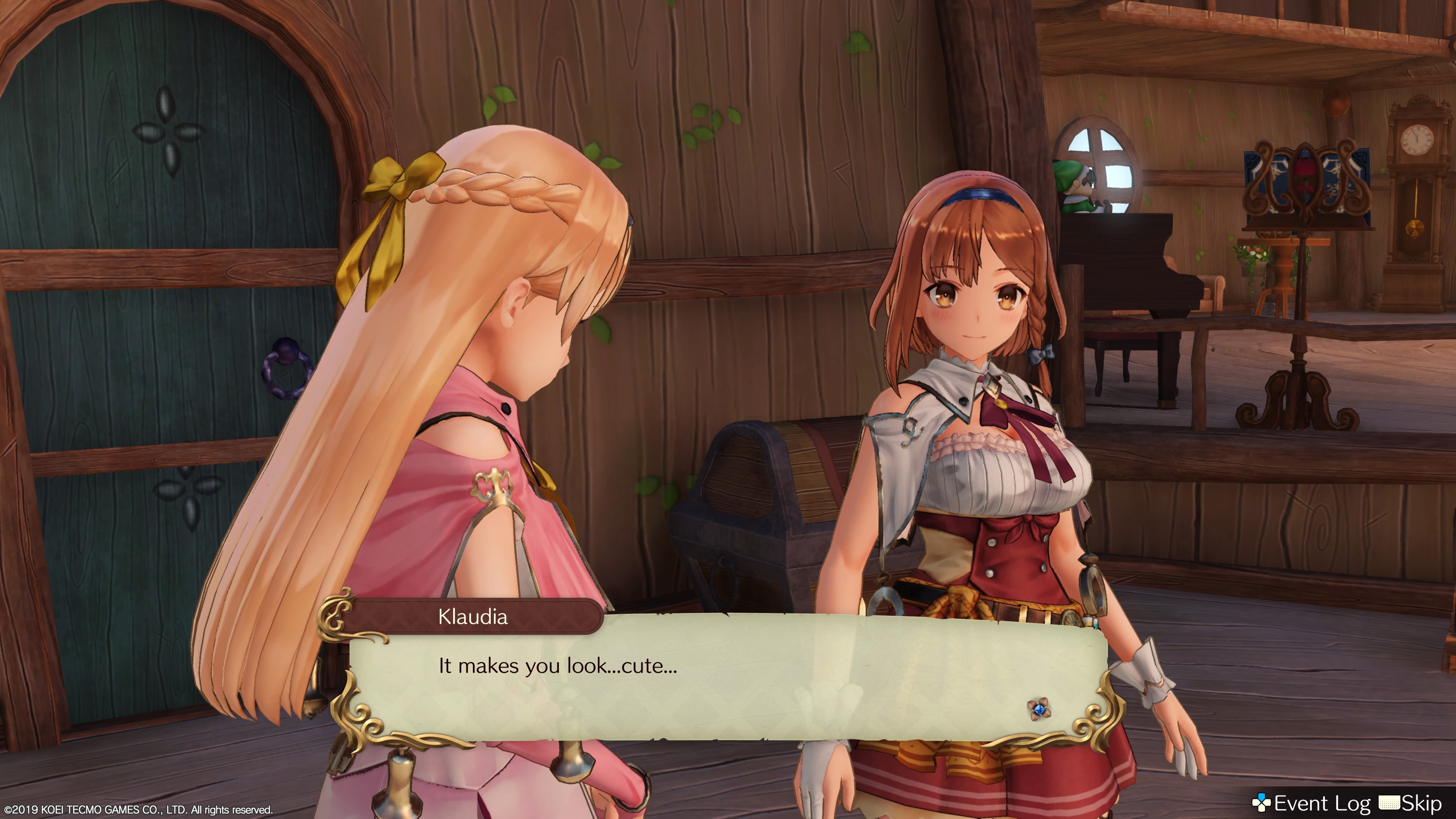
You have the titular character, Ryza herself, who is sort of a brat who thinks there must be more than this provincial life really doesn’t want to inherit the family farm. She eventually evolves into… well, sort of a bratty Tony Stark, always inventing new things without knowing quite what they’re going to do.  Some of them explode.

She has a pair of childhood friends, and I will forgive you if you just call them “brains” and “brawn” but their real names are Tao and Lent.  They mostly get exist to get sucked into her crazy misadventures.

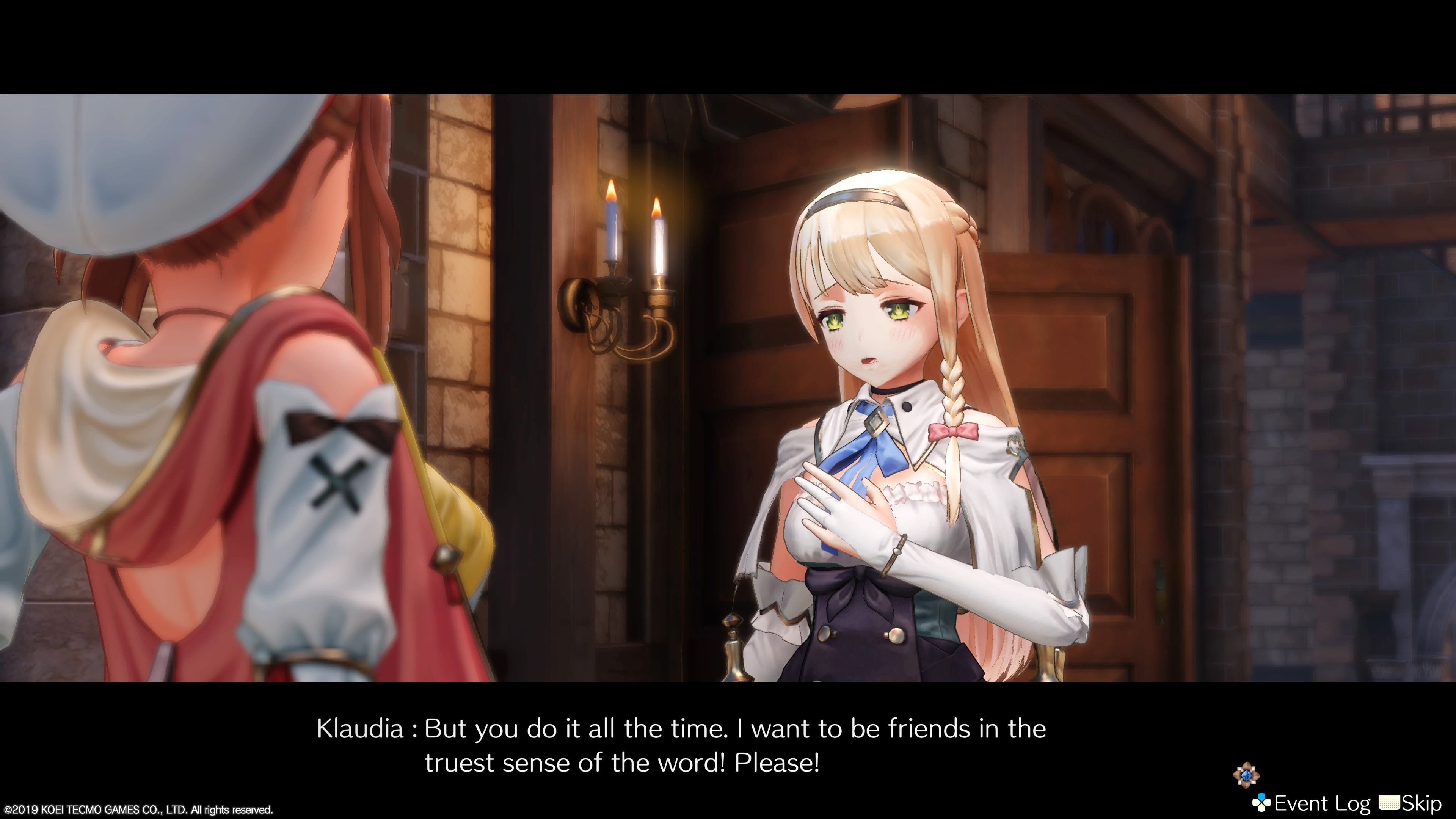
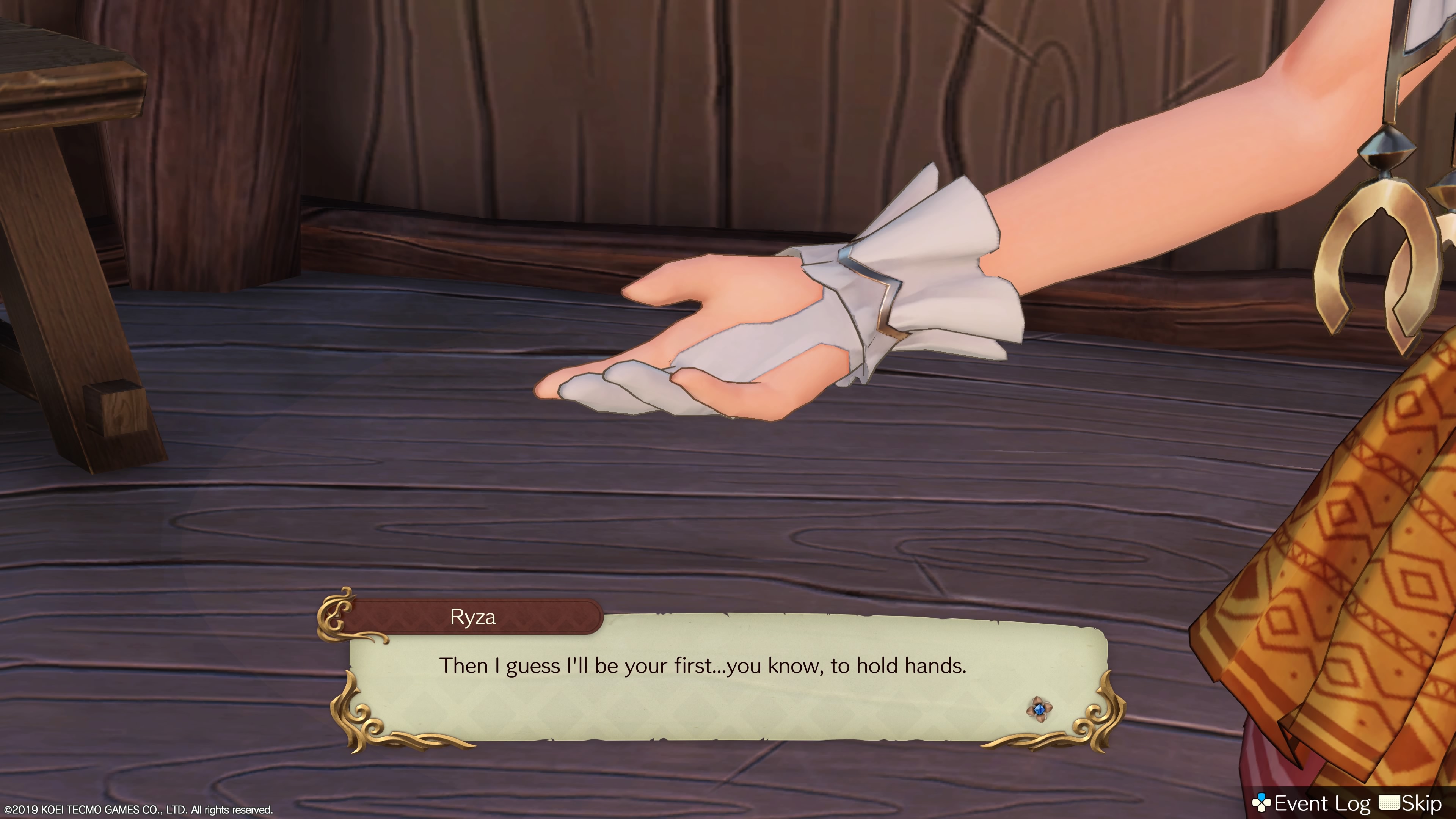
She picks up a traveling merchant’s daughter, who represents the barely veiled actually not veiled at all love interest.  Ryza herself appears to be completely clueless that the party’s token buffer/healer is crushing on her.
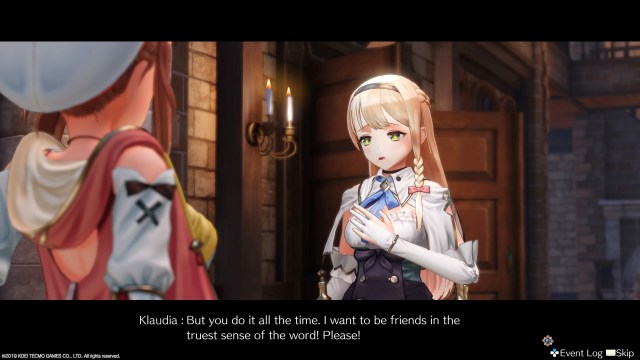
…well, at first.

LEWD.

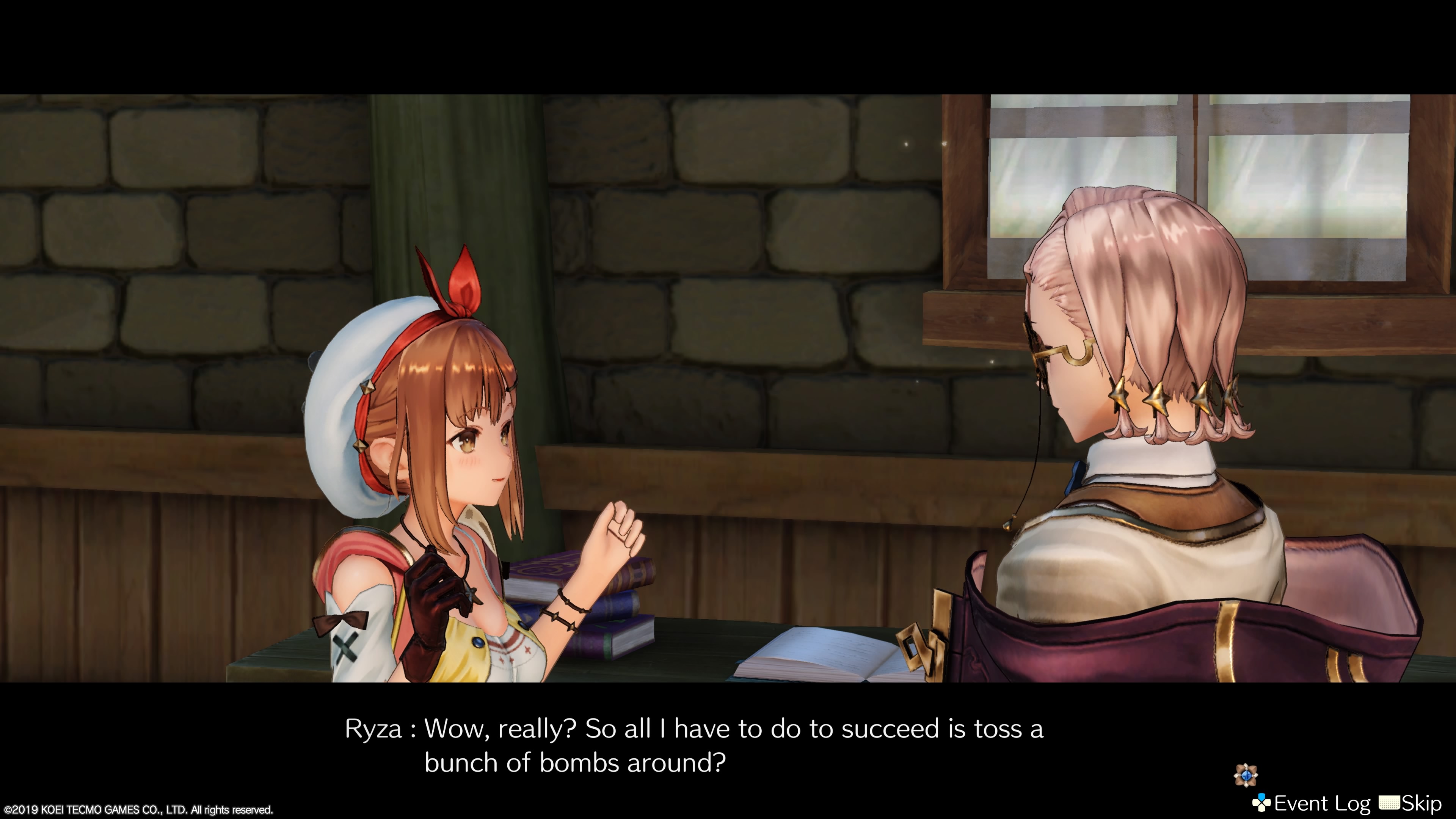
She also gets an Alchemy mentor who teaches her the subtle tricks of the trade.

…and the alchemy mentor comes with some extra muscle.
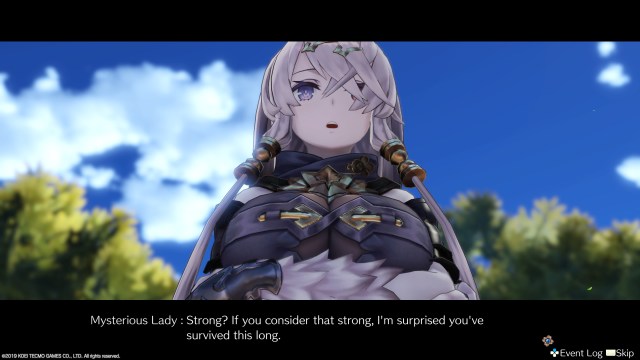
In this screenshot, you can see her eyes.  That isn’t necessarily always the case.

Some cutscenes are less than subtle with the camera angles, is what I’m saying.

Lila’s ample… tracts of land and some moderately-inappropriate bouncing on the 17-year-old main character aside, there’s really nothing objectionable about the game.  You could probably play this around friends or a spouse without more than the occasional eye roll.

Well, my wife did say a couple of things about Ryza’s Daisy Dukes, but there were several other outfits I could pick from.

I realize I may be sounding a bit negative at points in this, but I think most of the things that annoyed me were simply me needing to learn how the Atelier series works.  There were 20 games before Ryza, after all, and presumably there are a bunch of long-time fans who don’t need to be hand-held through the alchemy bits.  While I’m not going to jump right into Ryza 2, I’m expecting a lot of the stuff I learned from Ryza 1 to simply carry over when I do.

Overall, it was a nice comfy RPG with lower-than-average stakes and characters I didn’t mind hanging out with for 30 or 40 hours.  You’re not trying to save the entire world, you’re just trying to help the village and the people you grew up with, and you’re making friends along the way.

Well, and blowing stuff up.  FOR SCIENCE.


Posted in PS4, videogames | Leave a comment

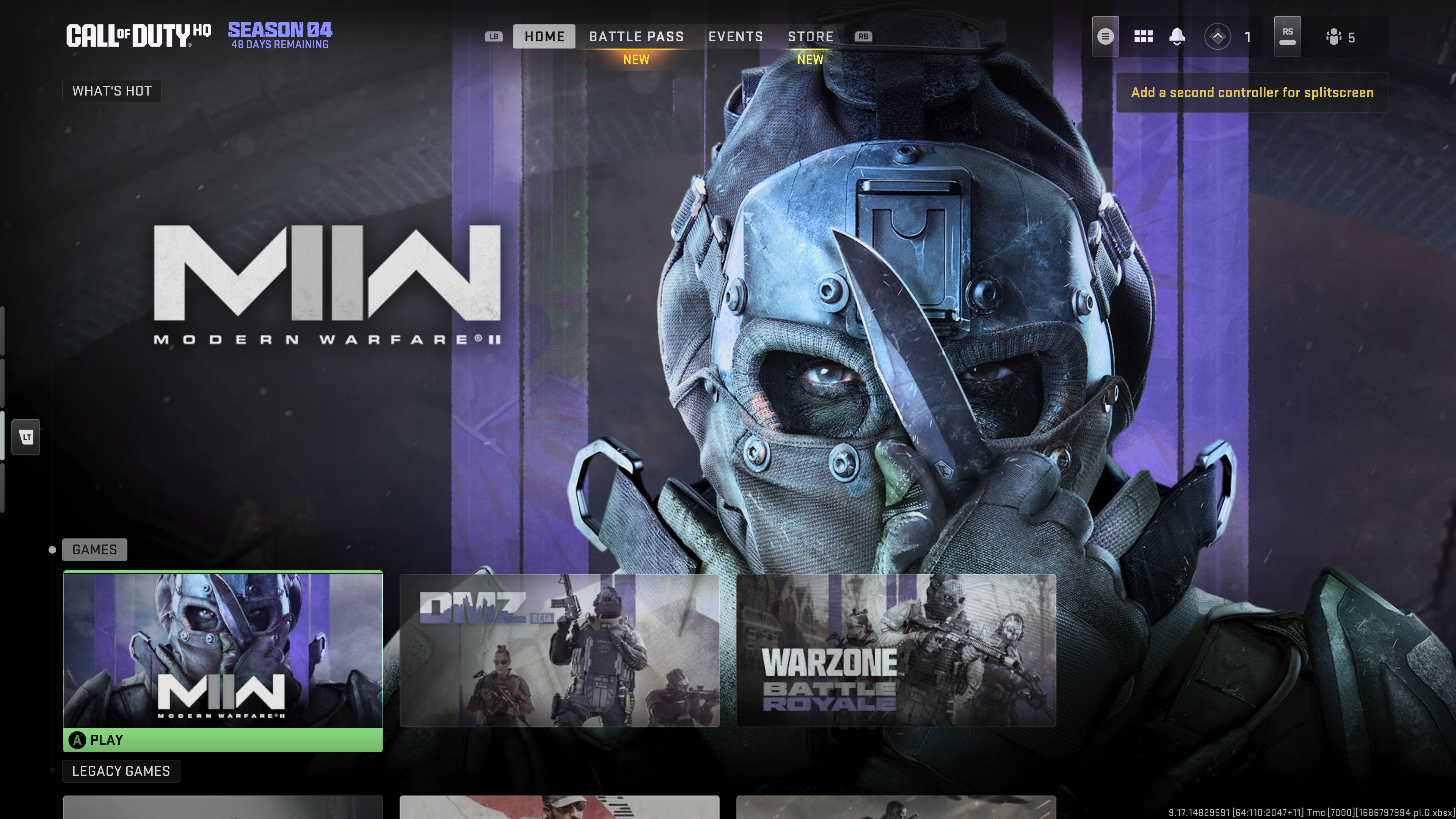
COD:MEWTWO. Completely different from CoD: MEWTWO.
After playing a dozen Switch games, it was kind of weird going back to the Series X and jumping into the Biggest of Big Budget games, but it turned out to be a pretty good change of pace.

I have a hard time keeping track of the stories in the assorted Calls of Duty, despite having played nearly all of them over the years.  I tend to play them out of order, with long gaps between, so the Big Reveals and character callbacks are largely lost on me.  One of these days, I should probably do what I did with the Halo series a few years back and just play through all of them in order, with supplemental lore material thrown in as I can.

Presuming there IS supplemental lore material.  I haven’t looked.  It’s very possible there’s like a forty novel series that is central to understanding why you are inserting bullet A into bad guy B in a variety of exotic locales, and if that’s the case then I may have to pass on the supplemental lore material.

Back to the game, though.

It’d be kind of silly to talk much about the actual gameplay of any given Call of Duty title, since they sell millions of copies, but since less than 13% of people have apparently finished the campaign mode I can at least talk about what I enjoyed there without feeling too silly about it.

Simply put, it’s a thrill ride.  Or, rather, an amusement park full of thrill rides, with a ton of variety.  While there are certainly levels that just consist of “run forward, shoot mans”, there are times you’re piloting an aircraft and providing cover for a ground team, or suddenly in a stealth-based level where you are gathering materials to craft crude tools, or trying to catch up to a fleeing SUV while jumping from commandeered vehicle to commandeered vehicle and dodging land mines.  The variety of stuff you DO on the wild ride from opening credits to ending credits and mid-credits teaser for the next game is just all over the place, and I was down for roughly 98% of it.

That remaining 2% represents some unkind thoughts about the sudden BOSS FIGHT HERE that is the culmination of level 16 of the campaign, but fortunately level 16 is the next-to-last level and the game ended with a gloriously manly sequence that washed the bad taste out of my mouth.

What really sets the series apart for me, however, is getting to see just what the game’s art and level team gets to do with functionally unlimited money, because the amount of detail that gets crammed into the various exotic shooting galleries you run through is just nuts.

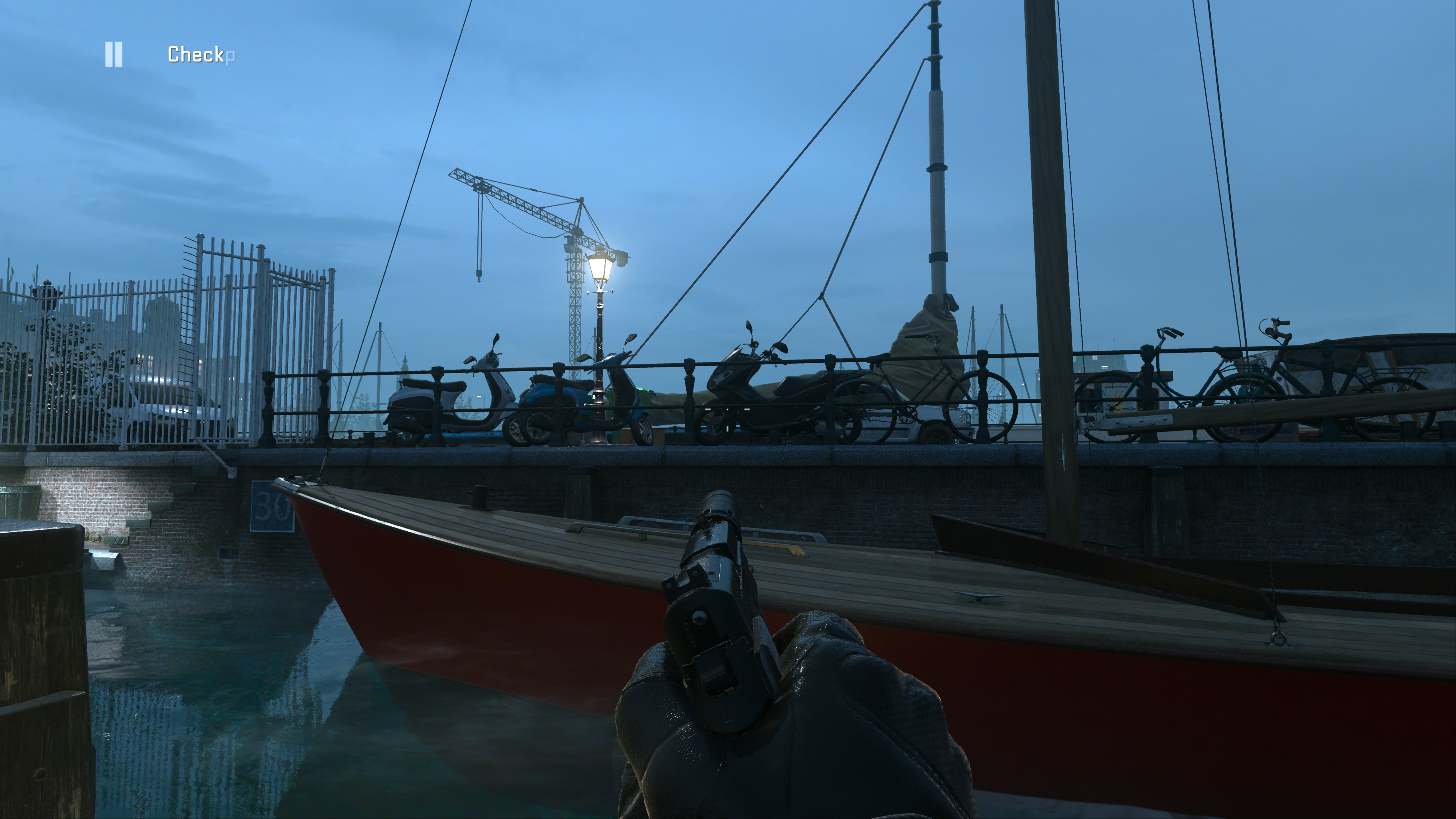
Also I love scooters and this game has a ton of them.

This one in particular is VERY similar to the Burgman I ride on a regular basis.

A bunch of smaller 50-150cc scooters, and another Burgman or similar, silhouetted against a moody Amsterdam sky.  I was supposed to be hunting down terrorists or something at this point.  This was the level where you spent a lot of time swimming around and murdering people standing on docks.  it was a good time for anyone not standing on a dock.

More obsessively-detailed set dressing:

I’m not sure what’s going on with this computer.  There’s no CPU cooler, but there’s a big boxy thing with a fan on it just behind the drive bays that looks like it might be a second power supply, or something?

Magazines and marshmallows.  Also whoever sits at this desk can’t decide whether pencils should go points in or eraser in, and I feel that alone is justification for the fact that I had probably shot him just minutes before taking this screenshot.  Some people are past redemption.

Someone spent a lot of money on an art degree and then spent at least a day of their life designing this cardboard box with uneven packing tape on it, and I feel that deserves recognition.  Also I love the little fake flowerpot next to the duffel bags full of weapons and bullets and explosives and stuff.

Less keen on the weird six week calendar.

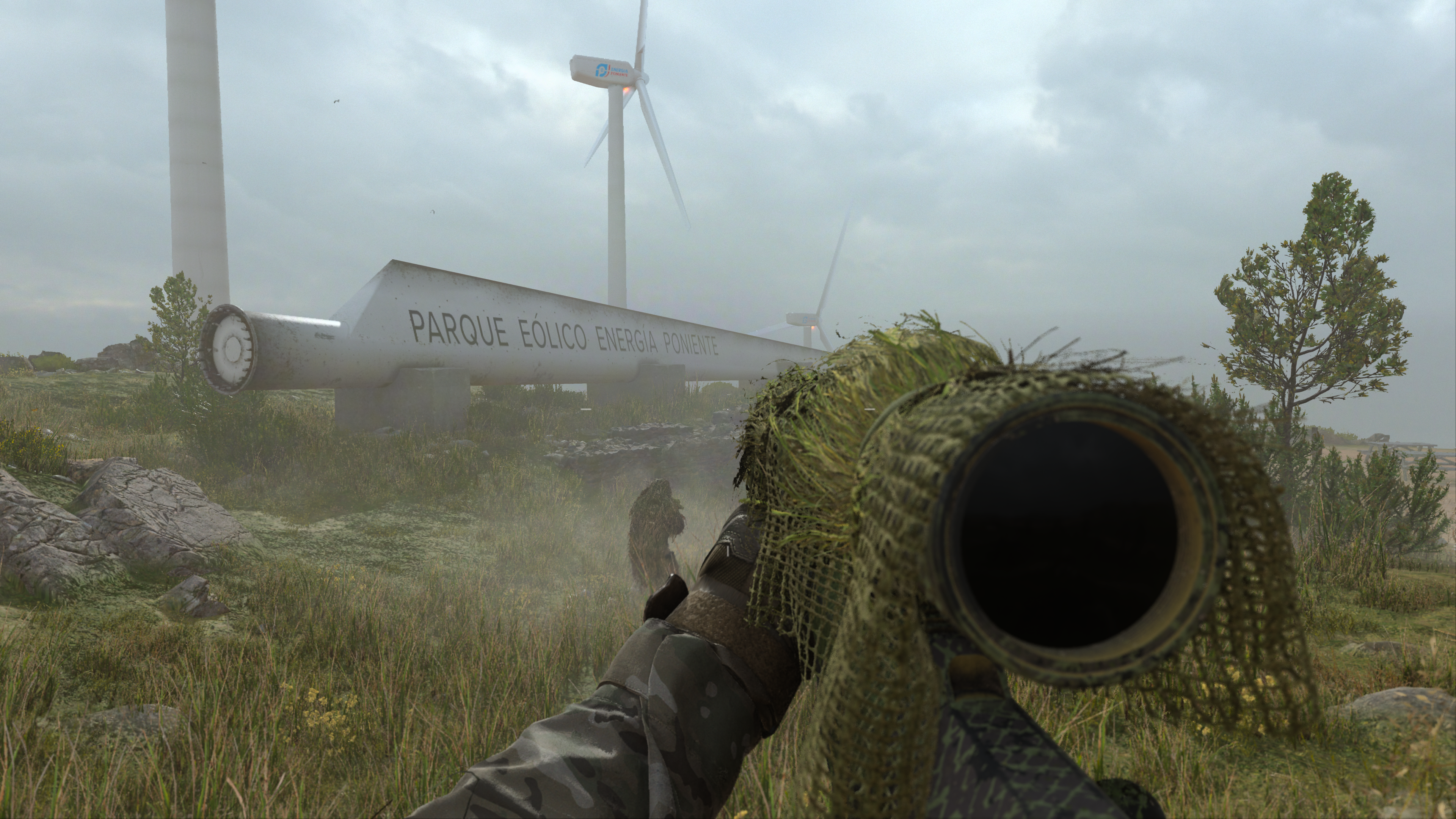
This level was like the Chernobyl level in Modern Warfare just dialed up.  Also windmills.  I didn’t notice any of the windmills missing blades.  Do they really just store spare blades next to wind farms?  I guess it makes sense to keep one or two around so you don’t need to ferry another one over if one breaks.

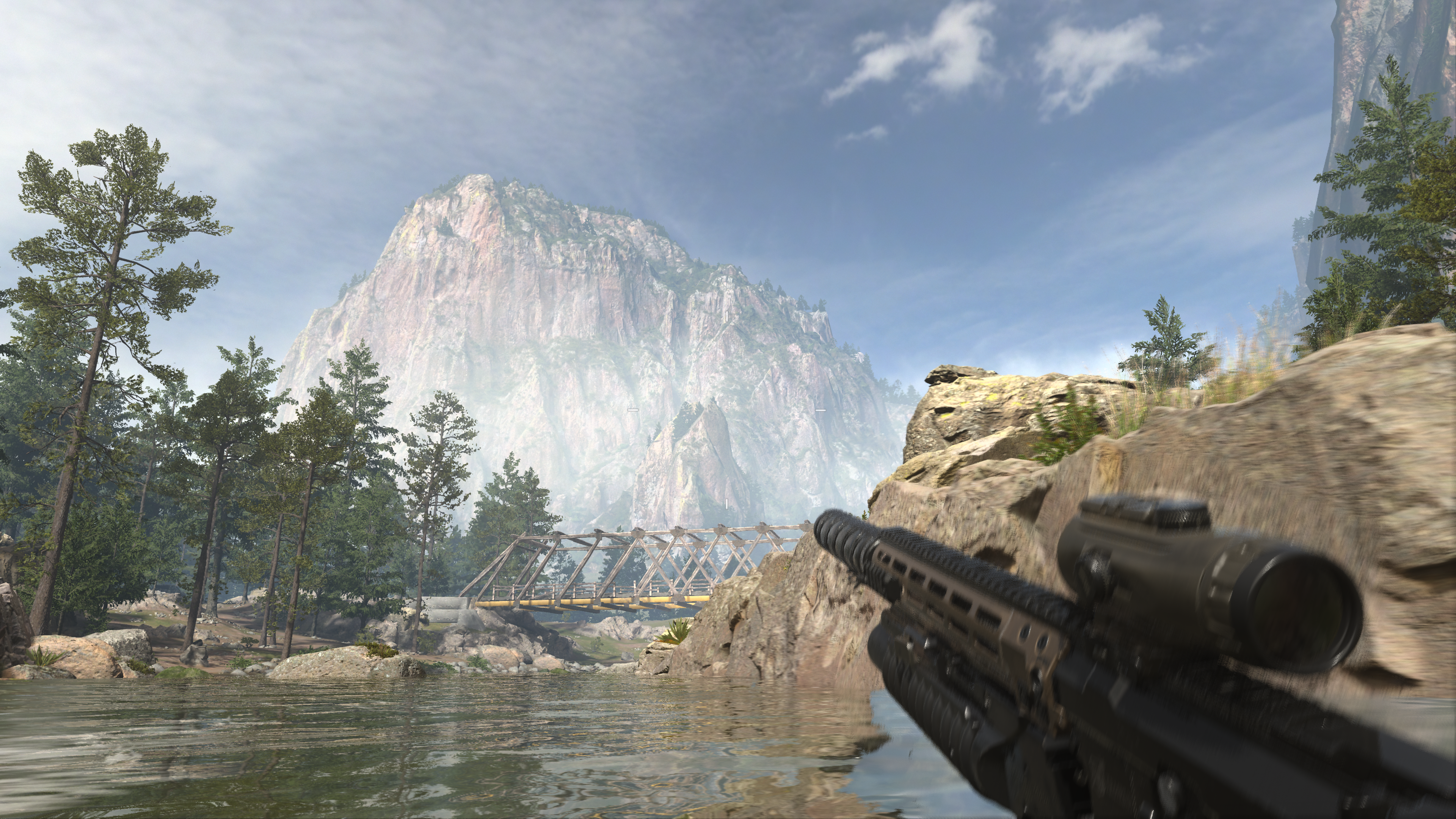
A pretty mountain in Mexico.  One of my favorite bits about the story of this game is that most of it is a cooperative thing between a dude from Scotland and a bunch of dudes from Mexican Special Forces and the dude from Scotland doesn’t speak any Spanish at the start of the game but is obviously hard at work learning Spanish throughout and seems pretty dang fluent by the end.  Like, when he’s in a black helicopter on his way to shoot a ton of dudes he is using that downtime to crack the books.

It kind of makes ME want to learn Spanish.  I thought video games were supposed to make me violent, not make me want to go back to school.

Lastly, a shot of Navy Pier in Chicago.  At least, I understand that’s where they keep their ferris wheel.  I think a lot of these screenshots were somewhat reduced in clarity when they were converted from HDR to SDR, which is a pity.  This was a really pretty night view and frankly I would 100% live on the 46th floor of a downtown Chicago skyscraper to get this view.

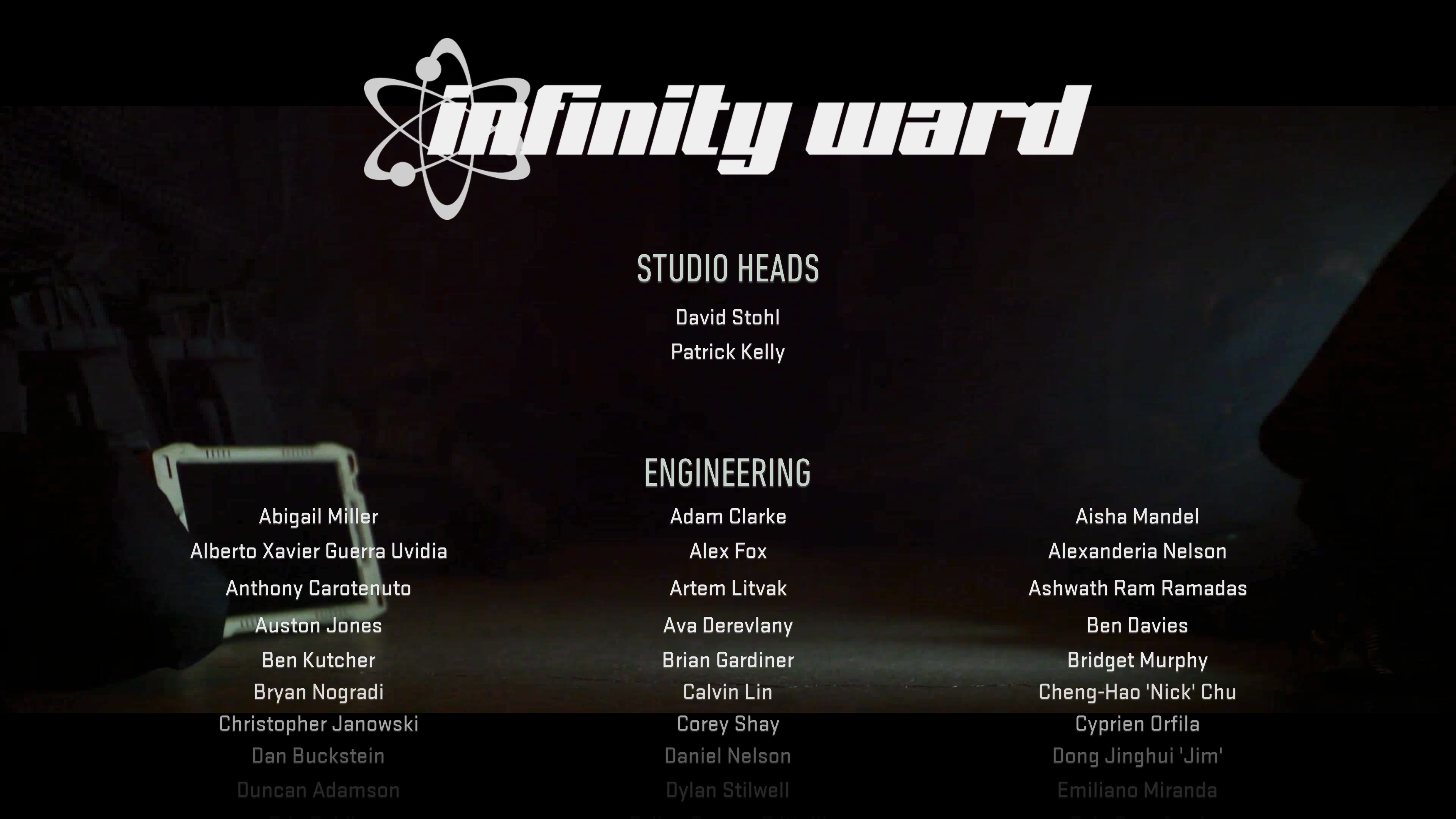
And a triumphant ending credit scroll.  It’s almost certainly an exaggeration to say that Call of Duty credits go on longer than the campaign itself but MAN do these games employ a ton of people to make.

After the ending credits, I played a single multiplayer match and managed to kill four opposing players while dying 28 times myself.  I understand that Call of Duty has matchmaking that is very aggressive about finding other players at your own skill level, and if that’s the case then I pity the poor algorithm that has to try to hook me up with ANYONE, should I give the multiplayer another chance to humiliate me.

Checking Wikipedia’s list of mainline Call of Duty games, I apparently skipped “Call of Duty: Vanguard”, which was last year’s entry.  I bought it during a PSN sale some time ago, so that’s going on the short list of to-play games.


Posted in videogames, Xbox Series X | Leave a comment

Switch thoughts, 12 games later.

It’s safe to say that I’ve gotten more use out of my Switch recently than usual.  I just wrapped up my 12th game in a row with Qureate’s Prison Princess, an escape-the-room sort of puzzle adventure game with cute girls in revealing outfits, that might have been great if the designers hadn’t decided to stick timers on the puzzles.  That is the end of my comments on Prison Princess.

I’ve never been much of a fan of the Switch hardware, as it feels like a system that tries to be both a console and a portable and doesn’t manage either very well.  It’s either an underpowered console or an pocket-unfriendly-sized portable with $60 $70 games.

Also I am still salty that they ditched StreetPass because I loved carrying my 3DS everywhere and seeing the green light come on.

HOWEVER.

There are a ton of them out there, like over a hundred million of the things, and it has mostly-standard controllers, and it’s powerful enough to run Xbox 360-era games in handheld mode while only costing a couple hundred bucks if you buy the doesn’t-actually-“Switch” version.

That many potential customers, and a robust eShop that finally has a mostly-modern account system, means that it’s an easy place to publish the most niche of niche games and you (probably) won’t have to worry about the sorts of ham-fisted content moderation policies that Sony has become known for lately.

With all of that added up, it’s turned into a pretty impressive way to play lower-spec games, or stuff that would otherwise be locked on decaying legacy hardware, or things that just make more SENSE on a system that turns on in seconds and doesn’t need a TV.  It’s perfect for the visual novels and weird food stall management games and unexpected revivals of forgotten titles that I have been playing recently, or to boot up the Arcade Archives release of Moon Patrol for when I want a heady hit of pre-teen nostalgia.

Though, to go back to being a bit of a downer, it rather feels like Nintendo is kind of coasting on the success of the system and letting the hardware stagnant. Like, they COULD go through all the trouble of hardware R&D and then publish a new Mario Kart for a new system, or they could just sit back and count the money rolling in for the one they already have and where the development costs were spent years ago.

I was certain there would be a new Switch for 2022 when Splatoon 3 came out, then absolutely positive they wouldn’t launch a new Zelda game in 2023 without one, and now I have no idea whether they’ll bother before the system turns 10 in 2027.

They probably won’t wait until 2027.  That would be just nuts.  And it’s not like I NEED a more powerful system to emulate Moon Patrol on.  Right?

Posted in Switch, videogames | 2 Comments

Let me be your HOG.

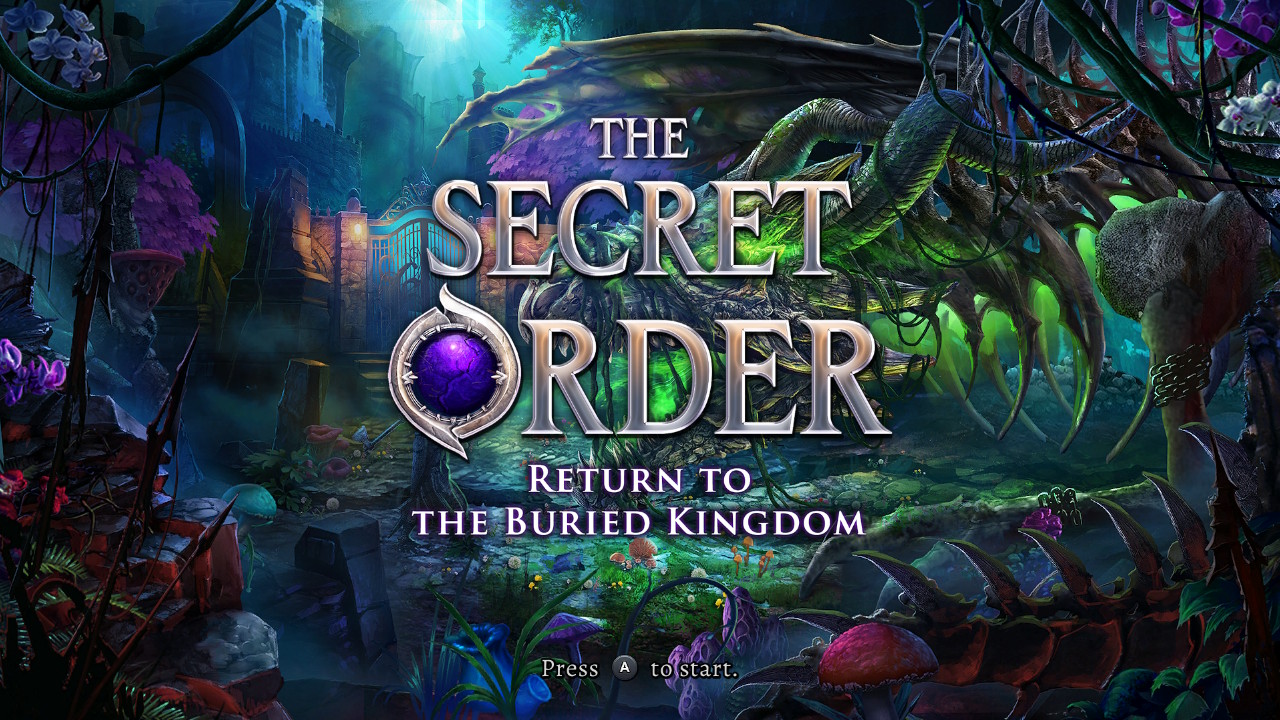
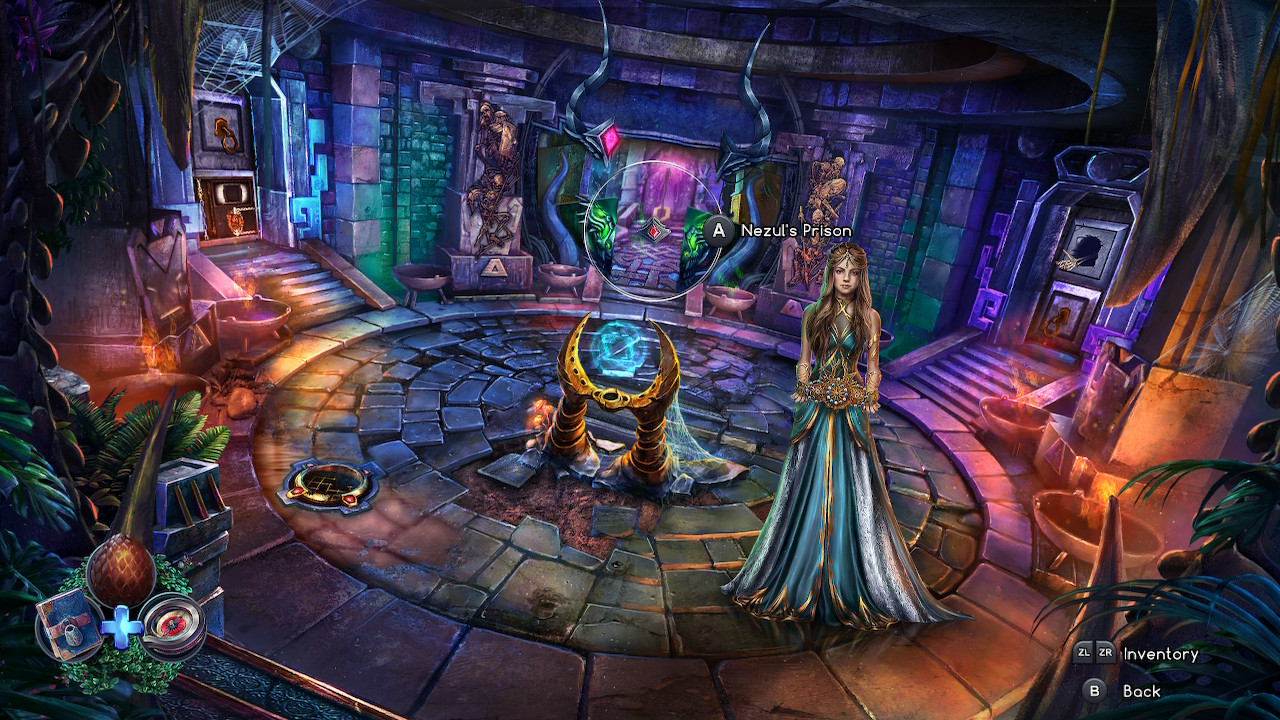
I haven’t played many hidden object games in the last few years, but I recently stumbled across the eighth entry in Sunward Games’ The Secret Order series on the Switch eShop, and since I’d played the first six games I figured I may as well see what Sarah Pennington has been up to.  Not sure how I missed #7, but maybe I’ll track that down later.

For the uninitiated, Sarah has been living a very odd life since the events of the first game, where she was a perfectly ordinary person living a perfectly ordinary life until she was saved from an assassination attempt by her nephew from the future.  She’s been to the past (a few times), to the Amazon, ancient Egypt, etc, etc, lots of various exotic locales where the problems of the day can be solved by rummaging through piles of junk to find random things and solving logic puzzles, and this installation in the series has her going back to, well, uh…

Look, it’s right in the title.

Anyway, the last time she was in the Buried Kingdom she made friends with a baby dragon and restored the proper ruler and all was well, which naturally couldn’t last.

Look, the plots in these things are usually pretty flimsy.  Bad guys are bad, good guys are good, it’s all about the art and the puzzles.

And this game IS pretty, with lots of the colorful environments you tend to get in any HOG and some very detailed characters.

Yes, you talk to a skeleton who is also a harp.  Which is pretty metal.

Admittedly, compared to Live2D or E-Mote, the actual character animations are pretty stiff and unremarkable.  It would be interesting to see Sunward combining an animation system like that with their more detailed characters.

The art style extends to some of the weird things you have to pick up and carry around until you’ve found the right place to use them to solve a puzzle, after which time you typically discard them without a thought towards future purpose.

Well, you use this thing twice, because it’s an axe on one side and a hammer on the other.  Unique tool, indeed.

And for some reason the developers put a mimic in the game?  You carry this around until you find a rope that needs something heavy on it to serve as a counterweight, then the mimic gloms onto the rope for you.  I’m actually OK with using this once and never again.


Unfortunately, while the art is top notch and the story had just enough weirdness to it to be interesting, the game as a whole is a bit of a letdown.

First, while this is a hidden object game, I had a heck of a time actually solving hidden object scenes on the tiny Switch screen.

I wound up needing to switch the game into “tile match” mode most of the time.  This lets you play a round of concentration to clear the hidden object scenes, and that was kind of a disappointment.  One of the big draws to any HOG is that it scratches the same itch as looking for “Nina” in a Hirschfield drawing or spending more time looking for the bunny on a Playboy cover than you do ogling the cover model, and playing a HOG as not-a-HOG doesn’t give you nearly the same feeling of being clever.

There is something about being told that you need to find a “bow” in a scene and needing to figure out whether you are looking for a projectile weapon, a violin bow, or a hair ornament, and whether it will be right out in the open or maybe just barely visible as an object in a painting, and I didn’t really get to enjoy that because it was frustratingly difficult to find things on the Switch’s screen and the virtual pointer didn’t really allow for precision clicking.  Some sort of zoom or magnification setting would have been really helpful here, or letting you use the touch screen to select things rather than forcing the use of the joycons.

I realize that I have just seriously dated myself with the earlier references.  Fortunately, the average HOG enjoyer is probably old enough to get them.

Second, it’s super short.  Like, you can make any hidden object game shorter if you abuse the “where do I need to go” button and fast travel, much less the hint button and puzzle skips, but this is blink-and-you’ll-miss-it short.  There aren’t very many hidden object scenes at all, and few puzzles that aren’t a matter of just using every item in your inventory on them until one of them works.

This is published by Artifex Mundi, who tends to have pretty steep discounts on their eShop games when they go on sale, so I suspect I paid closer to $3 than the $15 list price they ask for this. At $3 it’s a good deal for about 3 hours of light puzzle solving.  At full price I would have been upset.

Maybe I should figure out which game was #7 and give it a go.  I suspect if I actually play it on the TV instead of in handheld mode I will have much less to grouse about.

Posted in Switch, videogames | Leave a comment

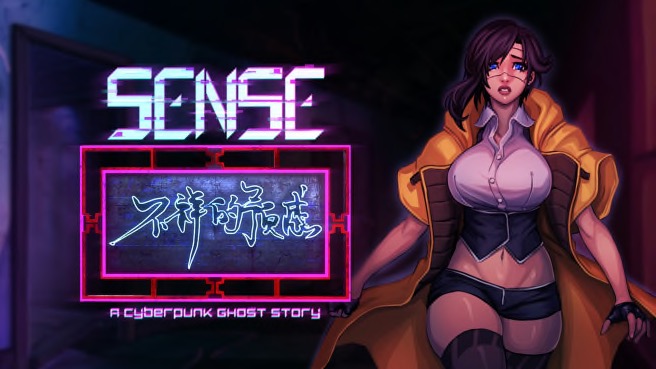
Sense – A Cyberpunk Ghost Story

It has been a very – VERY – long time since I have played a traditional adventure game, the kind where you wander through some sort of fantastical setting picking up every loose object you can find and trying to apply them to puzzles that make sense only in the game designer’s twisted logic.

To be honest, the last one I played may have come on floppy disks.

I’ve played a ton of “Hidden Object Puzzle Adventure” games in the intervening years, of course, but those tend to be very friendly and point out which locations still have stuff to find and where you might be able to use the latest thing you’ve just collected.  Many of them also have fast travel to avoid annoying backtracking.

Sense is not as nice about this.  It’s not as obviously-designed to sell hint books as the Sierra adventure games of yore, but there is an awful lot of needing to slowly walk back and forth, going into rooms you’ve already seen a ton of times, to find exactly the right spot to use the thing you’ve just picked up or to find the thing that you have walked past a dozen times that your character has finally realized is worth collecting.

So why’s it worth playing, then?

Well, apart from the blatant pandering to baser instincts displayed by the main character, it’s a really atmospheric horror game set in the sort of cyberpunk future that we used to envision 40 years ago.  Well, sorta.  Your character LIVES in 2083, but 90% of the game takes place in a haunted apartment complex that was sealed up in 1983 after things went horribly wrong.  Your only glimpses of 2083 come at the very start and end of the game, and in one tiny segment where you actually go outside to get between wings of the building.

I would not want to live in this 2083, but I’ve always associated the cyberpunk genre as “tech + decay” and this particular version of Future Seattle is beautifully realized for that aesthetic.

So, with a virtual setting of 1983, the tech inside the apartments themselves is… well, sparse and extremely analog.

Saving is done by finding betamax tapes and then betamax VCRs where you can record your progress, for example.  This is Survival Horror for Gen X Nerds.

With most of the game taking place in a very run-down and falling-apart 1983 apartment complex, I could understand some serious disappointment if you read the game’s title and expected to be jacking in to cyberspace and pulling off some William Gibson hijinks.  In fact, the main character is just trying to meet someone for a first date – hence the flimsy justification for the dressed-to-kill outfit – and has to go into the bathroom to calm her nerves while she waits for her date to show up.  When she comes out, everything has gone all to heck and suddenly she has a whole lot of ghosts to deal with while trying to escape the apartments she’s become mysteriously stuck in.

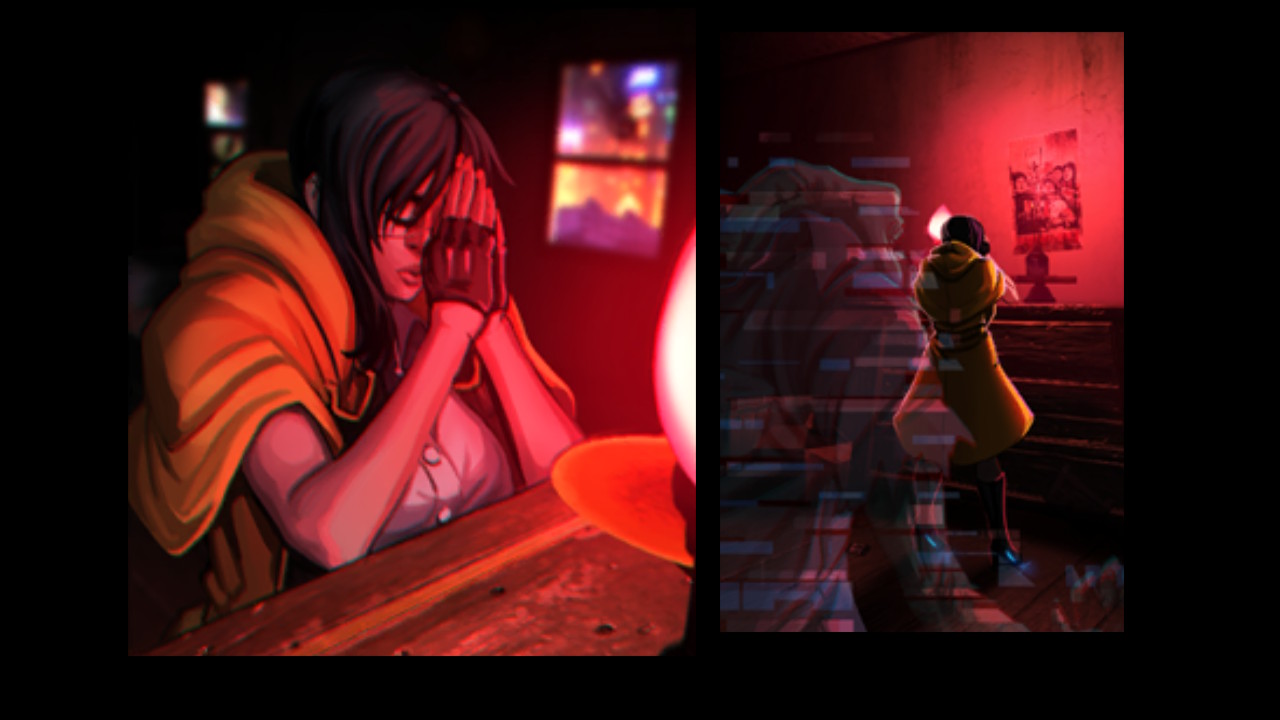
Some of these ghosts are simply mischievous – I loved the one that would steal items from your inventory and, ahem, spirit them away to its lair – some are actually friendly and some are downright malevolent.  Your mission, should you choose to accept it, is to find a way to lay them all to rest.   Each purification comes with a little comic-panel-style cutscene, and some of them are quite emotional.


The developer cites Fatal Frame as an inspiration, and while there’s no camera-related combat it definitely has some of the same feeling of wandering through the aftermath of Something Bad Happened and trying to piece it together from environmental clues.  There’s a lot of examining items and journal reading in your future.

It also has a related easter egg that gave me a huge grin when I examined a camera I found in one of the rooms.

I would also like to mention that the music and sound design are top notch.  Those are a big part of making an effective horror game, and I felt this nailed both.

The actual experience of playing the game, as I kind of alluded to earlier, is… well, clunky.  Setting the sometimes-obtuse puzzles aside, there’s a number of occasions where you can be doing things entirely out of sequence and the game does not adapt well.

For example, you don’t actually encounter many downright hostile ghosts until you’re about halfway through the game, and your character needs to learn how to exorcise them.  Straightforward, right?

Except you can skip the bit where you learn how to perform exorcisms and then suddenly find yourself in a cutscene where you are sealing away a ghost like you finally remembered that Exorcism 201 course you took back in community college.  I suppose it’s better than a painful death scene, but maybe locking the character out of the conflict until they’ve gone through the story justification to get there would have been better.

There’s also some combat, though it’s blissfully rare, which features you kind of vaguely waving this enchanted sword thing at ghosts and hoping the collision detection goes your way.

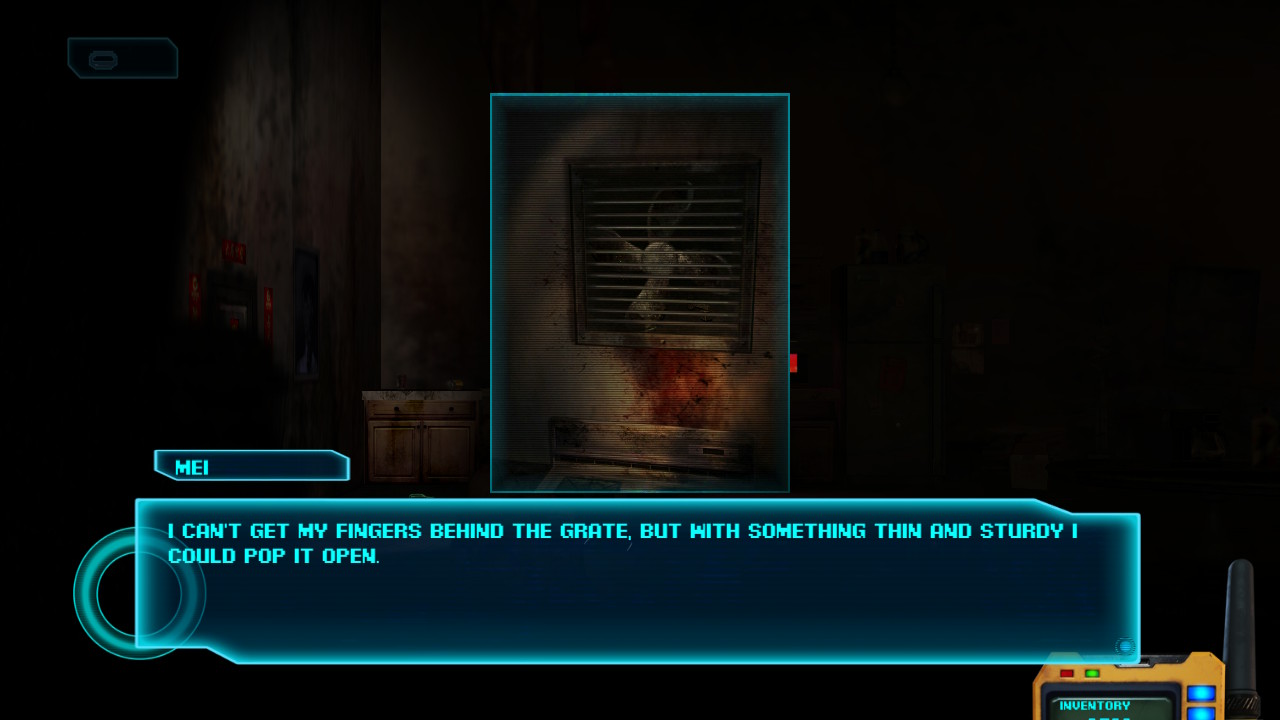
And, like every adventure game in history, it is plagued by Single Use Items.  This grate, for example, is something you run into very late in the game.  By this time you have used and thrown away a number of crowbars, knives, and screwdrivers, but when you get to this grate you now need to rummage around until you’ve found a letter opener to get into it.

The last negative thing I’m going to say is this: Sense is available for the Switch, Mac, Linux, Windows, Playstation and Xbox.  If you have any choice at all, do not play it on the Switch like I did.  For a game that doesn’t seem like it should be taxing the system all that much, it suffers some really obvious slowdown throughout.  It was written by a three person team, and I stumbled across a Steam forum post from the developer apologizing for the Switch performance and saying they weren’t able to optimize it further, so at least they tried?

So, would I recommend this game?

Well, hmm.  Yes.  If you are able to get into the setting and atmosphere, you can probably forgive the clunkiness and slow pacing.  There’s a demo version on Steam to check out, which should help seal the deal one way or the other.

Posted in Switch, videogames | 1 Comment

Gunma’s Ambition: What did I just play?

So, Japan has a reputation for putting out weird games at times.  And I’m very guilty of pointing at something like Umamusume and saying “look, Japan so wacky!”.

But, really, that’s just girls who are idol singers and also horses.  It’s (cute thing + cute thing + someone’s fetish) and that’s not weird so much as it’s just cashing in on the weak-minded who will trade money for horsegirl .pngs.

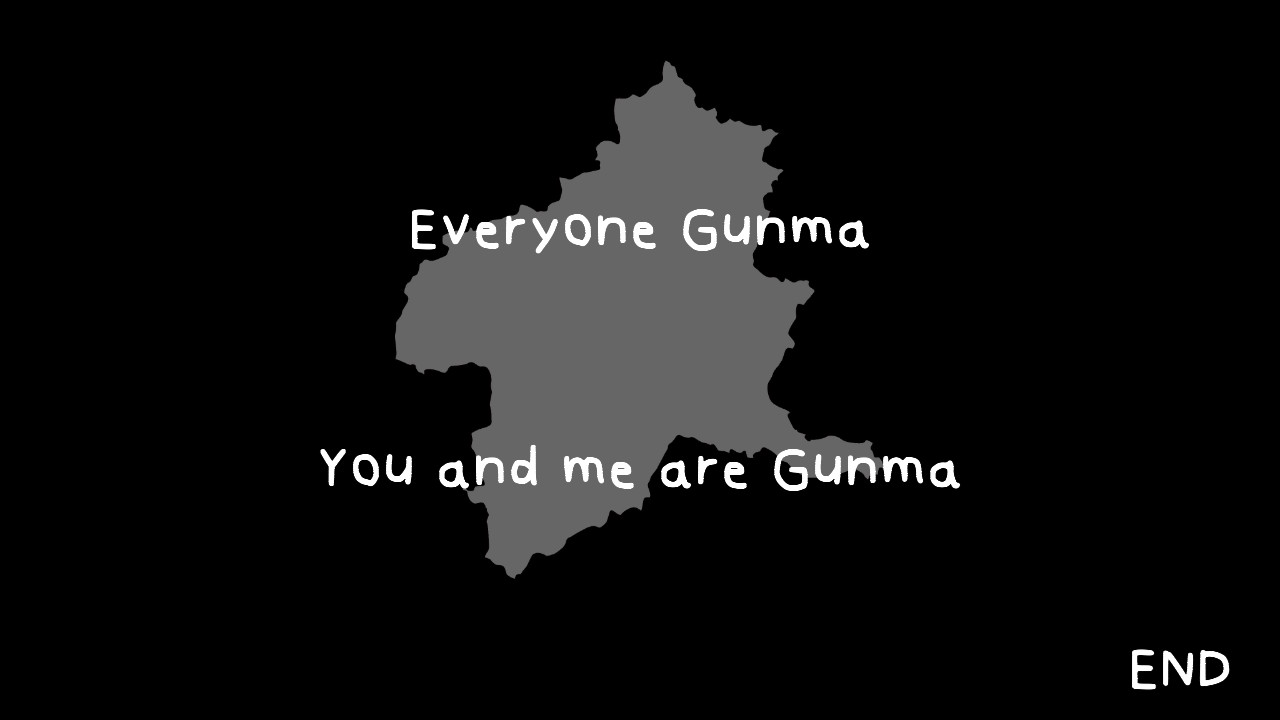
Gunma’s Ambition: You and Me are Gunma, now this is a weird game.  It’s the sort of thing that we got on phones back before every game became a f2p micro transaction nightmare, and it fits perfectly with the general vibe of the Switch.

I know nothing about Gunma prefecture.  I’ve only ever heard of it because J-list makes their headquarters there, and also it shows up in an episode of Rail Wars! which is a fine anime about trains and you probably should just leave that statement right there and not google image search it.

Now that I’ve played this game, I went over to Wikipedia to see if it could tell me more, and apparently it’s one of Japan’s few land-locked prefectures and is historically associated with horse (actual horses, not girls who are horses) culture in Japan and there’s not really much more to it.  But someone obviously really likes it, because this game is all about Gunma.  Specifically, you are converting every other prefecture in Japan into Gunma and maybe even picking up some geography and local knowledge along the way.

This probably takes some explanation.

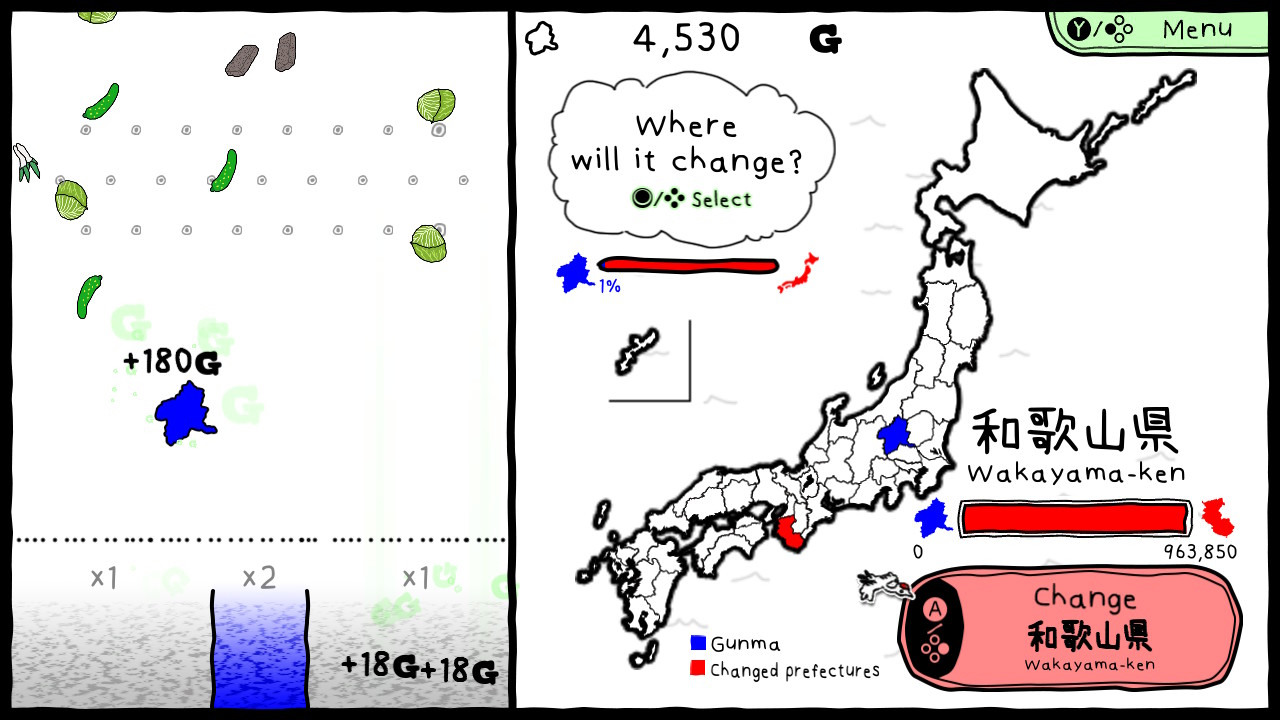
The main playfield of Gunma’s Ambition is on the left side of the screen, where an endless stream of local food and cultural objects falls from the sky.  Any you catch give you points, but you still get a few pity points for ones you miss.  There’s a multiplier zone in the middle and things you catch there are worth more.

On the right, you choose a prefecture to convert into Gunma.  You should probably start with the smaller ones and then work up from there.

After you’ve chosen a prefecture, you can spend points to draw cards from a Daruma.  Each card will either have a city or a prefecture on it, and the population of the place shown on the card will be applied to the prefecture you are converting.  Once you have converted every person in the prefecture to Gunma, it turns blue and you can move on to the next set of victims.

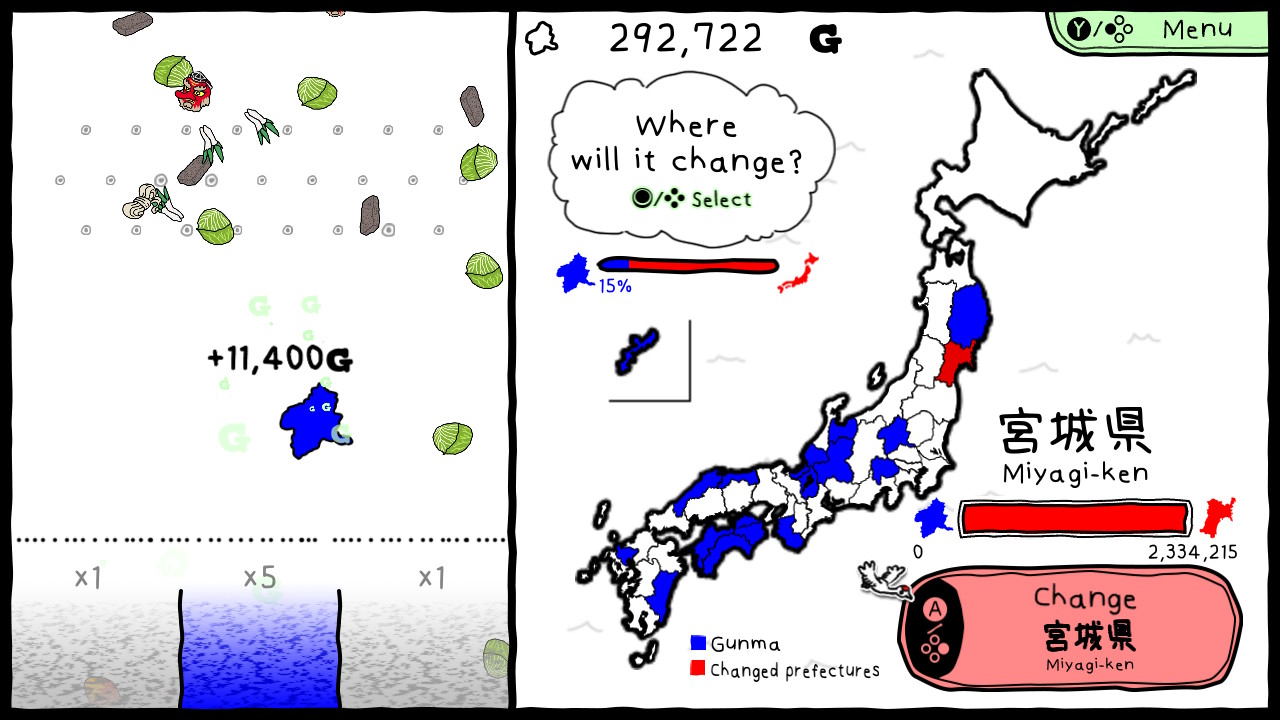
Initially, the stuff you’re trying to catch gives only a few points, and buying cards is pretty cheap as well.  Costs ramp up pretty steadily, though, so you periodically need to spend points in a few …skills?  I don’t know if I’d call them skills.  Stuff that makes the bar fuller faster, because this is a game all about filling bars.

Here I have a 36x multiplier on points, have made the bonus area larger and more valuable, and have increased the size of the little bouncing Gunma that I use to pick up items.

Should I mention that every single time you pick up an item it plays a sound bite of the word “Gunma”?  Gunmagunmagunmagunma, all set to cheery music.  I think this game may be violating some human rights regulations.

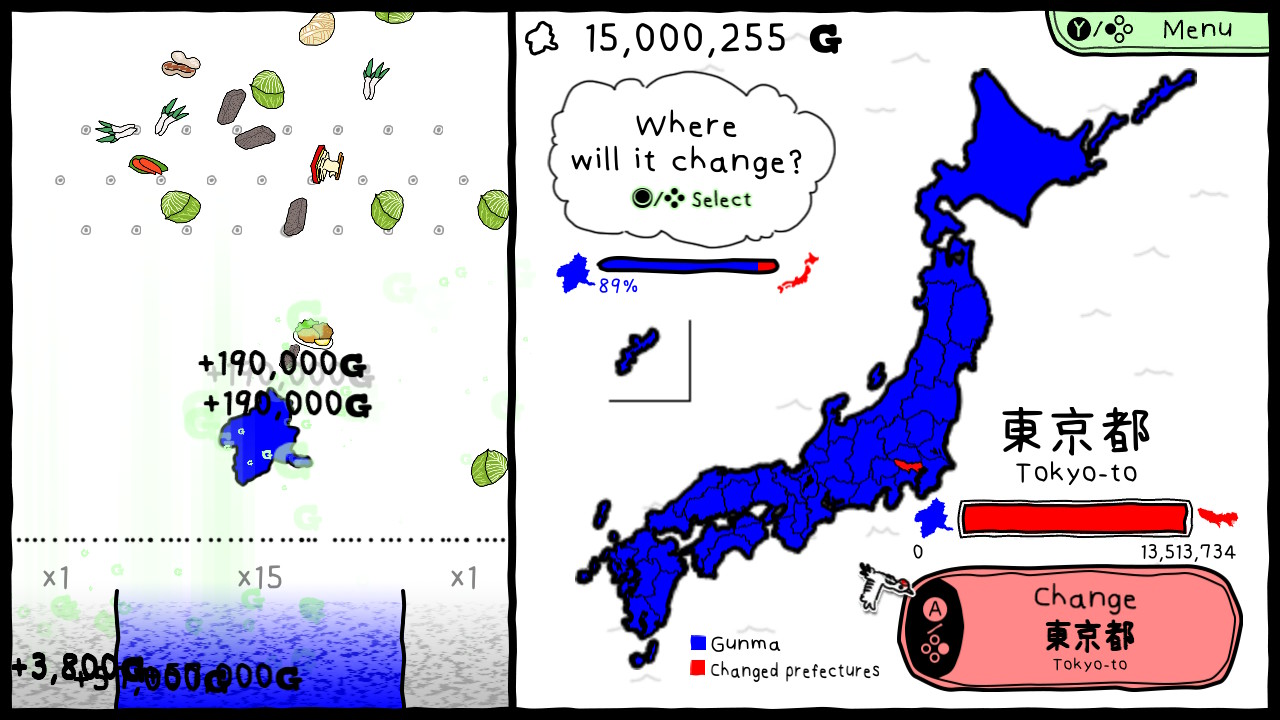
By the time you are working to convert Tokyo to Gunma, you have some truly big numbers going on.  While the early game is characterized by needing to be economical and strategic in your choices, this late game is just trying to spend points faster than you can make them and generally failing because your income is bonkers by this point.

Finally, once you convert all of Japan to Gunma, there is a bonus stage which I will not spoil because I wasn’t expecting it and it put the biggest grin on my face.

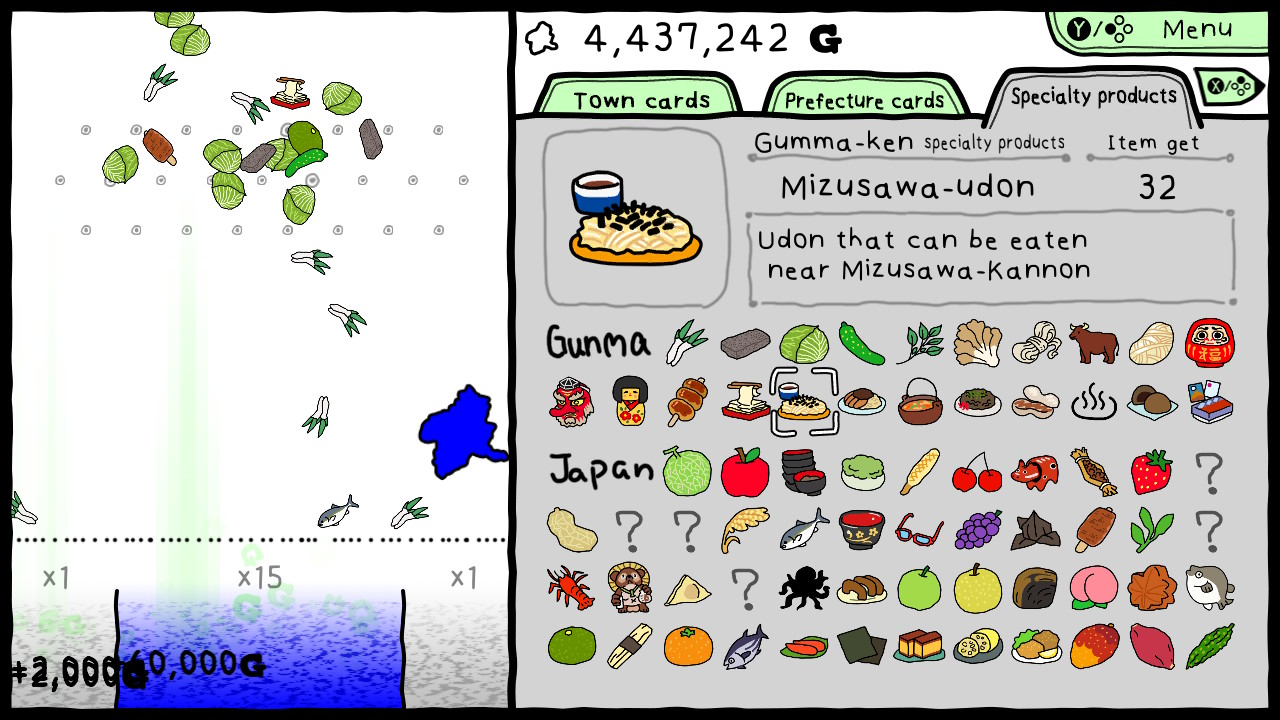
While you’re gathering food and collecting cards, you fill out a dictionary with little information about towns, prefectures, and cultural specialties of the various regions of Japan.  If you ever wanted to know the official flower, tree, and bird for any given Japanese prefecture, this is your reference guide:

The best thing about Gunma’s Ambition, apart from the way you fill bars and spend points to fill bars better and then fill bigger bars, is that the game is always in motion.  Even while navigating game menus, stuff is still falling and you can use the L and R buttons to move Gunma back and forth to catch it – or just let it fall and you’ll get some points anyway.  Need to take a bathroom break?  When you come back there will be more points to spend.  It’s a very fun energy, and while I still have no idea WHY Gunma, I at least know WHAT Gunma and WHO Gunma.

Posted in Switch, videogames | Leave a comment

Eroge minus Ero, take two: TroubleDays

More Switch gaming, this time Qureate’s visual novel “TroubleDays”.

No, there’s no space in the name.  Yes, it bugs me too.

If I had a nickel for every story I’ve seen where the plot goes something like “Succubus is sent to the human world to take her first victim but is super naive and can’t get the hang of the whole draining-the-life-force-from-men thing” I’d probably have between fifty cents and a dollar, which may be more of an indictment of the sorts of manga and anime I consume than it is a reflection of how common the trope really is. It’s no “teenage boy must pilot giant robot to save the world”, but it still seems to come up fairly often.

TroubleDays, at any rate, drops another nickel in that metaphorical jar. Much like the last Qureate visual novel I played, KukkuroDays, it’s a neutered version of an 18+ VN and falls into the same sort of reverse-isekai magical-girlfriend category. It’s fluffy and not particularly deep, mostly there to give you about three hours of time with a constantly-embarrassed succubus named Lovelia, and doesn’t charge much for the experience.

I have concerns about my comma usage in that last sentence, but none of my primary school English teachers are likely to ever read this.

There’s a bit more than three hours here if you want to chase down all of the story endings, of course. I finished the game with an ending that wasn’t entirely bleak but was still a bit dark, then went back with a walkthrough to see the mega-happy and 100%-depressing endings.

There are a few side characters, but the game is a little low-budget when it comes to character sprites and the only character you ever see outside of rare CGs is Lovelia. I suspect this is because the game uses the E-mote system to give the characters some motion and facial expressions, and rigging a character up for that system is much more costly than just slapping together a static 2D sprite like you’d get in older VNs.

It does make for some unintentionally-amusing scenes, though.

Lovelia’s supervisor doesn’t get a sprite OR a name.

Likewise, while Lovelia has full voice acting, everyone else is mute. I did like the voice actress quite a bit, and combined with the E-mote system it made for a very expressive main character, so my only complaint here is a personal failing and that’s that I tend to skip through text-only dialog before I’ve actually read it. At least there’s a log I can look at to see what I missed when I realize I’ve done that.

There’s considerable reuse of background images from KukkuroDays in TroubleDays. At least, I’m assuming this is the more recent of the two games, so maybe the reuse actually went the other way. Both use the gag of being set in Akihabara to excuse the fact that the main heroine is dressed extremely provocatively but it’s cool because everyone just assumes that it’s cosplay, and you get the same street scenes and some reused interior backgrounds.

The billboards changed a little anyway.


No change here though.

TroubleDays has far more settings, however, making it a little more interesting than the “main character’s bedroom – Akihabara main street – BookOff interior – Akihabara back streets loop” that KukkuroDays went through. The characters go to a hot springs! And an Animate!

Still, even the cases where the lower budget makes itself evident aren’t deal breakers for me. I have never really had the patience for the Big Name VNs with hundreds of hours of reading and intricate decision trees and so on. I own a few, but I’m going to actually read the fluffy short ones that know what their audience wants and gives it to them.

And what we want is a succubus in glasses.

I haven’t tried either of Qureate’s other “Days” series. I’m just going to assume that NinNinDays is a magical girlfriend story set in Akihabara where your magical girlfriend is a ninja and IdolDays is a …wait, that’s probably not a reverse isekai and the girlfriend probably isn’t magical. So maybe it breaks the mold. Unless she’s a magical idol? It’s set in Akihabara at least.

Also Ninjas technically aren’t magical either. Whatever. I’m going to ignore all evidence that goes counter to my theory.


Posted in Switch, videogames, visual novels | 1 Comment

Chrono Circle: I’m not obsessed, I swear.

So, I mentioned a couple of times last year that I had discovered an arcade rhythm game called Chrono Circle, that I had become quite fond of it, and that I had even spent some time grinding out the first Season Pass even though it was basically just unlocking a bunch of cosmetics that would theoretically become useless the moment the game went offline.

And all arcade rhythm games DO, eventually, go offline.  So grinding out a season pass is about the silliest thing you could ever do.

Grinding out EIGHT season passes in the time between those posts and today is just ridiculous.

Still, even after putting over two hundred play sessions into the game – the official website is very good at tracking your play statistics – I am having fun with it.  The music selection is large and full of energetic, happy tunes and the visuals and haptics do a fantastic job of making me forget that people might actually be watching me make a fool of myself playing.

That isn’t to say that I haven’t dabbled with other games.  The nearest Round 1 just added two “Music Diver” cabinets and I have sunk a few credits into those.  It’s a much more accessible game, and if the music selection wasn’t so dang limited I would probably be all distracted-boyfriend.  It’s got RAILGUN music in it, by God, and the opening song from Spy X Family.  Strong recommend.

Still, I keep coming back to Chrono Circle.  Despite grinding my way up the ranks to the point where the website says that I am in the top 3% of players, I spend most of my time with songs at “Hard” difficulty, because while I can generally pass “Experts” they just aren’t fun and Masters are impossible.  Hard is a nice balance between “working up a sweat” and “actually dying”.

And, speaking of working up a sweat, one other thing that keeps me coming back to Chrono Circle is that, while it’s not a dance game, it keeps me moving through the entire play session and my watch/fitness tracker LOVES me for it.  Like, it may be a bit silly to deliberately adjust my lifestyle in order to appease an eternally judgmental electronic minder, but when you think about it that’s the whole point of wearing a fitness tracker, right?

Posted in videogames | Leave a comment

Two out of three ain’t bad.

Hey.  Hey, you.  Do you like jazz music, mecha musume, and Taito’s 1981 arcade hit Qix?

Because if you are at the precise center of this extremely specific Venn diagram, boy do I have a game for you.

For the record, I’m not hugely fond of jazz, but the other two are right up my alley.

Bishoujo Battle Cyber Panic! publisher eastasiasoft has a heck of a lot of games for the Switch that can be summed up as “what if <x>, but with cute anime girls?”, and even a few “what if <x>, but with cute cross-dressing anime boys?” and while I wouldn’t think the market would be HUGE for “what if breakout, but with otokonoko”, they keep putting them out so someone must be buying them.

BBCP!, since I refuse to type out that entire name ever again, is, yeah, “what if Qix, but with cute anime girls” and if you’re looking for a rather fast-paced puzzler where success is rewarded by a gallery of girls-with-guns or girls-as-tanks, you don’t need to look much further.

Now, it has been the better part of four decades – excuse me while I crumble into dust – since I actually played a real Qix machine, but I remember it being one of those arcade machines where your defeat felt even more inevitable than usual.  While the titular enemy never seemed to take much interest in you, it had a marvelous ability to reverse course at just the right moment to steal one of your lives just before you’d completed a line.

The enemies in BBCP! behave very similarly, in that they mostly bounce randomly all over the screen and kill you when you get too greedy, though there are quite a few varieties and some seem more intent on chasing you than others.  In early levels, there aren’t very many to dodge…

…but when you get past about level 30 the opposing forces get a little ridiculous:

That’s five enemies that bounce around the screen and try to run into you, two that stay stationary and fire bullets at you, and two that follow you around the edge like the Sparks did in Qix.  And this is far from the worst level.

Fortunately, you can box in the enemies to clear them out, with an endorphin-triggering explosion of bonus points, and there are occasional powerups to gather to make the process easier.  Nonetheless, I did spend a lot of time huddled on a safe wall waiting for a tiny opening that would let me claim a few more pixels of the playfield in my quest to get 75%, unlock a new illustration, and then be faced with an even more challenging set of adversaries.

Right.  Illustrations.  Beyond a sense of satisfaction, every level you clear rewards you with a new picture of a cute anime girl, generally with a military theme to them.  Not sure why, not my place to ask, if this is what you’re in to then this is the game for you.

On the other hand, there’s one gallery page – so 10 illustrations, out of 50 – where the line between “fetish fuel” and “nightmare fuel” was crossed so long ago that it can only be seen as a fading memory in the rear-view mirror.

Again, if this is your thing then this is the game for you.  Just… well, I would say I have questions but I legitimately don’t want to know the answers.

One thing that killed me many, many times is that BBCP! does not have a button to press to engage “draw mode”.  If you’re at an edge and you press the thumbstick in the direction of empty space, you start drawing a line out into it.  This killed me a number of times when I accidentally took a tiny step out of safety, and it’s something that I would have greatly appreciated being able to toggle.

On the other hand, unlike some Qix clones, you can start drawing a line and then immediately back up, erasing the line and retreating back to safety.  So it’s got that going for it.

Overall, it was fun in the moment but pretty forgettable afterwards.  It does award you points based on your performance in a level, so if you really wanted to get into it then you could probably get a lot of hours out of chasing perfect clears.

This is one example of a perfect clear, and it gives you a little star for the level on the level select screen.  I’m not sure if there’s a reward for getting a star for every level, other than that all of your levels will have a star by them and I’m sure that’s enough for some people.

I didn’t see many perfect clears after about level 15, and by the time I hit the 40s I was grateful for any victory I could scrape out.  I wouldn’t describe the difficulty curve as steep, but it’s a gradual slope that definitely winds up getting some altitude at the end.

Looking at my Steam library, I seem to have a few other games in this series, and apparently I even played a similar Qix clone from the same publisher back in 2017.  I don’t remember it having creepy insect girls, though.  It’s possible I blocked them out?

Interestingly, the “but with boys” titles seem to be Switch-only.  Man, this system gets some weird stuff.

Posted in Switch, videogames | 4 Comments

Setting these aside.

While I’ve been going through my backlog of Switch games recently, I’ve found a few that were decent but that I don’t think I’m going to put a lot of time into.  Since one of the things that is impressing me about this system is the sheer variety of software available, I figured I’d give them a mention.

G-Mode Archives+ Idol Janshi Suchie-Pai * Milky’s Ambition

The Suchie-Pai games are responsible for my mild obsession with Japanese arcade-style strip mahjong games, and I was surprised to discover that there was a game in the series released for mobile phones in Japan.  G-Mode has actually released Switch versions of dozens of their games from this era, and they’re a fascinating time capsule of mobile gaming just before the smartphone explosion.

On the other hand, while I am not the world’s BEST mahjong player I am confident in saying that this particular version of the game cheats like crazy and there’s no real reason to play it when I could just play the Saturn games which have also gotten Switch releases.

Plus, it ditched the panel match mini game.  That’s just a sin.

Cotton Reboot!

Similarly to Suchie-Pai, the TG-16 version of Cotton was my introduction to cute-em-ups, and I had a lot of fun with it despite being very bad at the genre.  The Reboot version is just as cute and just as fun (and much prettier), and I got to try out the X68000 original that the TG-16 version was ported from, but in the end it turns out that I just don’t have the patience to get gud and simply credit-feeding to the end seems really cheap.  Maybe I’ll come back to it someday and do that.

Panorama Cotton

Something on the order of 25 years ago, when I was living in Los Angeles and regularly stopping by Pony Toy-Go-Round to browse all the neat things I couldn’t actually afford, they had a copy of Panorama Cotton in their import games display case, for I think about sixty bucks.  Since it now goes for over $1500, that’s sixty bucks I should have spent at the time.

Fortunately, in addition to the Cotton Reboot, we got all of the older Cotton games re-released for the Switch, and I finally got to try this weird little Space Harrier-alike.  It turned out to be a technical wonder for something running on Mega Drive hardware – I am reasonably sure the system couldn’t DO sprite scaling, so I have to wonder whether they had some sort of software scaling routine or whether they were just storing all of the sprites at various sizes, Neo-Geo style, and swapping in sprites as stuff got closer to you to give the illusion of distance.

Less fortunately, it turns out that the overall effect is so busy that I have trouble keeping up with it, and much like the side-scrolling iterations in the series I’m just not patient enough to actually get better.  I’m glad I got the chance to check it out as last, anyway.

While none of these hooked me enough to keep at them, I’m glad all three are available.  Two of them hook directly into the part of my brain that remembers being a young weeb and the third, while not for me, presumably does the same thing for some middle-aged salaryman who had Suchie-Pai and friends to help him through the monotony of his daily train commute.


Posted in Switch, videogames | Leave a comment