
So for about a year and a half, I didn’t own any modern consoles. Well, barring the Switch and later the Switch 2, but I think we can sorta hand wave Nintendo away as being its own thing.
And the mostly-console-free life wasn’t bad! Most games are available in versions for personal computers, and older games that were console-only can often be played through emulation.
But, Sony recently announced that they were hiking the prices on all of their consoles and I looked at the few reasons I might have to ever own a modern console again (Bloodborne, Gravity Rush, a handful of games I own on PS5 and don’t want to re-buy) and I reluctantly jumped on a PS5 before the price hikes could take effect.
Not a Pro, mind you. I looked at the $750-and-it-doesn’t-come-with-a-drive price and laughed.
Besides having access to a few console exclusives and being able to check PS5 games out of our local library and avoid paying for them, it’s also nice for Genshin and I play a lot of Genshin. You get the nice clouds and the nice textures and a bunch of other graphical tweaks that never made it to PC.




There are also a few cases where the PC port of a game is still lacking even if the console hardware is objectively weaker. Assassin’s Creed: Unity is a good example of this – you can get the graphics on the PC to look virtually the same as the console, or even better, but the PC version suffers from some egregious asset pop-in that is very distracting. At least, it is to me. The console version plays much more smoothly in my experience, even if the recent “60fps” patch is more of a “eh, 50ish fps” patch on the PS5.
Anyway. That’s some flimsy justifications for spending like five hundred bucks on a PS5. But I had the money, I spent the money, now I have a PS5.
And then I fell down a rabbit hole of, even for me, epic proportions.
See, I got the PS5 home, and I set it up, and I loaded a few games on it and I played them for the four or five hours that it takes for the DualSense to go dead, and then I plugged in my brand new controller to charge.
Then it got very very hot and refused to charge and refused to turn on and there was juuuuuust a hint of “burned electronics” smell.
I considered taking the whole thing back to Walmart, but I’d spent so long loading games onto it that I decided to try out Sony’s warranty service instead – and, to their credit, they are very good. I opened the warranty ticket, got a FedEx label emailed to me the next day, mailed off the broken controller and got a replacement inside of a week. Different serial numbers, too, so they just dropped a new one in a box for me.
Issue solved! But it got me thinking.
See, even though I’d sold my old PS5 a couple years back, I’d held on to a DualSense for use with my iPad and with my CachyOS system. But it’s a little bit of a pain to charge when you’re not plugging it into a console – in fact, it completely refuses to charge from some chargers. Won’t even light up. More annoyingly, if you play a long time with it plugged into a PC, the battery will die even though it should be charging off the PC. I couldn’t figure it out.
So when I got back the one that had burned up while charging, I collected a bunch of various chargers and cables from around the house and started plugging things into other things. I also took advantage of the fact that my MacBook will report the output wattage of a USB-C charger plugged into it to try to map out which chargers delivered how much power and under which circumstances.
The short version of all of this is that I eventually discovered that DualSenses are kinda picky about the power input they take and chargers that try to support the proprietary charging standards that Samsung etc use can confuse it. The best case outcome here is that they won’t charge, but the worst case is that they can confuse it to the point of drawing way more power than it can handle.
This isn’t what killed the controller in my particular case, mind you. It managed to self-immolate when plugged into my new PS5. I have since charged it and other controllers from the same PS5 without incident so presumably it was a fault with the controller and not the PS5.
Anyway. That wasn’t really the short version. The short version is that I can’t reliably get a DualSense to charge from any of my fancy multi-port Ugreen or Anker chargers. It charges just fine when plugged directly into the PS5, it will charge if plugged into the USB-C port of my iPad, it will also charge without complaint when plugged into an Apple 20W charger.
(I looked up Apple chargers after discovering this. It turns out that they have support for very few charging standards, meaning that they don’t confuse the PS5 controller. Basically they’re dumb enough for it to handle.)
Happily, I have a bunch of Apple 20W chargers around. So for anything that just needs 20W or less and isn’t proprietary they may be the best solution.
I also spent way longer than I’d like to admit looking at USB-C cables and mostly throwing my hands up in frustration. I tossed a few that were obviously very cheaply-made but I have a bunch of cables from Anker and Ikea and Ugreen that are probably decent quality but I would need a specialized USB-C cable tester to be certain and the price is, charitably, prohibitive. Suffice it to say, USB-C is a headache.
Edit: Less than 24 hours later I have been made aware that there are sub-$50 USB-C cable testers available. For that price I will take the plunge.
I know I am not the first person to come to this realization. And it’s better than the previous alternatives. But like, I know I have a single USB-C cable that can do 240W power. I know which one it is, because it’s the only white 2-meter cable I have with a silicone sheath. But nothing on the cable itself tells me that and I am left wondering why they can’t just print this sort of stuff on the cable? Like, if I pick up an ethernet cable there is a 90% chance I can glance at it and know, hey, this is cat5e. USB-C I have to remember.
There was also the like 90 minutes where I hunted down every USB hub and dock we own and made a spreadsheet out of them. Looks like this:
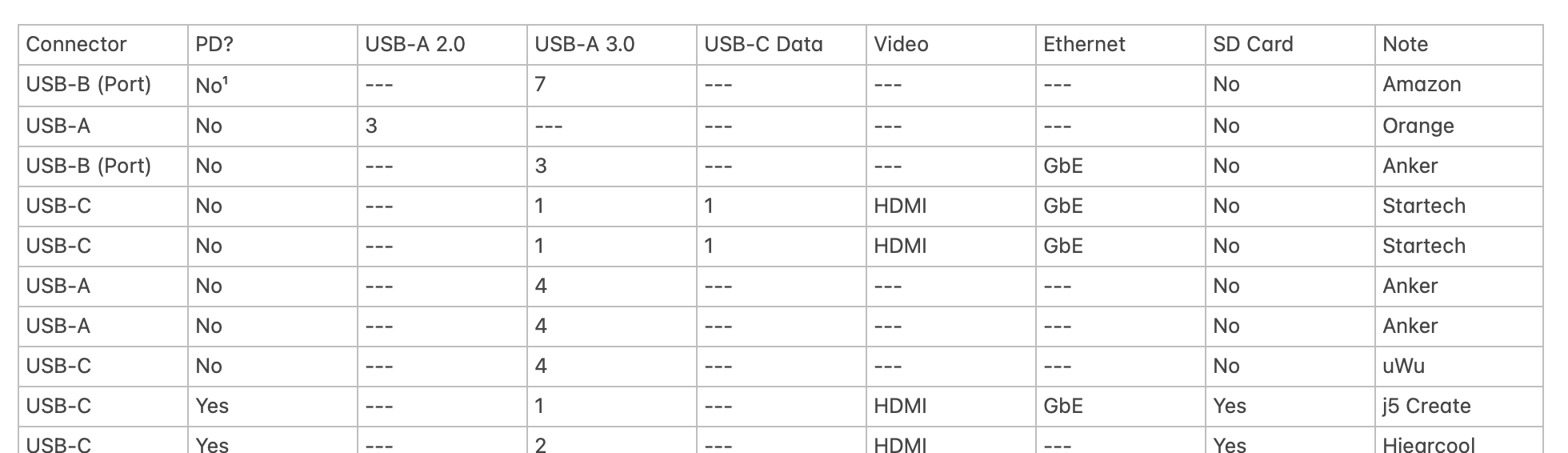
I cropped it here because the list was frankly embarrassing.

