14:55:36

A few days ago, I mentioned that I had a habit of starting new Dark Souls playthroughs, ringing the first Bell of Awakening, and stopping there, and that this takes me about an hour each time.

Well, this last time I started wondering just how long it would take to play through the game if I never stopped to grind and just kept steadily moving forward.  It turns out that it’s just shy of 15 hours, though nearly 2 of that was spent just farming humanity so I could save Solaire before he went insane.  I like Solaire, and though I have killed Gwyn without his help in the past… it’s a lot easy with everyone’s favorite sunbro around to take aggro.

Now, let’s be clear.  The current world record no-glitches Dark Souls speedrun is under an hour.  That guy has nothing to fear from me.  On the other hand, it took me SIXTY HOURS to beat the game the first time I played it, so being able to go back and whip it in a quarter of the time feels awfully good.

For a little extra masochism, I played the PS3 version, arguably the worst experience possible.  I’d only played the dsfixed Prepare to Die edition and the PS4 Remastered edition before, so I’d never experienced Blighttown in its original 15-frames-per-second glory.  It was… something.

I also wound up needing to eat some crow, because I’d seen a lot of people griping about the new lighting in the Remastered edition and to be perfectly honest I figured it was just a bunch of whining.  Playing the PS3 version after the remaster… no, they really do have a point.  I think the newer version is still better overall, but it stings a little to see the obvious room for improvement that could have made it the truly definitive version.

Counterpoint: oh my god the lava.  I don’t know what they were thinking with the lava.  It was blindingly bright, and it made the half-dozen attempts at Bed of Chaos just that extra bit of awful.

The bigger shock, however, was just how active the seven-year-old PS3 version is.  Nearly every boss room had at least one summon sign sitting in front of it, even the Kiln of the First Flame.  Early bosses, like the Gargoyles and Quelaag, had several signs, and  I even got invaded twice!

…mind you, I died both times.  But at least they were fair fights, not the “and now I will teleport behind you and backstab you” fights that had me turning off the online on the PS4 game.

I’ve been revisiting a lot of old favorites this year, and I should probably do less of that.  At least I haven’t been BUYING a ton of brand-new AAA games to feel guilty about.


Posted in ps3, Souls, videogames | Leave a comment

On Cultural Exchange

A few days ago, I mentioned that I’d thrown in my Japanese copy of Dark Souls to unwind after a little bit of a vexing day.  It wasn’t one of my more accessible posts, since I was talking about trophies not popping and giving no explanations for why I found that so weird, and I should probably avoid posts full of in-jokes in future.

…in future.

It’s not the future yet, so I’m going to point out one more thing I got a laugh out of from playing the Japanese version of the game.

One of the more…endearing? Sure, that’s a word. Let’s run with it.

One of the more endearing things about the Souls games is the way that the player base uses the in-game messaging system for two purposes:

  1. In an attempt to get other players to jump off of high places and die.
  2. To make off-color jokes that would be the envy of any 7th-grade cafeteria.

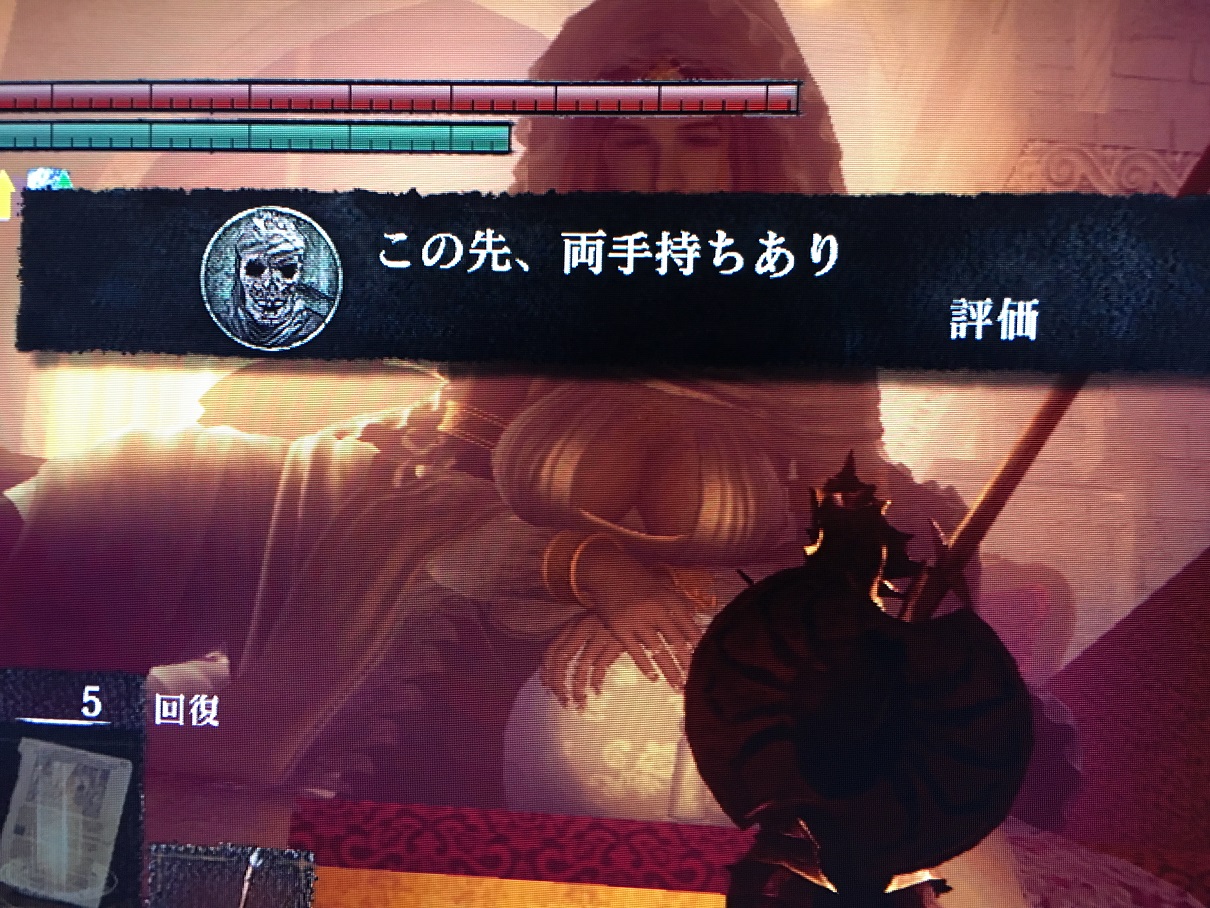
The most prominent example of #2, of course, is the floor in front of Gwynevere, the improbably-endowed self-proclaimed Queen of Sunlight.  Anyone who has struggled through Anor Londo to enter her chamber will be met with a sea of messages along the lines of “Amazing Chest Ahead” or “Try Holding With Both Hands”, and one of the things I have been a little curious about is whether the same sort of sophomoric humor would show up in the Japanese version.

Sadly, I must report that “Amazing Chest Ahead” does not appear to be a joke that works in both languages.

On the other, er, hand,

…I am happy to report that “Try Holding With Both Hands” seems to be universal.

This has been your Cultural Exchange Moment of the day.


Posted in ps3, Souls | Leave a comment

An entirely heretical opinion about Mass Effect 3.

So, I finished my full Mass Effect series play-through several days ago, but I wanted to sit on this and think about it.

I first played the trilogy in 2014, and the second game was easily my favorite.  It had a huge cast of characters and I loved how everyone got a spotlight mission to dig into their past and their motivations.  I thought the ending was a little… silly, if I’m honest, but that was my only quibble.

Anyway, a big part of my reason for playing through all three games again was because I wanted to play Mass Effect 2 with all of the DLC expansions.  And they were… OK?  They were pretty OK.  I liked the Kasumi character mission, and Lair of the Shadow Broker, but the other two expansions didn’t really grab me, and adding two more crewmembers to the Normandy felt a little unnecessary considering the size of the cast.

I also wound up feeling frustrated by the simplified character customization options – both the skill trees and the gear you acquired felt like huge steps backwards from the first game.

So, it was still great… but I realized that I much preferred the first game, for all of its janky animations and spotty performance, just because it felt more like an RPG and less like a combination of a mediocre cover shooter and an RPG.

After that, I started Mass Effect 3 with some trepidation.

Mass Effect 3, it turns out, is a bit like a milkshake.  A proper diner milkshake, that is, one of the ones where they bring you out a glass of milkshake and then a tumbler full of more milkshake to pour into your glass when you’re finished with the first serving.  At the bottom of the glass, there is a mess of chocolate sludge that you regret drinking almost as soon as you’ve drunken it.

In this analogy, the tumbler of more milkshake is the DLC and the chocolate sludge is the ending.  Endings.  Look, I’m not particularly good at descriptive writing.

Leaving my literary failings aside, it turns out that it’s a pretty good milkshake.  In fact, I wound up liking it more than the middle entry in the trilogy, which shocked the heck out of me.  It’s still half cover shooter and half RPG, but the shooter part of it feels MUCH better than it did in both previous games, and it’s a lot more challenging on the “Normal” difficulty level than I expected.

Part of that is because your squadmates are as dumb as bricks at times, which I will acknowledge as a very valid critique of the game.  But only part.

ME3 also brings back interesting skill trees and an overflowing arsenal of loot and upgrading weapons and installing mods and choosing between your favorite mods and your favorite ammo types and… look, if enjoying choosing which of a dozen subtly-different shotguns I want Tali to be packing is wrong, then I don’t want to be right.

Also, while the side stories in ME2 were great, ME3 is where you finally see stuff pay off.  You get to see the end of the Krogan genophage storyline, you find out where the Geth came from and maybe even get to negotiate a truce with them, you catch up with the Rachni queen and even find that Conrad Verner has been hiding a brain under that knockoff N7 helmet.

You notice I am not talking about the END end, just the satisfaction of seeing the plot threads from ME1 and ME2 finally tied off.

Then you dig into that second tumbler of milkshake and it turns out that the expansions are pretty fantastic as well.  It’s a shame that they originally cost as much or more than the game proper, of course.  I’m looking at them from the perspective of someone who got them for 1/3rd of their original prices.  “Omega” is a little bit of a shooting gallery, but “Leviathan” and “Citadel” were so good that it’s nearly criminal that they aren’t bundled with the main game.

It’s one really good milkshake…

…and then you hit the chocolate sludge.  And, yeah, it’s the last thing you’re going to remember about the milkshake, and none of the endings are particularly SATISFYING (Though I did wind up enjoying the Deus Ex-esque “Control” ending), but it’s still a 40 hour game that nails the first 39 hours before hitting a banana peel while trying to stick the landing.

So here I am, completely rethinking how I felt about these games.  I’m not absolutely certain whether I prefer the first or the third, but suddenly the one I would have raved about (to anyone patient enough to listen) is sitting on the third place pedestal and wondering what happened.

Crazy times.

Posted in Xbox 360 | 3 Comments

The Dark Souls of Trophy Glitches

After finishing my Mass Effect trilogy replay – I’ll have a post about that in a few days – I was looking through my backlog for inspiration and realized that I had a bunch of games on the PS3 that had been picked up in one PSN sale or another and never played.  I figured I’d dig the system out, hook it up, and see whether or not I actually wanted to give any of them any serious time.

The answer was no, by the way, which was kind of a depressing realization.  I doubt I spent more than five dollars on any of the games I wound up consigning to the digital trash heap, but it was still a reminder that I used to be pretty indiscriminate in what I bought, so long as it was a bargain.

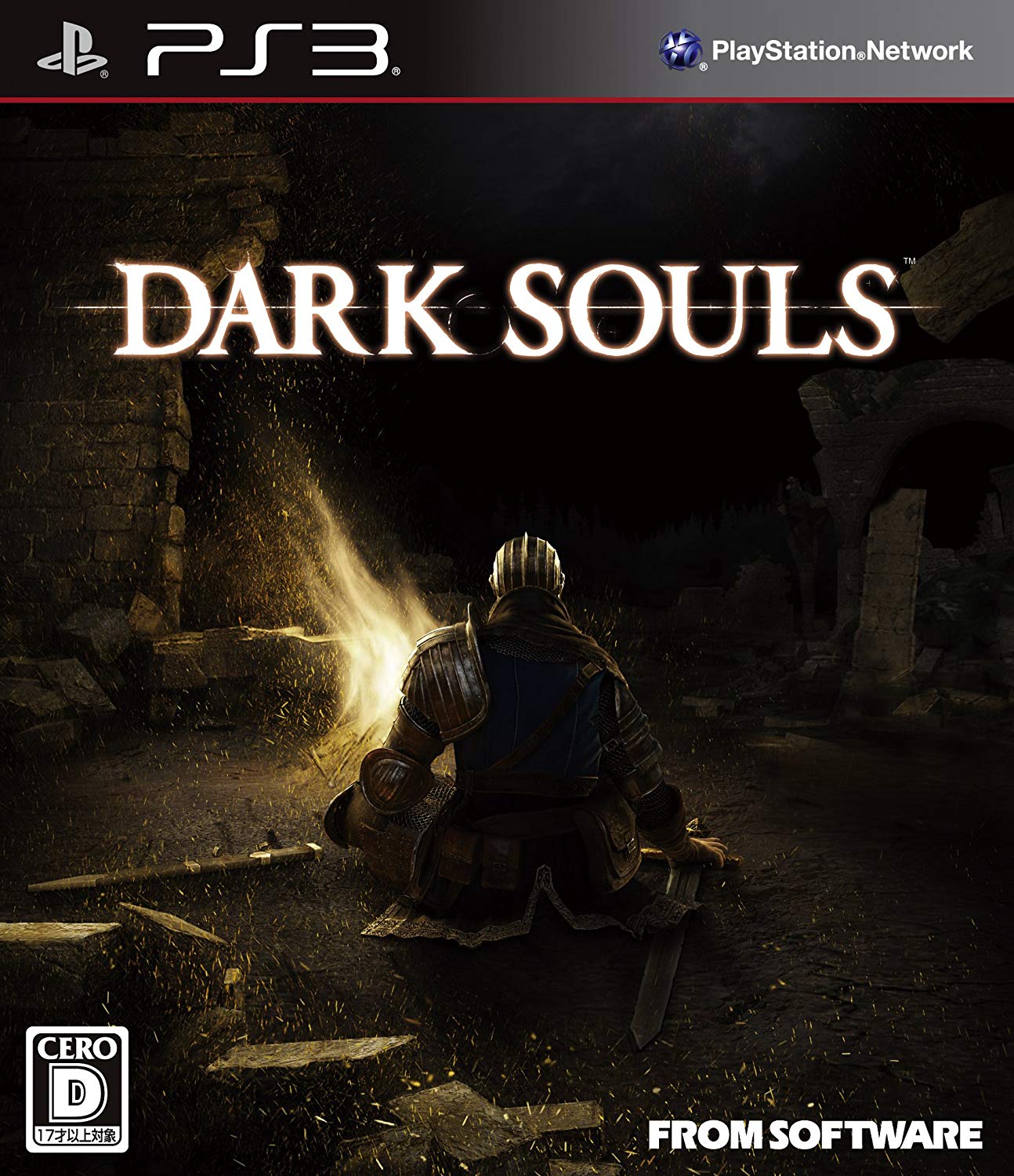
Anyway, after feeling a bit silly about the money I’d wasted, I decided to work off some of the frustration with a quick Dark Souls session.  I’d never actually played the PS3 version of DS1, but I picked up a disc of it in Japan last year because I liked the cover art and I thought it might be interesting to see what the game was like under the limitations of its original hardware.

(Unsurprisingly, it’s the same game, just a little less pretty and a little more clunky.)

I have a habit of starting up Dark Souls, creating a new character, making a mad dash through the graveyard to grab the Zweihander, grinding up enough levels so I can two-hand it, and then going and killing the Taurus Demon and the Gargoyles so I can ring the first bell of awakening.  It takes me a bit over an hour to do this.  I’m not exactly a speedrunner.

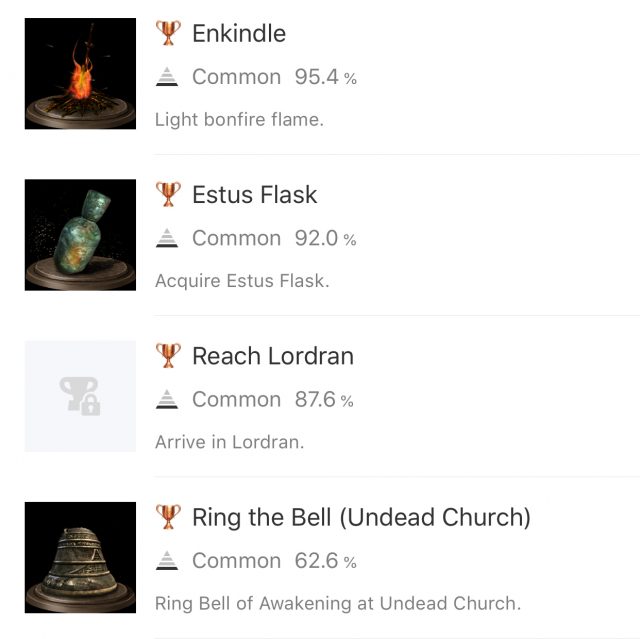
The strangest thing happened when I got to the bonfire above Andre, however – I had the “Estus Flask” trophy pop.  This is normally a trophy you get about five minutes into the tutorial.  On the other hand, I was playing a Japanese version of the game.  Maybe the trophies were laid out differently?

I kept going, whacked the Gargoyles, got the general feeling of self-satisfaction that always comes after killing a Souls boss even if you’ve killed it a dozen times before, rode the elevator back to Firelink and shut the game down.

Then I took another look at my trophies…

…I’m not really sure how that happened, but I’m kind of tickled to see it.

Side note, when it comes to games you wouldn’t expect to still have any multiplayer action happening, the original Dark Souls ought to be right at the top of the list.  It’s seven years old at this point, and there are superior versions on every modern console and PC.  I did NOT expect to get to Solaire’s ledge before the gargoyles and see FOUR white soapstone signs next to his bright yellow summon sign.


Posted in ps3, Souls | Leave a comment

Being a basically immature individual.

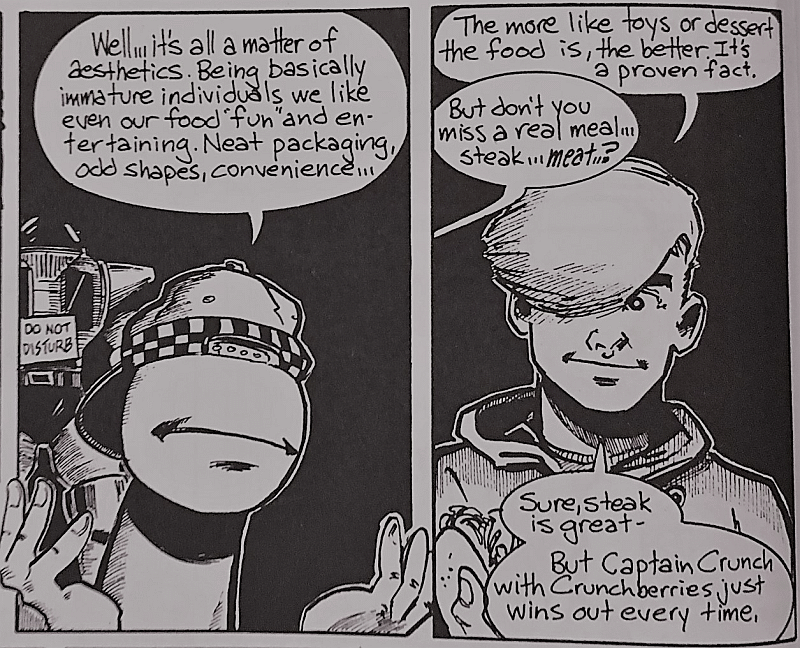
Discovering Evan Dorkin in my late teens may not have been the best thing for me.  That point in your life is when you’re supposed to start Growing Up, and I was doing an OK job of it… and then I found Hectic Planet.  I’m not going to say it’s completely responsible for my spending the last few decades with a maturity level stuck at roughly twelve years old, but it was certainly a contributing factor.

It’s in this general spirit that I regularly seek out and eat novelty “food” items, most of which are Very Bad For Me.  That’s your rainbow frappucinos, your grossly-oversized burgers, your deep-fried-anything.  Fair food.

Frankly, it’s a wonder I’ve lived this long.

Anyway, Carl’s Jr is currently selling a limited edition dessert item consisting of a box of Froot Loops-themed mini donuts, and I would like to be very clear that I was actually sort of being an adult here.  I did NOT go to Carl’s Jr to buy a box as soon as I found out about them.

On the other hand, when my wife asked me if I wouldn’t mind stopping at their drive-thru window so I could bring home burgers, well… obviously it was a sign.

Froot Loops were always a favorite cereal of mine when I was a small lad, and I have fond memories of getting up early on Saturdays to watch cartoons and pound down bowl after bowl of, basically, a shaped and brightly-colored sugar substrate.

I have less fond memories of the first time I actually made myself sick in the process.  But let us continue.

What you get for your money is five tiny donuts in gloriously brilliant shades of neon.

Hilariously, when I went to find the nutritional information for these things on the Carls Jr web site, I found them filed under “breakfast sides” and not “desserts”, which is, um, creative if nothing else.  I guess it’s because they’re cereal themed, but the Dave Berry gag about “part of a balanced breakfast” has never seemed more appropriate.

For the record, the box of donuts is 320 calories – less than a package of Pop Tarts –  so it’s not the absolute worst thing you could be eating.  Take that to heart as you order your own box.

I expected… well, I expected the worst, to be honest.  I have never been a fan of Hostess Donettes, and that’s what these kind of look like.  I also haven’t eaten the cereal these are based on since those days of Saturday morning cartoons, so I was expecting to have some last bits of my childhood ruined.

With that last bit in mind, I cannot say for certain whether these actually taste like Froot Loops cereal.  I CAN say that they have a taste and smell that is 100% faithful to my MEMORY of Froot Loops, so at the very least they are powerful nostalgia bombs.

As a display of self control, I actually did offer my wife one.  Since she is far more of an adult than I will ever hope to be, she graciously declined.  Her loss.

I probably shouldn’t go back to Carl’s Jr until these things have left the menu.  The urge to buy a couple of boxes and bring them home and pour milk on them is strong, and I think – no, I am certain – that I would regret the experience.

Posted in food | Leave a comment

On the Inexorable Passage of Time

As I have occasionally mentioned, I am a geek of the age where my engeekening coincided with the rise of pencil & paper RPGs, so a good chunk of my formative years were spent compulsively reading, re-reading, and memorizing the many rule books for games like Dungeons & Dragons, Gamma World, Traveler… and, of course, Car Wars.

Car Wars is an alternate-future game, set in a world where a massive oil shock in 2000 leads to nuclear war in 2012, followed by general anarchy that lasts for several years and winds up with different regions of the US setting up very local governments with only a little bit of federal oversight and where slapping machine guns and rocket launchers onto the family vehicle is not only legal but an incredibly popular sport.  It’s closer to a “miniatures game” than an RPG, but as the game became more popular, the folks at Steve Jackson Games tried to make it a little more about the person behind the wheel and not ENTIRELY about the car you were driving,

Even so, the real fun of the game came from designing an endless assortment of impressively-weaponized death wagons, keeping at all times within space, weight, and cost budgets.

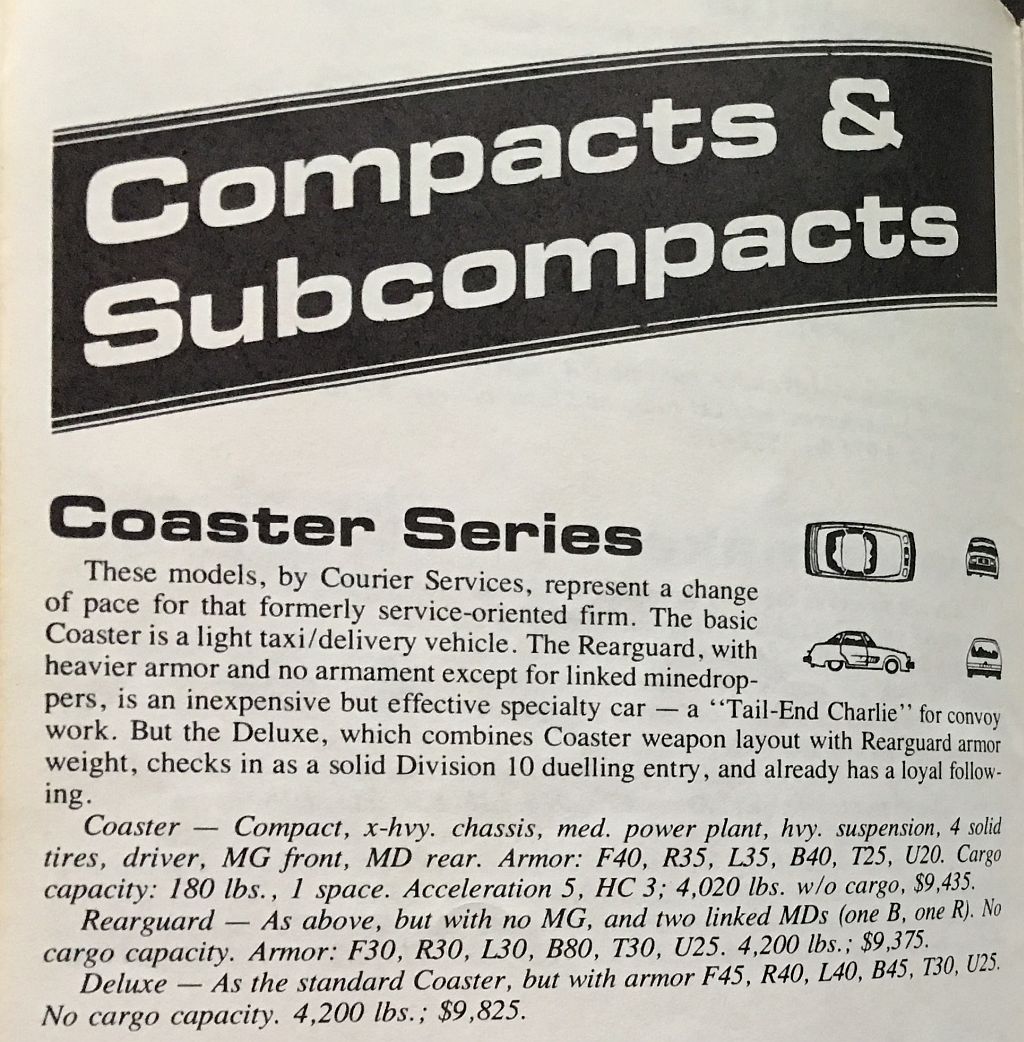
They did publish source books with sample cars, of course, such as this one below, but that was always a little dull compared to making your own.

As an aside, Car Wars made me ridiculously good at math for my age range.  I credit it with a lot of the advanced classes I got shoved into as a youth.

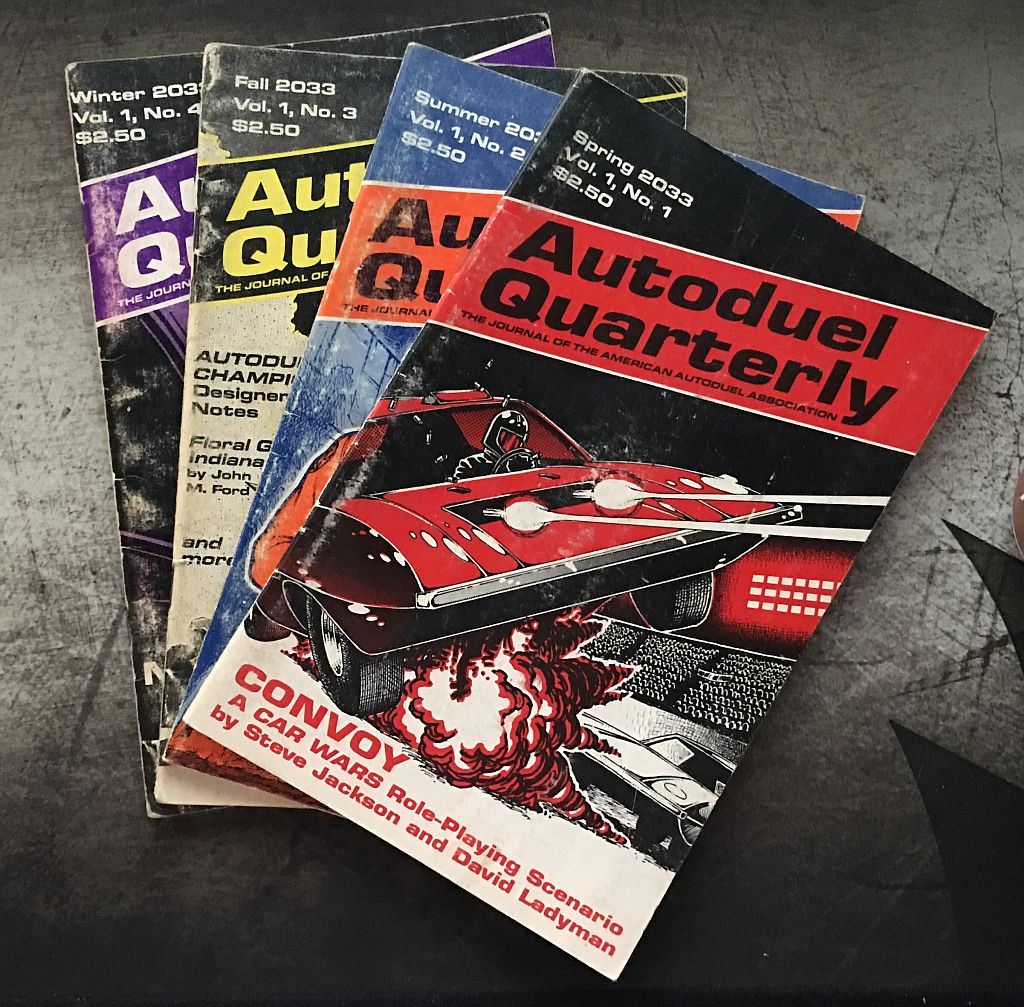
Anyway, part of the shtick of Car Wars was that it was always set 50 years in the future.  So, for example, they published a Car Wars calendar in 1988 that was labeled “2038”, and they published a magazine – Autoduel Quarterly – whose cover dates were always likewise a half-century ahead.  I own about six years’ worth of the magazine, so I can probably track the rough point where I stopped being super into RPGs by when I stopped buying it.

I have been on a bit of a scanning binge this year, as I’ve been converting papers and comic books and magazines into PDF files, and I finally dug my old ADQs out of a box in preparation for scanning.

Then I looked at the covers, and got socked in the gut by just how many years it’s been.

We’re 15 years away from actually catching up to these.  Barring any health issues, I am likely to pass these fictional future dates by.  This is a heck of a depressing thought for a Sunday evening.

(And I still cannot legally mount a flamethrower on my Mazda 3.  So very sad.)


Posted in organization, random | 2 Comments

Examining Mass Effect 3’s Multiplayer

The title of this post actually lies a little.  I’m not going to do any sort of deep dive into the multiplayer component of Mass Effect 3, but I am going to talk about it in terms of the intersection between business decisions and consumer expectations.  It’s a six-year-old game, so this may be one of the more useless articles I’ve ever written, but I like to hear myself talk.

Without going into spoiler territory, one of the primary mechanics in ME3 is the collection of “War Assets” for use in your final conflict against the villains of the game series.  You get these by building alliances with alien races, or rescuing important NPCs, or… well, there are a lot of ways to build up War Assets.  You’ll also get War Assets from choices you made in the first two games in the series, so it really is one of the ways where the series delivered on its promise of having choices that matter.  The ending of the game depends on how many War Assets you have, so you want lots of them to get the Best Ending.

On the face of it, War Assets are a super straightforward thing.

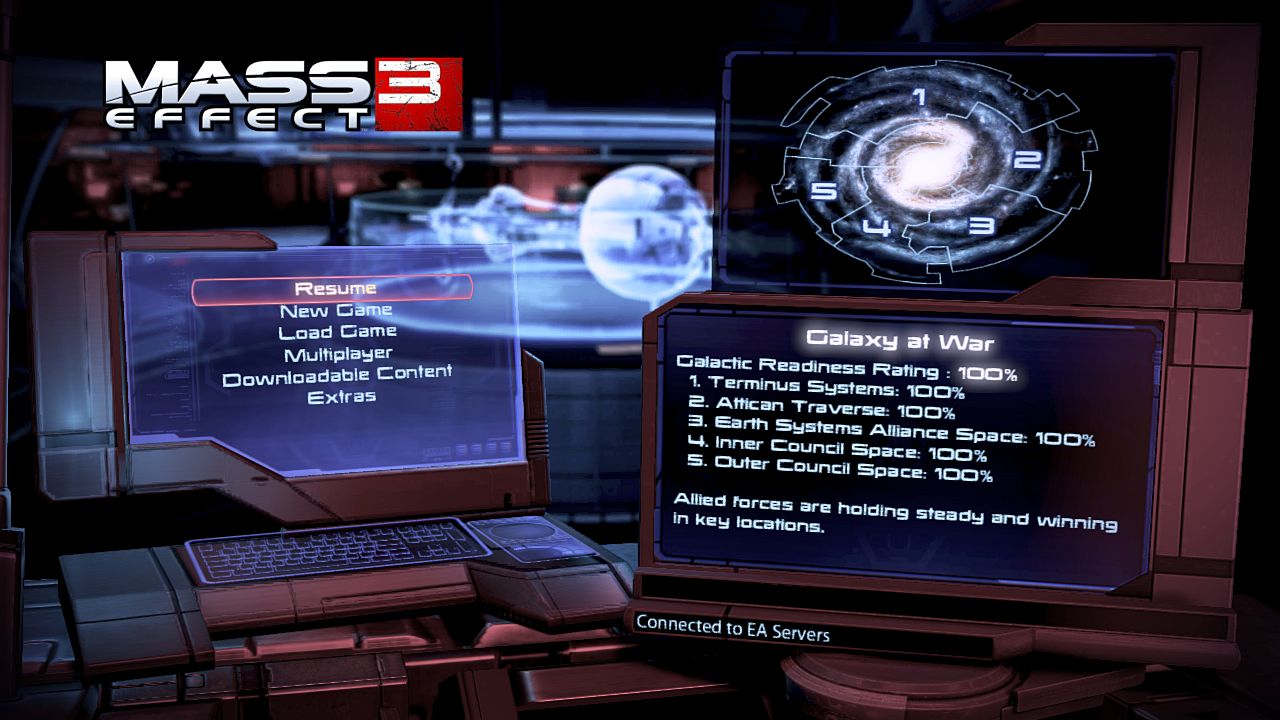
They get a little less straightforward when we add the “Galactic Readiness” stat, which is a multiplier applied to your collected War Assets to determine your ACTUAL War Assets.  This starts at 50% and can only be increased by playing the game’s multiplayer mode, so a player who avoids multiplayer is only going to get half the value of any War Assets they acquire during the campaign.

In fact, when the game originally released, there were not enough War Assets available to get the best ending without dipping into multiplayer, which understandably annoyed a lot of fans – the first two games were strictly solo affairs, and there really wasn’t a ton of story justification for the multiplayer mode… but there was an obvious business reason.  ME3 came out during EA’s “Project Ten Dollar” campaign against used games and game rentals, and it came with a single-use code in the box to enable the multiplayer.  If you bought the game second-hand, no amount of grinding would make up for the need to buy an online pass.

After a VERY vocal outcry, the War Assets required to get the best ending were lowered so they could be gathered without needing to play multiplayer, and the whole online pass thing quietly went away after a couple of years anyway.  So it really doesn’t matter, except as a footnote in gaming history.

…so, why am I even going on about this in 2018?

Well, it’s because I’m replaying the Mass Effect series, and I made the decision to at least try the multiplayer to see if anyone was bothering with it, and I have been very pleasantly surprised to find that (a) it seems quite active, and (b) it’s pretty fun and shouldn’t have been the source of so much controversy.  It also fits into the game story fairly well, though it’s not particularly well-explained.

To sum up, there’s one game mode, and it’s 4-player PVE pitting you against ten waves of increasingly-difficult bots, with occasional objectives sprinkled in to break up the waves.  You pick one of an initially-limited set of available characters, gain experience and currency through playing, use the experience to level up your character and the currency to buy upgrades and unlock new characters, and the “Galactic Readiness” stat I mentioned earlier slowly increases.

It took me 5 hours 16 minutes to get my Galactic Readiness to max, most of that with me being carried by people who had obviously played a LOT of the multiplayer.  It’s a little repetitive, but it definitely scratches the itch of watching bars fill up and occasionally go ping.

Just before I hit 100% Galactic Readiness, though, the character I was playing reached the level cap, and I got a new option on the character select screen – I could now “promote” the character and turn it into a War Asset itself.

In short, I don’t think the original purpose of the multiplayer WAS to serve as a paywall between the gamer and the Good Ending.  Rather, it feels like the intent was to serve as an optional route to build up your War Assets without doing a bunch of alien diplomacy, or to compensate for poor choices in previous games, and I think ME3 would have been far better received if that original design had been kept in.

Posted in videogames, Xbox 360 | 5 Comments

A Heretical Opinion About Mass Effect 2

I first played through the Mass Effect trilogy in the summer of 2014, and it’s one of a very few series that I have enjoyed enough to let me play all of the entries back-to-back-to-back without needing any breaks.  I didn’t have any of the DLC at the time, however, so I’ve always been a little curious about how things would be changed and whether the things I’d been confused by in Mass Effect 3 might make more sense after playing through those extra story bits.

For the record: The opening to Mass Effect 3 ALONE makes way more sense if you’ve played the “Arrival” DLC for ME2.  I will not say anything else nice about the “Arrival” DLC, because I had a hard time extracting any fun from the “game” parts of it that were inconveniently sandwiched between the cutscenes.  It may just be the particular class I was playing in ME2, but there was an awful lot of “Arrival” that is just the slow wearing-down of rooms full of swarms of enemies with flamethrowers and rocket launchers and it just gets kind of tedious after a couple of rooms-full.

But I digress, and as I opened this post by implying that I had a heretical opinion about Mass Effect 2, it’s probably best that I get around to it:

Mass Effect is better than its sequel.  Yes, really.

ME2 does have some really good characters, and possibly the best single character MOMENT in the series – Legion’s introduction – but it also felt like the designers took complaints about the original game’s complexity far too seriously.  Skill trees are reduced to a bare handful of skills, combat no longer gives experience or gear, looting lockers and boxes gives a monotonous stream of credits rather than exciting randomized loot pinatas, the goofy fun of driving around planets in the Mako and reveling in its sheer disregard for gravity is replaced with endless planet scanning, and the occasionally-frustrating hacking minigame from ME1 is replaced with your choice of one of two minigames that are practically impossible to fail – but they NEED to be impossible to fail, because the level designers loved to stick the “bypass” minigame on doors that MUST be opened for story reasons, as opposed to only doors that lead to optional areas.

*deep breath*

Oh, and the final boss is just silly in context.  Normally, I would LOVE the 80s-heavy-metal-album-cover aesthetic, but in this universe?  It feels like the last boss fight from a forgotten 16-bit shooter.

Actually, I haven’t played all of the Contra games.  It might actually BE a boss fight from one of those.

I’m not going to say anything silly here, like claiming that ME2 is a BAD game in any respect.  It has a lot of highlights.

Miranda alone has a LOT of highlights.

BUT.  The first game was better, and anyone who wants to join my cult can pick up a flyer from the card table near the door.

Meanwhile, I am on to Mass Effect 3.  I’m particularly looking forward to “Leviathan” and “Citadel”, which I didn’t get to see the last time, and I may even try the multiplayer if anyone is still playing it.

Posted in videogames, Xbox 360 | 7 Comments

Frog parking only, all others will be toad.

Yesterday’s post was me ranting about being annoyed by Wii controls, so I thought I’d be a little more positive today.  Fortunately, I also knocked the last couple of WiiU games off my backlog, and it’s easier to be positive about games when you’re not constantly thinking how much nicer they would be if you weren’t needing to keep a remote pointed at the TV at all times.

That isn’t to say that Captain Toad: Treasure Tracker is entirely free of control gimmicks, mind you.  It mandates the use of the WiiU gamepad for touch and blow controls in several levels, which is the sort of thing I would probably be much more upset by if I’d spent money on a WiiU pro controller.

In addition to the mandatory tablet control gimmicks, there is a level quite close to the end – “Magma Road Marathon” – which is just absurdly difficult in comparison to every other level, and the reason I’m mentioning this up front is that I have no other complaints about the game.

None.

Captain Toad is brilliant and charming and just one of the best entertainment experiences I’ve had this year.    Seriously, I want to find someone who hates this game simply because I am curious what a person with no joy in their heart could possibly look like.

Though I will understand if you hate “Magma Road Marathon.”

So, a short explanation.  Captain Toad is a platform game that stars a character who can’t jump.  You can fall off things, and climb ladders, and pick stuff up and throw it at enemies and other things, but the second you leave an edge you plummet to whatever solid surface is below you, or to your doom if no such surface exists.  Your goal is to waddle around bite-sized levels, most of which can be spun all around with the camera to aid in finding secrets, making your way to the end of each level to collect a happy golden star.

Happy is a good word for this game. Almost every level is sunny and cheerful and your opponents seem almost apologetic in their attempts to cutely murder you. There’s no surprise there, I’m sure – Nintendo has built their empire on knowing just how to find the button that makes adult humans turn into blithering idiots at the sight of a puppy or kitten, and they jam on that button hard.

Short version: if you own a platform that can play Captain Toad, and if you want joy in your life, I strongly recommend connecting the two things and making a small financial transaction with your nearest vendor of digital entertainment.

Fast Racing Neo – pardon me, FAST Racing NEO – is a little less joyful, but it is a game designed for anyone who kind of misses the days when we got Wipeouts and F-Zeros and Extreme-Gs and similar futuristic hovercraft racers.

OK, I will admit that it is very unlikely that anyone misses Extreme-G.  I’m not sure, even, whether it’s more properly spelled Xtreme-G and I don’t care enough to look it up.  But I digress.

Unlike Wipeout, FAST Ra… I can’t do that any more.  I have more self-respect and regard for the rules of capitalization.  Let’s start over.

Unlike Wipeout, Fast Racing Neo is not a weapon-based racer, and you have limited ability to influence other vehicles on the track.  Rather, your goal is just to beat 9 other hovercraft to the finish line on a variety of very cool science-fictiony tracks, generally by getting crushed by your opponents until you have memorized where every boost pad and hazard are so you can hit one and not the other, because WOW this features some vicious AI.

One of the issues with racing games is that, at their heart, they are games where the computer chooses to let you win.  Sure, player skill is important, but an AI-controller racer programmed to drive perfectly will do just that.  There has to be some degree of slop in their design, some code that says “actually, you should occasionally miss a boost pad or fail to make a turn”, and Fast Racing Neo does not have a lot of slop, even on the beginner difficulty.  If you are tooling along in a comfortable second-or-third-place spot, with your eyes on the leader and ready to make your push for first, and accidentally hit one of the many obstacles on the track, you are almost certain to be in 10th place by the time you finish respawning, with a bitter road ahead if you want to even make it into the top half of the pack.

I got thoroughly trounced by the very first set of races, several times in fact, and it was enough that I wound up quitting out and glaring at the game icon on the WiiU dashboard, very tempted to just delete the thing and forget about it… and then I decided that I was not going to be beaten and launched it again.

At the end, when I’d finally beaten all of the races and unlocked the next difficulty level, I felt wonderfully accomplished and decided that it was a good place to stop.  I’m a masochist, but only to a point.

Anyway, that brings the days of the WiiU to a close for me, and it can go to a comfortable storage box in the closet until I get the urge to play through Fatal Frame or TMS#FE again.  Unless those get ported to Switch.  Hopefully they will get ported to Switch. 🙂


Posted in videogames, WiiU | Leave a comment

On Wii Ennui

I’ve been playing through the last bits of my Wii and WiiU backlog recently, in preparation for freeing up another HDMI input, and it’s been an experience that has really made me think about the last few console generations and why it’s difficult for me to decide how I feel about this pair of systems.

The Wii, in particular, is a weird system because it was a phenomenal commercial success, sold a ton of software – nearly a billion units – and then spawned the WiiU, a system that was arguably dead after its first holiday season.

There’s not even any single massive flub that you can point at to explain the crash.  If you look at historical flops like the Saturn or the Xbox One’s first couple of years, you can point at the “we’re going to launch five months before we said we were and piss off our retail chains” or “what we think people really want from a games console is Fantasy Football League and not being able to resell games”, and there’s not a ton of debate there.  The Wii was a success until it wasn’t, and I can’t believe that it was just because it was a fad, like Cabbage Patch Dolls or Pogs.

The theory I’ve come to is that the Wii Remote was brilliant, but a bit of an evolutionary dead end, and this is where I spend a couple of paragraphs defining that by defining the inverse.

Before I bought my first console – a Sega Genesis – I’d been exclusively a computer gamer, and computers used one-or-two-button joysticks where you generally controlled movement with the right hand and pushed buttons with the left.  This was a control scheme inherited from the arcade machines, so it was natural, and moving from that to my first gamepad was a little weird – now you were moving with the left hand and pushing buttons with the right.

Once I’d gotten the hang of the three-button Genesis controller, however, it was a natural progression to the six-button Genesis controller, and then to the Saturn pad, and then the Saturn 3D controller which became the Dreamcast controller which became the Xbox controller, then the Xbox 360 controller, and finally the Xbox One controller which is my new Gold Standard for input devices.

Likewise, you can trace an evolution from the SNES pad to the Playstation controller and all of its subsequent iterations.

If you’re still with me, then you’ve probably gotten where I’m going with this.  The Wii Remote took a small bit of its DNA from earlier Nintendo controllers – the Nunchuck attachment is essentially the middle prong of an N64 controller, and the Remote could be held as a NES pad – but the real draw were the motion and pointer controls, and so much of the Wii’s library didn’t work very well with the control schemes that developers came up with for them.

I like horror games, so let’s take “Calling” as an example because it’s about as far as you can get from the Wii Sports / Just Dance / Carnival Games stereotype of Wii games. It also sold approximately five copies, so I’ll forgive you if you haven’t played it.

Calling was one of a bunch of Wii games that tried to make up for the lack of a second analog for camera control by having the player point the remote at the screen and point near the edges of the screen to change the view.  This works great, as long as your TV is located well in relation to the player – if the TV is above a median viewing angle, you are constantly holding the remote up, which is a fantastic way to wear your arms out in a surprisingly short period.  It also made frequent use of both the “-” and “1” buttons – take a moment, here, to look at a Wii Remote and speculate on how you are supposed to comfortably press these while keeping the pointer aimed at the screen –  AND had a mechanic where you would occasionally be jumped by ghosts and need to flail the Remote about to shake them off.

When people make fun of “waggle” controls, “shake the remote to break free” is exhibit A.

I eventually found a position that sort of made this work, but it involved me sitting on the couch, with one leg tucked up and a pillow resting on my knee, and controlling the camera by swinging my knee left or right.

Needless to say, I didn’t stick it out for very long.  Maybe it will get remastered someday.

Fragile Dreams, the next Wii game I tried to play, kept the same camera controls and added an element of “sweep the remote over the screen until the cursor changes to let you know there’s something there you can zoom in on.” which, well…  at least it doesn’t have shake-to-escape, but I’m still going to be waiting for a remaster.  Weirder things have happened.

By contrast, games like Pandora’s Tower made brilliant use of the remote – to the point where, even though it offered a traditional dual-analog control scheme if you had a Classic Controller, the remote was the preferred way to play.  Exergames were also perfectly suited to the remotes – one of the last games I have left in my Wii backlog is We Cheer, and working up a sweat by swinging virtual pom-poms around is both a joyful experience and something that couldn’t possibly be done if I was trying to hold on to a Dualshock.

My wife is not allowed to watch me playing We Cheer, as an aside.  There are some things no other human should see.  It’s bad enough that I occasionally catch two of our cats staring at me in rapt attention.

Here’s the issue, though, and I swear I’ve been getting around to this the whole time.  Even if you were absolutely in love with motion controls, and even if you found the pieces of software that were designed around them and used them intelligently… it still didn’t prepare you for any other console, and certainly not for a console where you had to split your attention between two screens while manipulating a dual-analog setup and occasionally poking at or blowing on the thing you were holding.

I find myself wondering what would have happened if, instead of doubling down and introducing the Wii Motion Plus, Nintendo had started packing the Classic Controller into the base Wii set around 2010 and mandating – or at least strongly recommending – developer support for both control schemes.  The Wii balloon would still have shrunken quite a bit – I don’t think there’s any way around that – but I don’t think it would have collapsed with such finality.

Anyway, enough of that.  I have gotten my Wii backlog down to the point where all I need to do is an awful lot of virtual cheering, and I’m pretty happy to have gotten to this point.

Posted in videogames, Wii | 2 Comments